OpenAI Recruits Dwarkesh to Design Evals? Benchmark Methodology Sparks Discussion

OpenAI staff publicly affirmed a benchmark's methodology and invited Dwarkesh Patel to design evals, reflecting a repricing of eval talent.
A tweet from an OpenAI employee brought eval benchmark methodology to the forefront: the author highly praised an unnamed benchmark's design approach and publicly invited tech podcast host Dwarkesh Patel to design evals. The article argues that as general capability gaps narrow, eval design quality directly affects outside judgment and training direction, and crude benchmarks reward score gaming rather than real capability. Evals require dedicated judgment across task construction, scoring, data contamination control, and adversarial design. Dwarkesh's sensitivity to "good questions" from in-depth interviews is exactly the transferable capability eval roles value. This reflects evals shifting from auxiliary work to a repriced core capability, and suggests researchers should understand benchmark design assumptions rather than chase scores.
A tweet from an OpenAI employee has thrust a benchmark's methodology into the spotlight. The author admitted to being "honestly quite impressed" with the design of a certain benchmark and directly called out to well-known tech podcast host Dwarkesh Patel: want to come design evals at OpenAI?
The tweet itself is short, but the signal it reflects is worth unpacking: as model capabilities converge, evals are transforming from a behind-the-scenes tool into a key link that determines product direction, and top-tier eval design talent is becoming a hotly contested resource.
The Signal Behind a Single Tweet
The tweet carries two layers of core information. The first is high praise for the methodology of an unnamed benchmark—wording like "honestly quite impressed" is uncommon from OpenAI employees, suggesting the benchmark's design approach genuinely has merit. The second is a public recruiting invitation, directed at Dwarkesh Patel, a podcast host known for in-depth interviews with AI researchers.
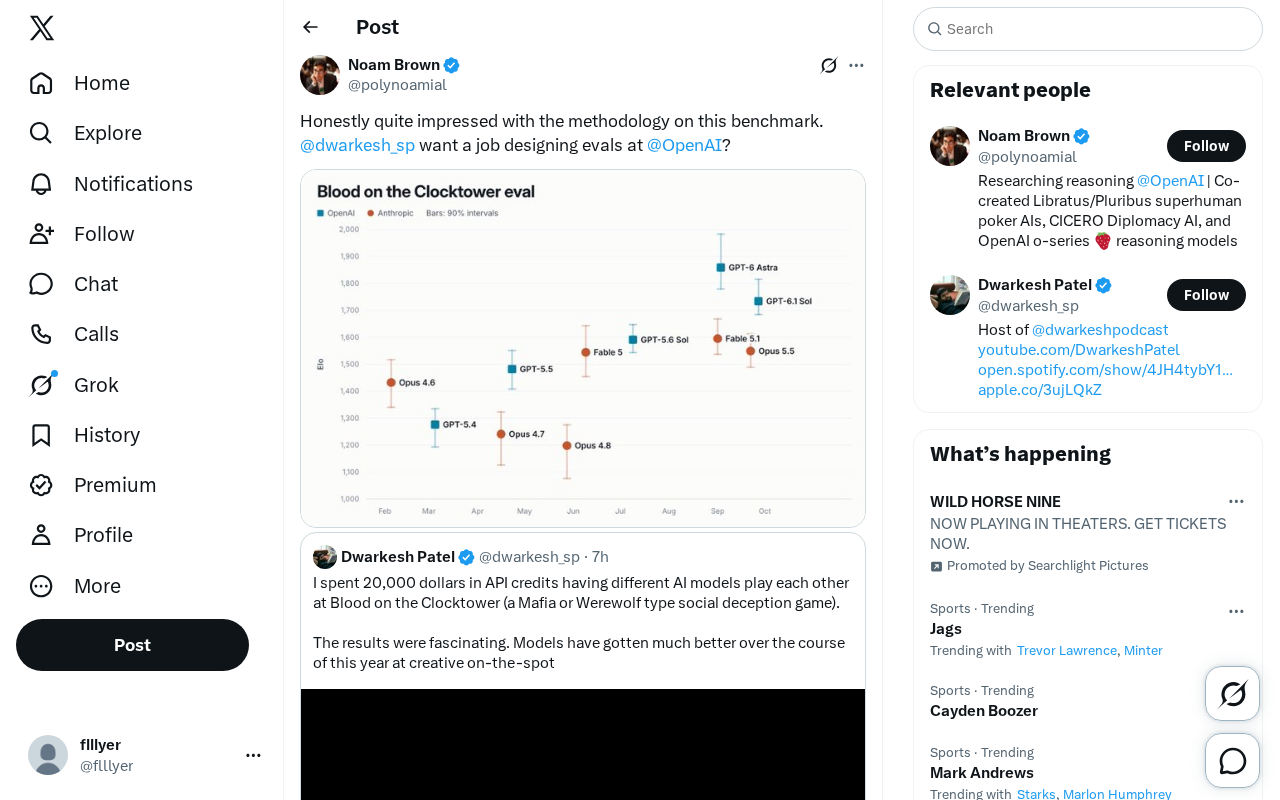
A public call-out is not the same as a formal offer, but it sends a clear signal: OpenAI believes eval design is work that requires dedicated talent, not something a few engineers can casually cobble together. Dwarkesh has long conversed with frontline researchers and has extensive first-hand observations about "what capabilities are worth measuring and how to measure them without distortion"—experience that traditional engineering backgrounds struggle to replace.
Why Evals Suddenly Matter
In the past, evals were often treated as a pre-release compliance step: run a standard test set, post a score, done. But as models converge in general capabilities, the design quality of evals directly affects how the outside world judges models—and even influences the direction of model training itself. A poorly designed benchmark may reward "score gaming" rather than real capability; a well-crafted benchmark can reveal a model's weaknesses in specific scenarios.
This is why "designing evals" would be singled out as a standalone role. Evals involve task construction, scoring criteria, data contamination control, adversarial sample design, and a series of other issues, each requiring judgment. The tweet's assessment of methodology is essentially an affirmation of the value of that judgment.
Data contamination is one of the core challenges in eval design. Once a benchmark test set is made public, model training data may inadvertently contain test questions or highly similar samples, causing models to "memorize answers" rather than genuinely possess capabilities during evaluation. Common countermeasures include: regularly rotating test sets, using private holdout sets, constructing dynamically generated questions, and detecting whether model outputs highly overlap with training data. Once data contamination occurs, benchmark scores lose their reference value and may even mislead training direction.
Adversarial samples refer to inputs specifically designed to expose model weaknesses, such as subtle wording variations, out-of-distribution scenarios, or deliberately constructed edge cases. Good evals not only test what a model "can do" but also systematically probe "under what conditions it fails." Adversarial design prevents models from gaming scores through surface pattern matching and forces evals to focus on real robustness. This directly relates to the "rewarding score gaming rather than real capability" mentioned in the article.
From Podcast Host to Eval Designer: A New Path for Talent Mobility
The invitation extended to Dwarkesh Patel is itself interesting. He is not a traditional AI researcher but has built a systematic understanding of the research frontier through interviews. OpenAI's willingness to reach out to someone with this background shows that eval roles value sensitivity to "what makes a good question" rather than sheer paper count.
This talent mobility path was uncommon in the past. Evals were long viewed as auxiliary work, but now they may become a channel from content creation and research communication into core R&D. For those following the AI industry, this is a change worth noting: eval capability is being repriced.
Dwarkesh Patel's podcast is known for long-form, in-depth interviews, with guests mostly frontline AI researchers and lab leaders. Such interviews require hosts to possess cross-domain knowledge integration: understanding technical details of papers, probing methodological assumptions, and identifying ambiguity in answers. Over time, this cultivates judgment about "what questions truly matter and what answers withstand scrutiny."
This capability is highly isomorphic to eval design. Designing an eval is essentially asking: does this task really measure the target capability? Will the scoring criteria induce models to take shortcuts? Do the questions cover edge cases in actual use? The podcast host's working habits—constantly asking "what is the evidence" and "how far does this conclusion apply"—correspond precisely to methodological scrutiny in evals. OpenAI's invitation is therefore not a cross-industry gimmick but a recognition of a transferable capability.
Implications for the Industry
The传播 value of this tweet is not in the recruiting outcome but in bringing eval methodology to the forefront. When a leading lab publicly expresses approval of a benchmark's design approach, other teams will naturally study "what exactly makes it good." This kind of peer scrutiny is a sign of a maturing eval ecosystem.
For developers and researchers, the actionable takeaway is: rather than chasing leaderboard scores, spend time understanding the design assumptions behind benchmarks—what they measure, what they don't, and which behaviors get rewarded. This judgment is both a prerequisite for using eval results and a foundation for participating in eval design.
One-line Summary
An OpenAI employee publicly praised a benchmark's methodology and invited Dwarkesh Patel to design evals, reflecting a repricing of eval talent.
Paragraph Summary
A tweet from an OpenAI employee brought eval benchmark methodology to the forefront: the author highly praised the design approach of an unnamed benchmark and publicly extended a job invitation to tech podcast host Dwarkesh Patel to design evals. The article argues that as general capability gaps between models narrow, eval design quality directly affects outside judgment and training direction, and crude benchmarks reward score gaming rather than real capability. Evals involve task construction, scoring criteria, data contamination control, and adversarial sample design, requiring dedicated judgment. Dwarkesh's sensitivity to "good questions," accumulated through in-depth interviews, is precisely the transferable capability that eval roles value. This reflects evals transforming from auxiliary work into a repriced core capability, and suggests researchers should understand the design assumptions behind benchmarks rather than chasing scores.
Related articles
 Tech Frontiers
Stylome Bot Slammed as Useless Junk: Why Do AI Detection Tools Keep Failing?
Reddit users test the Stylome AI detection bot: Gemini-rewritten text judged human-written, consistently low confidence. An analysis of AI text detection's technical dilemmas, privacy concerns, and credibility crisis in community governance.
 Tech Frontiers
When AI Becomes a Productivity Divide: Clarity or "AI Psychosis"?
A civil engineer's deep use of agentic AI boosted efficiency but bred contempt for peers who refuse to learn. Is this clarity or AI psychosis? An analysis of the cognitive and psychological challenges behind the AI productivity divide.
 Tech Frontiers
Opus 5.5 Benchmark Scores Climb, Community Says Its "Weights Are Blessed"
Reddit community discusses Opus 5.5's rising scores on the Benchmaxxing Bench, with users describing its performance as "weights are blessed." This article interprets the community reaction and cautions against conflating benchmark scores with real capability.