OpenAI SDK v3.27.0 Released: Introducing Prewarmed Hosted Environments

OpenAI SDK v3.27.0 adds prewarmed hosted environments to cut cold-start latency in managed inference.
OpenAI SDK v3.27.0 introduces prewarmed hosted environments as its core new feature. By initializing and keeping runtime instances ready before requests arrive, this mechanism addresses cold-start latency in serverless and managed inference scenarios — where first responses can spike from milliseconds to seconds, significantly impacting real-time conversations and interactive agents. As a backward-compatible minor release verified via GitHub GPG signature, upgrading carries low risk. Developers should consult PR #4043 and official docs for configuration details.
OpenAI SDK v3.27.0 Update Overview
OpenAI has officially released SDK v3.27.0, now live on GitHub and verified with an official GPG signature. The centerpiece of this release is a new API-level feature — the introduction of prewarmed hosted environments — corresponding to PR #4043 with commit hash c511a77.
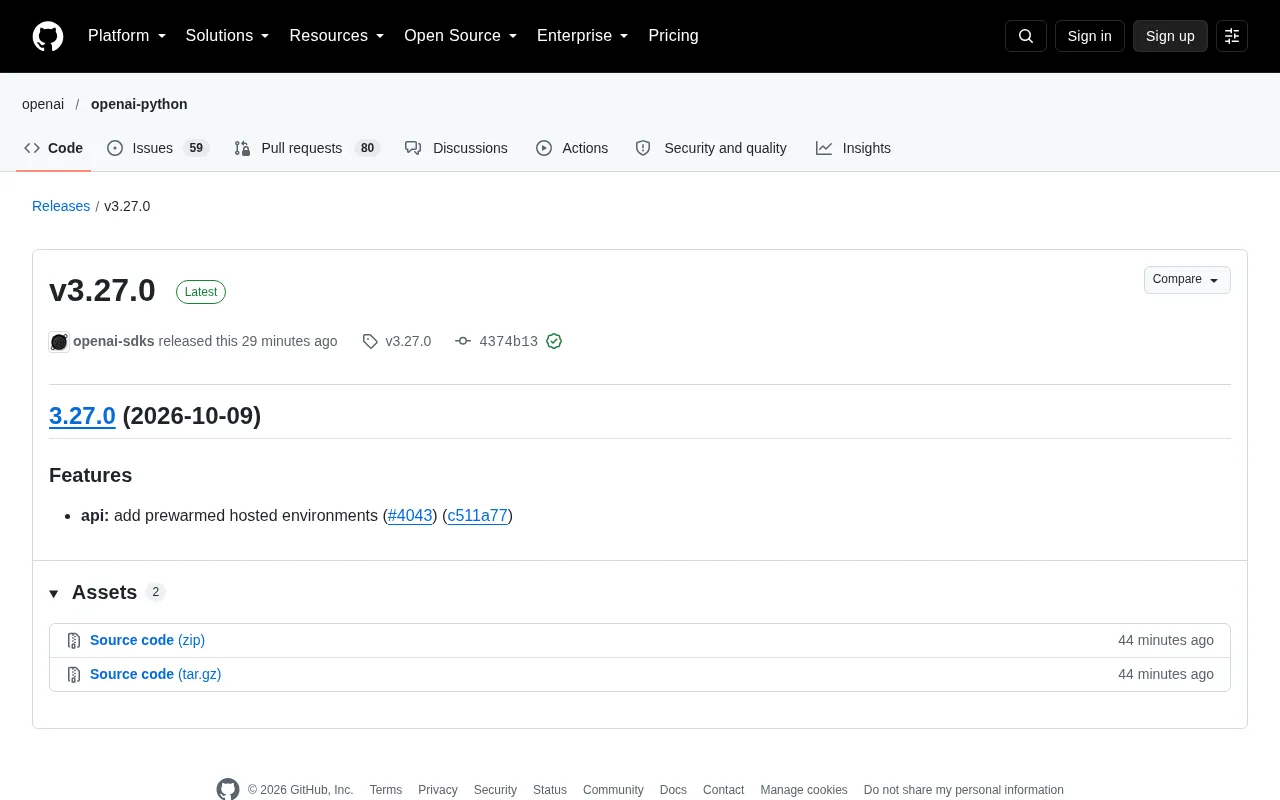
Based on the release notes, this is a feature-focused iteration. The release has been verified with GitHub's trusted signing (GPG key ID: B5690EEEBB952194), confirming its authenticity and integrity — making it safe to adopt in production environments.
What Prewarmed Hosted Environments Mean
The only explicitly listed new feature in this release is "add prewarmed hosted environments." A prewarmed hosted environment refers to a server-side mechanism where runtime instances are initialized and kept in a ready state before any request arrives. For managed services that invoke models or execute code, this approach can significantly reduce the first-response latency caused by "cold starts."
In practice, cold starts have long been a pain point in serverless and managed inference scenarios: when an environment is idle, the first incoming request must wait for container spin-up, dependency loading, and runtime initialization — pushing latency from milliseconds to potentially several seconds. Prewarming addresses this by maintaining a pool of hot-standby instances, smoothing out that variability so even the first requests receive near-steady-state response times.
It's worth noting that the official release note only provides the feature title, without elaborating on usage patterns, configuration parameters, or scope of applicability. Developers seeking interface details will need to consult PR #4043 and the official API documentation directly.
From an engineering perspective, prewarmed hosted environments within OpenAI's product ecosystem are likely closely tied to stateful managed features such as the Assistants API or Code Interpreter. These features rely on dynamically allocated sandbox containers on the server side to execute code or maintain session context, and container lifecycle management directly determines the user experience. A warm pool is essentially a resource pre-allocation strategy: the platform predicts traffic based on historical patterns and pre-retains a number of already-initialized container instances in a "hot standby" state. When a request arrives, the system immediately allocates from the pool, bypassing the startup phase entirely. This mirrors the concept of a database connection pool — the tradeoff is continuous consumption of underlying compute resources, while the benefit is user-visible low latency and reduced jitter.
Practical Impact for Developers
For teams building applications on the OpenAI SDK, improvements to this kind of underlying infrastructure tend to be "invisible but valuable." If prewarmed hosted environments can be leveraged directly through the SDK or provide automatic benefits, latency-sensitive scenarios — such as real-time conversations, interactive agents, and low-latency tool calls — will be the most immediate beneficiaries.
From a semantic versioning standpoint, the jump to v3.27.0 is a minor release increment, indicating backward-compatible feature additions rather than breaking changes. This means the risk of upgrading existing projects to this version is relatively low — it's advisable to validate in a test environment before rolling out to production.
Semantic Versioning (SemVer) defines the version format as MAJOR.MINOR.PATCH, where a MINOR increment signals backward-compatible new functionality, while a MAJOR increment indicates breaking changes. For projects depending on the OpenAI SDK, both ~3.27.0 (allowing patch updates) and ^3.27.0 (allowing minor updates) version constraint strategies can safely adopt this upgrade without modifying existing call code. That said, "backward compatibility" only guarantees that existing interfaces won't be removed or have their semantics changed — new features may still require actively calling newly added API methods to take effect, so reviewing the interface signature changes in PR #4043 remains a necessary step.
Upgrade Recommendations
Given the limited public information available at this time, here are a few practical recommendations:
- Review the change details in PR #4043 to confirm whether prewarmed environments need to be explicitly enabled or configured
- Monitor the official changelog and API reference documentation for follow-up additions
- Run benchmark tests on latency-sensitive business paths to compare first-response times before and after the upgrade
- Verify signature integrity (GPG already verified) before incorporating into dependency management
Overall, v3.27.0 is a focused, incremental update to performance infrastructure. Although the release note is brief, the direction toward "prewarmed hosted environments" reflects OpenAI's continued investment in reducing inference latency and improving the managed service experience.
Related articles

T3 Code: The Open-Source AI Coding Assistant's Comeback Story
T3 Code is an open-source AI coding assistant that unifies subscriptions like Codex and Claude, with powerful remote control and parallel task management.

Never Elected, Yet Ruled New York for 30 Years: The Ultimate Case Study in the Mechanics of Power
Robert Caro's biographies reveal how unelected Robert Moses ruled New York for 30 years through legal drafting and public authorities, and how Lyndon Johnson built leverage as a "powerless" Senate Majority Leader. Unpacking the underlying logic of accumulating and sustaining power.

The CPython 3.10 Recursion Trap and Synthetic Recovery in TokenGuard, an LLM Circuit Breaker
TokenGuard's author recounts a recursion crash caused by OrderedDict.pop in CPython 3.10 and introduces v0.3.0's Loop Nudge synthetic recovery, inline DLP scanning, and other new LLM agent circuit-breaker capabilities.