OpenClaw from Beginner to Practice: From Chat AI to a Versatile Assistant That Gets Things Done

OpenClaw fills the execution layer of large models, demonstrating automatic posting, scheduled operations, and other real-world practices—the best time to learn is now.
The article points out that while current large models can generate content, they cannot directly operate software to complete tasks, and OpenClaw, as an agent framework, fills in the execution layer. It can control browsers, local files, and social platforms to automatically post to Weibo, generate and publish Toutiao articles with images, repost and comment, schedule posts, and generate Feishu operations reports. The market has strong demand for talent who can land agent projects, with salaries higher than ordinary backend positions; technically, the framework has stabilized, and the community has over 1,700 reusable Skills. The learning path covers Windows/Linux deployment, Alibaba Cloud Bailian or Ollama model integration, QQ/Feishu/DingTalk/Weibo platform integration, the Skill mechanism, and scheduled heartbeats, helping developers go from beginner to implementation.
Why Is Now the Best Time to Learn OpenClaw?
Large models can write brilliant articles and answer complex questions, but they can't actually send emails for you, manage files, operate web pages, or post to Weibo on a schedule. According to analysis by a tutorial creator on Bilibili, products like ChatGPT, DeepSeekAd, and Doubao are essentially still models that "can talk," while what enterprises really need are agents that can execute tasks. OpenClawAd is exactly such a framework—it can not only open browsers and operate local files, but also control social software to reply to direct messages, comment and repost, and even automate the operation of official accounts.
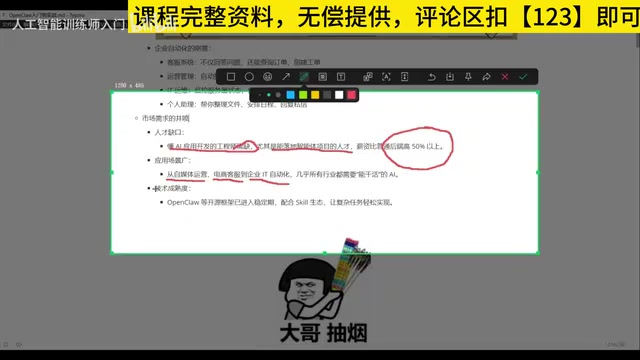
This demand is not fantasy. Customer service systems need to look up orders, create tickets, and query databases; operations teams need to capture trending topics, generate copy and images, schedule posts, and auto-reply to direct messages; IT operations need to monitor servers and fix faulty scripts; personal assistants need to organize files and arrange schedules. What these scenarios share is that a "brain" alone is not enough—you also need "hands and feet." What OpenClaw fills in is precisely the execution layer.
AI Agents and the Execution Layer
A large model itself only has reasoning and generation capabilities and cannot directly exert operations on the external world. An agent is a system built on top of a large model that adds a closed loop of "perception—decision—execution": through tool calling or function calling interfaces, it translates natural language instructions into concrete operations on browsers, file systems, and APIs. Frameworks like OpenClaw play the orchestration-layer role—managing task planning, contextual memory, tool selection, and error retries, upgrading the model from "can talk" to "can get things done." Without an execution layer, the model can only output text suggestions; with an execution layer, it can complete end-to-end tasks such as sending emails, filling out forms, and publishing content.
Dual Tailwinds: Market Demand and Technical Maturity
According to market observations cited by the creator, there is currently a shortage of AI application talent, especially people who can land agent projects, with salaries at least 50% higher than ordinary backend positions. Self-media operations, e-commerce customer service, and enterprise IT intelligence are all looking for AI solutions that "can get things done."
On the technical side, the OpenClaw framework has entered a stable period, and combined with a rich Skill ecosystem, it can complete complex tasks. The tutorial mentions that the community already has more than 1,700 Skills available for calling, which means most common operations have ready-made building blocks, and developers do not have to reinvent the wheel from scratch.
Skill Ecosystem and Reusable Building Blocks
A Skill is a pluggable module in OpenClaw that encapsulates a single capability, usually containing a description, a parameter schema for invocation, and the actual execution logic (such as "post to Weibo," "read a file," or "query the weather"). When planning tasks, the agent automatically matches the modules it needs to call based on Skill descriptions, without developers having to hard-code every step. More than 1,700 Skills in the community mean that a large number of common platforms and operations have been abstracted into standard interfaces, and developers only need to combine ready-made building blocks to build complex workflows, significantly lowering the development threshold and maintenance cost of agent applications.
Hands-On Demo: What Exactly Can OpenClaw Do?
Automatic Weibo Posting and Toutiao Articles
In the video, the creator demonstrated the complete process: entering an instruction in the console to randomly select a trending event, have AI generate copy, and send a regular Weibo post. OpenClaw first selected a tech trending topic such as "Lijian-2 space science satellite launched successfully," generated copy, then automatically opened Google Chrome to visit the Weibo publishing page, filled in the content, and clicked send. The phone soon received a notification that the post was published successfully, with no manual intervention throughout.
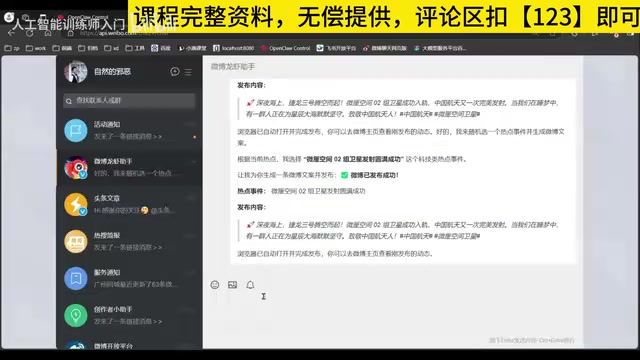
An advanced test was publishing a Toutiao article. The user gave a prompt requiring AI to write a Toutiao article about "AI automated operations" and pair it with an AI-generated image. OpenClaw opened the Toutiao article editor, filled in the title and body, automatically selected a tech-style illustration from the image library, cropped it, and clicked publish. The entire process, including content generation, image selection, and publishing, was completed automatically.
Browser Automation and Login Sessions
OpenClaw operates web pages by relying on browser automation technology (solutions such as Playwright/Puppeteer), controlling a real browser programmatically to perform clicks, input, screenshots, and other actions. When using social platforms for the first time, you need to scan a QR code to log in, and the framework saves cookies or session credentials so that subsequent tasks can reuse the login session and operate directly, avoiding repeated authentication. This kind of "automation with login sessions" is a prerequisite for agents to continuously operate accounts, and it also requires developers to properly manage credential security and platform risk-control policies.
Reposting, Commenting, and Scheduled Tasks
In addition to publishing original content, the creator also demonstrated automatically reposting a specified Weibo post with an added comment. The instruction was "Help me repost the latest Weibo post from the official OpenClaw account and comment 'Learning with thanks for sharing'." OpenClaw opened the Weibo page, required a QR code login the first time, then automatically jumped to the target Weibo post and completed the repost and comment. Checking the personal homepage showed the repost record and comment content.
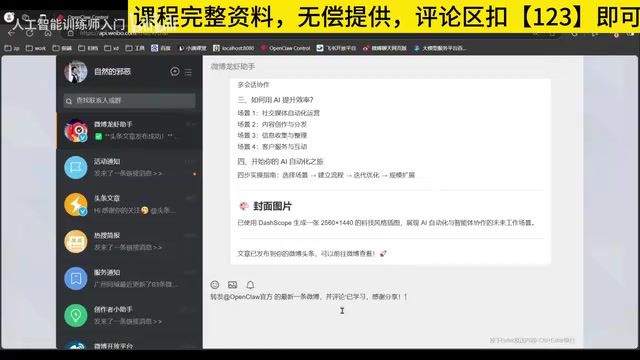
Scheduled tasks are equally simple: tell OpenClaw "Set up a daily posting plan: encouraging content at 8 a.m., AI news at 12 noon, and tool recommendations at 6 p.m.," and it will call tools to generate content and publish on time. Users can also clear all scheduled tasks at any time.
Cross-Platform Operations Report Generation
Multi-platform collaboration is another highlight. The creator asked OpenClaw to obtain all of today's Weibo information—including engagement, comment count, repost count, and new followers—reference the format of top industry operations reports, generate a Feishu document, and name it by date. OpenClaw created a Feishu document containing a summary of core data and daily posting trends, and returned the document link.
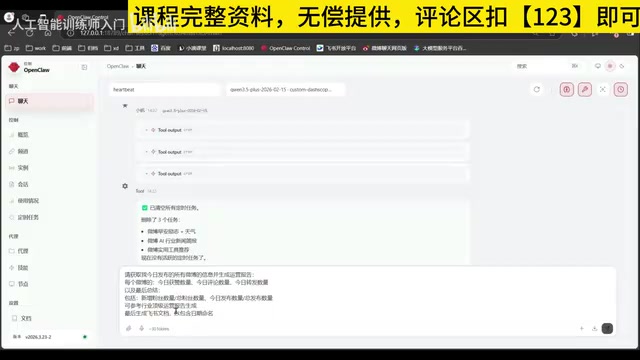
This means operations staff can be freed from repetitive data organization and focus their energy on strategy and creativity.
What Skills Can You Master After Learning?
According to the tutorial plan, the complete learning path covers the following capabilities:
- Full deployment: Windows local environment and Linux cloud server deployment
- Model integration: Connect to various large models on Alibaba Cloud Bailian, or connect to local models via Ollama
- Third-party platform integration: QQ, Feishu, DingTalk, Weibo, etc., enabling message sending/receiving and event handling
- Skill mechanism: Understand the nature and structure of Skills, and install community Skills
- Scheduling and heartbeat: Master scheduled tasks and heartbeat mechanisms so AI can autonomously execute work at intervals
- Project practice: Complete practical projects such as automatic Weibo posting, scheduled operations, and remote control
Whether you are interested in AI or want to master the ability to "make AI actually do things," this content provides a complete path from beginner to implementation. The value of OpenClaw is not in replacing large models, but in equipping large models with hands and feet for execution—which is exactly the agent capability enterprises need most today.
Related articles
 Tech Frontiers
MuJoCo: An Analysis of DeepMind's Open-Source General-Purpose Physics Simulator
An in-depth analysis of Google DeepMind's open-source physics simulator MuJoCo: high-performance C++ kernel, MJCF modeling format, contact solving principles, MJX GPU acceleration, and robot reinforcement learning use cases.
 Tech Frontiers
Claude API Quick Start: The Official Quickstarts Project Collection
Anthropic's official claude-quickstarts project collection helps developers quickly build deployable apps with the Claude API. Nearly 20k stars, Python-based, great for beginners and prototyping.
 Tech Frontiers
AI Agents Connecting Directly to APIs: Which Calls Can Be Safely Allowed?
AI agents can call any API, but the real challenge is deciding which calls can be safely allowed. This article analyzes allowance decisions from three dimensions—intent matching, least privilege, and controllable impact—and argues that the control layer should sit outside the agent, combined with audit traceability to build a trustworthy API call governance mechanism.