OpenLLM: Let AI Tokens Flow Freely Across Tools
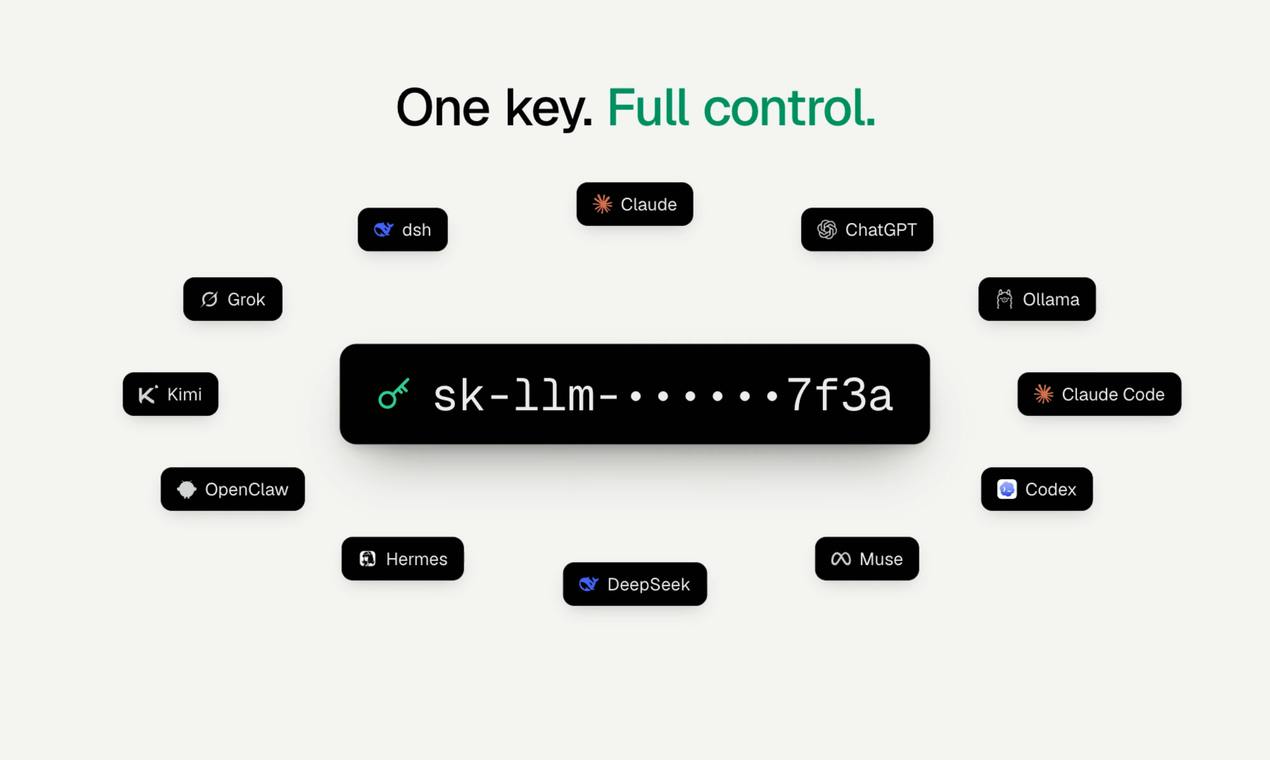
OpenLLM unifies subscriptions, API Keys, and local models into a cross-tool token pool with quota failover and remote sessions.
OpenLLM is a developer tool that debuted on Product Hunt, aiming to solve the problem of AI tokens being locked in different platforms. It unifies the user's ChatGPT subscription, Claude API Key, and local open-source models into a callable token pool for use in Codex, any coding Agent, and the Mac ChatGPT app. Core capabilities include cross-tool invocation, automatic switching when quotas are exhausted to keep sessions going, and remote coding sessions that run on the home machine. It is positioned between a proxy layer and a developer tool, handling token routing rather than building models. It currently has 76 votes and ranks 13th on Product Hunt, with above-average traction and likely an early stage. Its value depends on seamless switching, remote session stability, and acceptable differences in output quality across models.
Why Do We Need OpenLLM?
Developers often face an awkward situation: you have a pile of tokens in your ChatGPT subscription, money loaded into Claude API, and open-source models running locally—but these resources are locked inside different tools and platforms. The Agent you use for coding and the ChatGPT desktop app you use for chatting can't share these quotas with each other. Once a service hits its limit, your workflow breaks.
OpenLLM's tagline on Product Hunt is "Take your AI tokens anywhere," and it targets exactly this pain point. What it aims to do is unify your subscriptions, API Keys, and local models into a single callable pool, so tokens follow the person rather than the tool.
Core Features: One Token Pool, Consumed in Many Places
According to the product description, OpenLLM offers three layers of capability:
- Cross-tool invocation: You can use your own subscriptions and API Keys in Codex or any coding Agent, and you can also call local models from the ChatGPT app on Mac.
- Quota failover: When a service reaches its limit, OpenLLM automatically switches so the session can continue instead of simply breaking off.
- Remote session launch: You can start a coding session from anywhere, while the actual compute runs on your machine at home.
Combined, these three points essentially turn AI tokens from "platform-bound" into "user assets." For developers using multiple model services at once, this flexibility has real value—you don't have to stop what you're doing just because one tool's quota runs out.
Token Pool is the core concept for understanding OpenLLM. In the traditional model, each AI service's access credentials (such as the OAuth token for a ChatGPT subscription or an Anthropic API Key) are tightly bound to a specific platform and isolated from one another. A token pool abstracts these scattered credentials into a unified resource set, scheduled on demand by a middle layer. This is similar to "resource pooling" in cloud computing: users no longer care which specific instance underlies the service, only how much available capacity remains in the pool. In implementation, OpenLLM needs to maintain credential mappings for each source, quota status, and health checks, and dynamically select the most suitable backend at request time. The key challenge of this model is that different services have very different authentication protocols and rate-limiting strategies, so the pooling layer must do careful adaptation to avoid single points of failure.
Quota Failover borrows from the failover mechanism in high-availability systems. When an AI service's quota is exhausted or a rate limit is triggered, the system automatically routes subsequent requests to other available sources in the pool instead of returning an error to the user. This is similar to how a load balancer switches to a backup node when a server goes down. Achieving seamless failover requires solving two problems: first, state synchronization—whether the previous conversation context can be carried over after switching; second, quality consistency—different models have different output styles and capabilities, and users need to be aware that a switch has occurred. OpenLLM's product description doesn't state whether full context is preserved during switching, which directly affects the continuity of the experience.
Design Approach and Potential Scenarios
OpenLLM's positioning sits between a "proxy layer" and a "developer tool." It doesn't produce models; it handles token routing and scheduling. This model isn't new in the API gateway space, but bringing it to the coding Agent and desktop application level—and supporting local models—is what makes it somewhat distinctive.
Typical use cases might include:
- Writing code at the office with Codex during the day, then automatically switching to the local model at home to keep running once the quota is used up;
- Calling a locally deployed model directly from the ChatGPT app on Mac without additional configuration;
- Using a remote session while on the go to let the machine at home execute coding tasks.
These scenarios are relatively appealing to indie developers and people who frequently switch tools. However, remote session latency, local model response speed, and whether switching between different services is smooth all directly affect the experience. These details aren't elaborated on the Product Hunt page and require actual use to judge.
Local Model refers to open-source large language models running on the user's own hardware, such as Llama, Mistral, and Qwen deployed via Ollama, llama.cpp, or LM Studio. Compared with cloud APIs, local models have no per-token cost, data never leaves the machine, and privacy is better—but limited by local compute, inference speed and model scale are usually inferior to the cloud. By including local models in the token pool, OpenLLM needs to provide a compatibility layer that disguises the local model's inference interface as the format of a cloud API, so that coding Agents and desktop applications can call it without modification. This layer of compatibility is usually achieved through an OpenAI-compatible API, i.e., the local model server exposes an endpoint consistent with the OpenAI Chat Completions format. The real difficulty lies in function calling, streaming output, and context window management, where the maturity of implementations varies across different local models.
Coding Agent refers to AI systems that can autonomously perform programming tasks, with typical examples including GitHub Copilot, Cursor, Codex CLI, and Claude-based coding assistants. Such tools usually need a configured model backend and traditionally can only point to official APIs or specific cloud services. OpenLLM claims it can let coding Agents use the user's subscriptions and API Keys, which essentially means inserting a routing layer between the Agent and the model service, intercepting API requests from the Agent and forwarding them to the selected backend in the pool. This requires OpenLLM to precisely reproduce the target API's request and response formats, including streaming, error codes, and retry semantics. If the format isn't fully compatible, the Agent may fail to parse or behave abnormally.
Market Feedback and Competitive Position
OpenLLM received 76 votes on Product Hunt, ranked 13th, with 3 comments. This data shows it has attracted some attention but hasn't yet generated widespread discussion. In the developer tools category, this level of traction is above average, and the product may still be at an early stage.
From a competitive perspective, there are already some tools on the market for API aggregation and routing, but most focus on cloud APIs and have limited support for local models. Including local models in the token pool is a differentiating step for OpenLLM. However, the challenges it faces are also obvious: different models have different interface protocols, billing methods, and context lengths, and achieving seamless switching is not easy. If context is lost or response formats get scrambled during switching, the user experience will suffer significantly.
Points Worth Watching
OpenLLM's idea is to return AI tokens to user control rather than keeping them locked inside a platform. For developers who need to manage multiple model sources at once, this kind of tool can reduce switching costs and provide a fallback path when quotas are tight.
But its actual value depends on the details: whether switching is truly seamless, how stable remote sessions are, and whether the difference in output quality between local and cloud models is acceptable. All of these need to be verified in real workflows. Currently, the information available on the Product Hunt page is limited, and developers who are interested are advised to start with small-scale trials and observe how it performs in their own commonly used toolchains.
Background Supplement
API Gateway is a middle layer between clients and backend services, responsible for request routing, authentication, rate limiting, and protocol translation. OpenLLM's token routing approach is highly similar to an API gateway, but traditional gateways mainly target internal service calls in microservice architectures, whereas OpenLLM targets AI model services and needs to handle streaming responses, long contexts, and heterogeneous billing models. Another related concept is the LLM router, such as OpenRouter, which aggregates APIs from multiple cloud models and provides a unified entry point, billing by usage. The difference between OpenLLM and OpenRouter is that the former emphasizes using the user's existing subscriptions and local resources without additional markup, while the latter acts as a reseller with unified billing. In addition, OpenLLM supports remotely launching sessions, which involves reverse tunneling or relay server technology, i.e., the home machine actively connects to a public relay, and external requests are forwarded through the relay to the intranet machine, thereby bypassing NAT and firewall restrictions. Latency and bandwidth are the main bottlenecks of such solutions.
One-line Summary
OpenLLM unifies subscriptions, API Keys, and local models into a token pool callable across tools, enabling quota failover and remote sessions.
Paragraph Summary
OpenLLM is a developer tool that debuted on Product Hunt, aiming to solve the problem of AI tokens being locked in different platforms and unable to be shared. It unifies the user's ChatGPT subscription, Claude API Key, and local open-source models into a callable token pool, supporting consumption in Codex, any coding Agent, and the Mac ChatGPT app. Core capabilities include cross-tool invocation, automatic switching when quotas run out to keep sessions going, and remote launch of coding sessions so compute runs on the home machine. The product is positioned between a proxy layer and a developer tool—it doesn't build models but handles token routing. It currently has 76 votes and ranks 13th on Product Hunt, with above-average traction and likely an early stage. Its actual value depends on whether switching is seamless, the stability of remote sessions, and whether the quality differences across models' outputs are acceptable.
Related articles
Build a Reasoning Model from Scratch: An 11-Hour Open-Source Course Breakdown
Sebastian Raschka releases a free 8-episode, ~11-hour video course teaching you to build a reasoning model from scratch with Python and PyTorch—from a small Qwen3 model through Verifier, Inference Time Scaling, GRPO, and distillation, with open-source code on GitHub.

An 11-Hour Reasoning Model Course in Practice: How Small Models Learn to Think
Starting from Sebastian Raschka's 11-hour reasoning model course and HN buzz, this analyzes small-model training, legal text version control, Anthropic data policy, and product reliability reviews.

Lightpanda: A Headless Browser Built for AI and Automation
Lightpanda is a headless browser built from scratch in Zig for AI and automation, with 37,852 GitHub stars. This analysis covers its technical approach, design choices, and use cases.