OPO: A PPO Improvement That Replaces Fixed Clipping with Ordering

OPO questions PPO's fixed clipping radius and uses ordering plus a tail profile to achieve adaptive per-sample clipping.
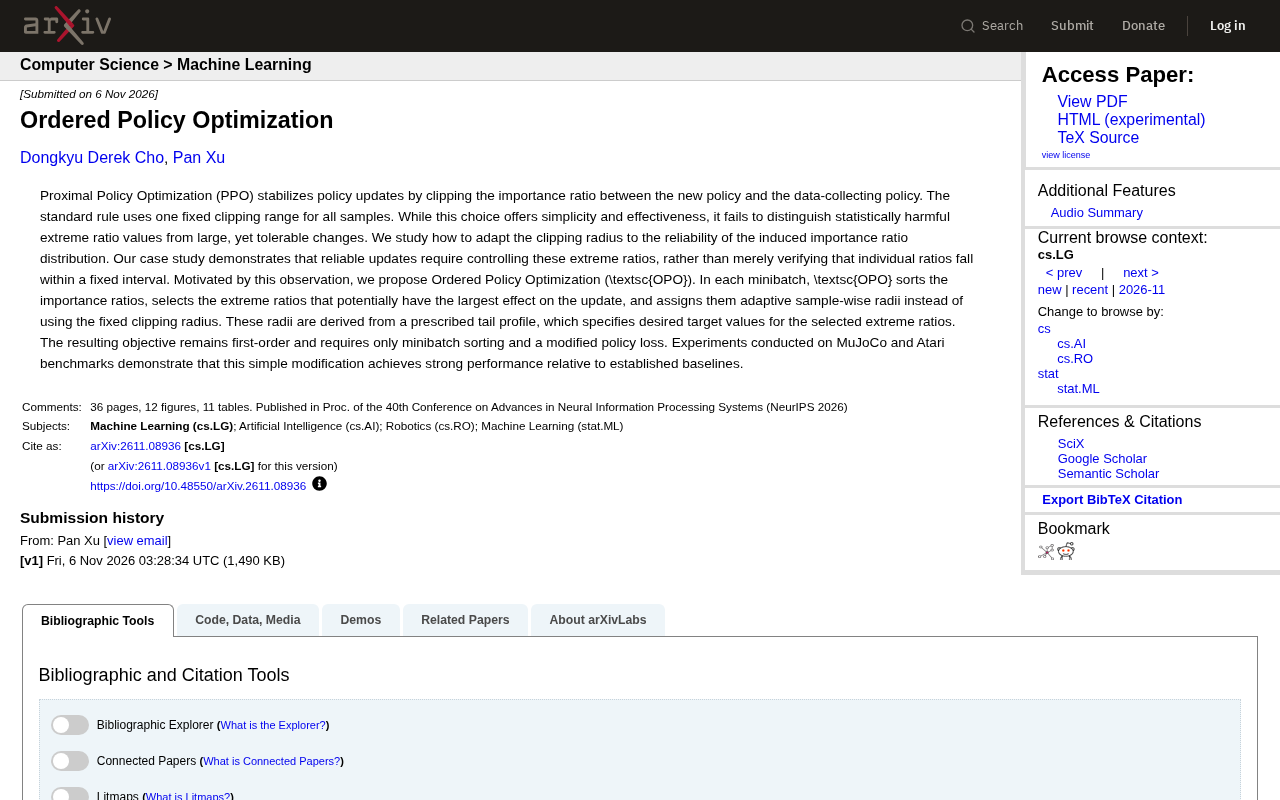
The paper argues that PPO's fixed clipping radius cannot distinguish statistically harmful extreme importance ratios from large but tolerable policy changes, and that the tail shape of the ratio distribution determines update reliability. It proposes Ordered Policy Optimization (OPO): within each minibatch, sort importance ratios, identify extreme samples, and assign adaptive per-sample clipping radii based on a preset tail profile. The method is lightweight, keeps a first-order objective, and plugs directly into existing PPO pipelines. On MuJoCo and Atari, OPO achieves strong results over baselines.
PPO (Proximal Policy Optimization) has been one of the most widely used policy gradient algorithms in reinforcement learning since its introduction, and its core stabilization mechanism—clipping the importance ratio to a fixed range—has become almost a default setting. But a new paper questions this conventional practice: can a fixed clipping radius really distinguish between "harmful extreme ratios" and "large but acceptable policy changes"? The authors propose Ordered Policy Optimization (OPO), which offers a rather clever alternative.
The Blind Spot of Fixed Clipping
PPO's clipping rule treats all samples the same: gradients are truncated whenever the importance ratio falls outside a fixed interval (such as the commonly used [1-ε, 1+ε]). The benefit of this uniform treatment is simplicity and effectiveness, but the paper points out that it cannot distinguish between two fundamentally different situations—one being statistically truly harmful extreme ratios, and the other being ratios that are numerically large but reflect policy changes still within a tolerable range.
The authors further illustrate through a case study: reliable policy updates require controlling the tail of the importance ratio distribution (i.e., those extreme values), not just checking individual ratios one by one against a fixed interval. In other words, the assumption behind a fixed clipping radius is "safe if within the interval," but what actually matters is the shape of extreme values in the overall distribution. This observation forms the starting point for OPO's design.
Importance ratio is a core quantity in policy gradient algorithms, defined as the ratio of probabilities under the new and old policies on the same state-action pair: $r_t(\theta)=\frac{\pi_\theta(a_t|s_t)}{\pi_{\theta_{\text{old}}}(a_t|s_t)}$. It measures how much the policy's preference for a given action changes before and after an update: $r_t=1$ means no change, $r_t>1$ means the new policy favors that action more, and $r_t<1$ means the opposite. Under the importance sampling framework, an unbiased estimate of the policy gradient requires weighting by $r_t$, but when the new and old policies differ too much, $r_t$ can take extreme values, causing gradient variance to explode or the update direction to become distorted. PPO's clipping is precisely meant to suppress this risk: by restricting $r_t$ to $[1-\epsilon,1+\epsilon]$, samples outside the range no longer contribute gradients. Understanding this helps grasp OPO's motivation for improvement—a fixed interval only constrains the magnitude of individual ratios and does not care about the tail shape of the entire ratio distribution.
OPO's Core Mechanism
OPO operates within each minibatch: it first sorts the importance ratios, identifies the extreme ratios that may have the greatest impact on the update, and then assigns adaptive per-sample clipping radii to these samples instead of using a uniform fixed radius.
These radii are not set arbitrarily but come from a preset "tail profile"—which specifies target values that the selected extreme ratios should reach. In this way, clipping is no longer a blunt truncation but a directional guidance: pulling the distribution tail toward the desired position.
At the implementation level, the paper emphasizes that the changes are very lightweight: the objective function remains first-order, and the additional overhead is limited to sorting within the minibatch and modifications to the policy loss. This means OPO can be directly embedded into existing PPO training pipelines without restructuring infrastructure such as the optimizer.
Tail profile is the constraint target introduced by OPO, which can be understood as a set of desired values for the tail of the importance ratio distribution. Specifically, after sorting by $r_t$ within each minibatch, the algorithm selects the most extreme samples (e.g., the largest and smallest few ratios) and sets target values for them—these target values are given by the tail profile function rather than a uniform $1\pm\epsilon$. Then, per-sample clipping radii are derived so that these extreme ratios are pulled exactly toward the target values. The effect is that clipping no longer independently judges whether each sample "crosses the boundary," but instead shapes the tail at the distribution level, compressing extreme ratios in an ordered way into the preset form. The specific form of the tail profile (e.g., linear, exponential decay) is a key design choice of the method and directly affects how tight or loose the clipping is.
Experimental Results and Significance
The paper conducts experiments on two classic benchmarks, MuJoCo and Atari, and the results show that this simple modification achieves strong performance relative to existing baselines. Considering that these two benchmarks represent the two mainstream scenarios of continuous control and discrete decision-making, respectively, the coverage of the results is reasonably convincing.
From a broader perspective, OPO's value lies in re-examining the least questioned hyperparameter design in PPO. A fixed clipping radius is a convenient engineering choice, but it is not a theoretical necessity. Making clipping adaptive to the distribution through ordering plus a tail profile provides an improvement path with almost no additional cost but with a clear statistical motivation. For researchers and engineers who routinely use PPO to train policies, this "low-change, pluggable" method is worth attention and experimentation.
Of course, the paper currently only provides benchmark-level validation; the specific way of setting the tail profile, its sensitivity across different tasks, and its relative merits compared with KL-constrained methods remain to be explored in future work.
KL-constrained methods are another route for controlling policy updates besides PPO clipping, with representative algorithms such as TRPO. TRPO ensures that the update magnitude is controllable by constraining the KL divergence between the new and old policies to not exceed a threshold. It is theoretically more rigorous but requires a second-order approximation of the objective function and solving a constrained optimization problem, which is computationally expensive. PPO's clipping mechanism can be seen as a first-order simplification of TRPO. The difference between OPO and KL-constrained methods is that KL constraints control the overall difference in policy distributions, whereas OPO directly intervenes in the extreme part of the importance ratio distribution through the tail profile. The two are not mutually exclusive—OPO's per-sample clipping is still a first-order operation and can coexist with a KL penalty term. The paper lists the relative merits of OPO and KL-type methods as an open research question precisely because the two have different trade-offs in terms of constraint targets and computational cost.
One-line Summary
OPO questions PPO's fixed clipping radius and uses ordering plus a tail profile to achieve adaptive per-sample clipping.
Paragraph Summary
The paper points out that PPO's fixed clipping radius cannot distinguish statistically harmful extreme importance ratios from large but tolerable policy changes, and that what truly determines update reliability is the tail shape of the ratio distribution. To this end, the authors propose Ordered Policy Optimization (OPO): within each minibatch, it sorts the importance ratios, identifies extreme samples, and assigns them adaptive per-sample clipping radii according to a preset tail profile, guiding the distribution tail to the desired position. The method is lightweight to implement, with the objective function remaining first-order and only adding sorting and policy loss modifications, so it can be directly embedded into existing PPO pipelines. On the MuJoCo and Atari benchmarks, OPO achieves strong performance relative to existing baselines, providing a low-change, statistically motivated improvement path for PPO's hyperparameter design.
Related articles
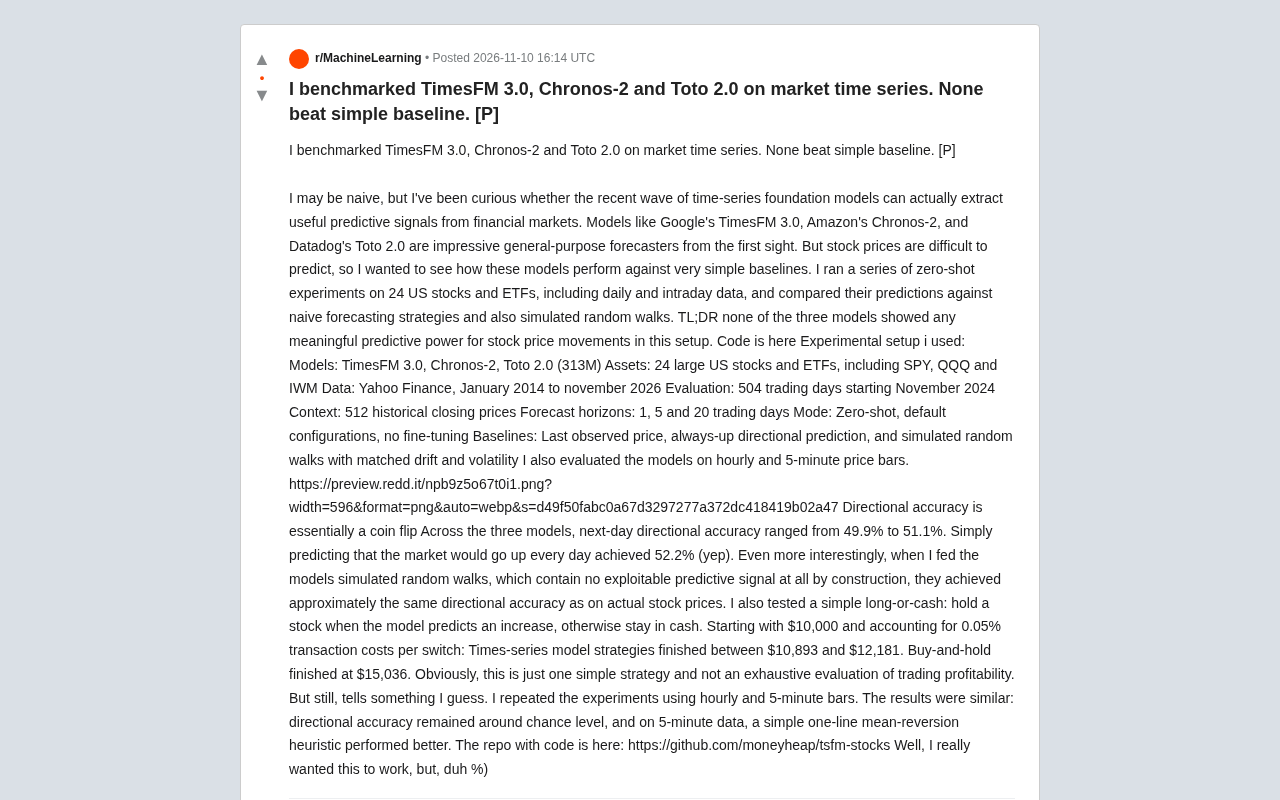
Putting TimesFM 3.0, Chronos-2, and Toto 2.0 to the Test: Time-Series LLMs Can't Beat Simple Baselines
A developer's zero-shot benchmark of TimesFM 3.0, Chronos-2 and Toto 2.0 on 24 U.S. stocks and ETFs: directional accuracy of just 49.9%-51.1%, and simulated trading underperformed buy-and-hold. Time-series foundation models show no edge over simple baselines on financial data.
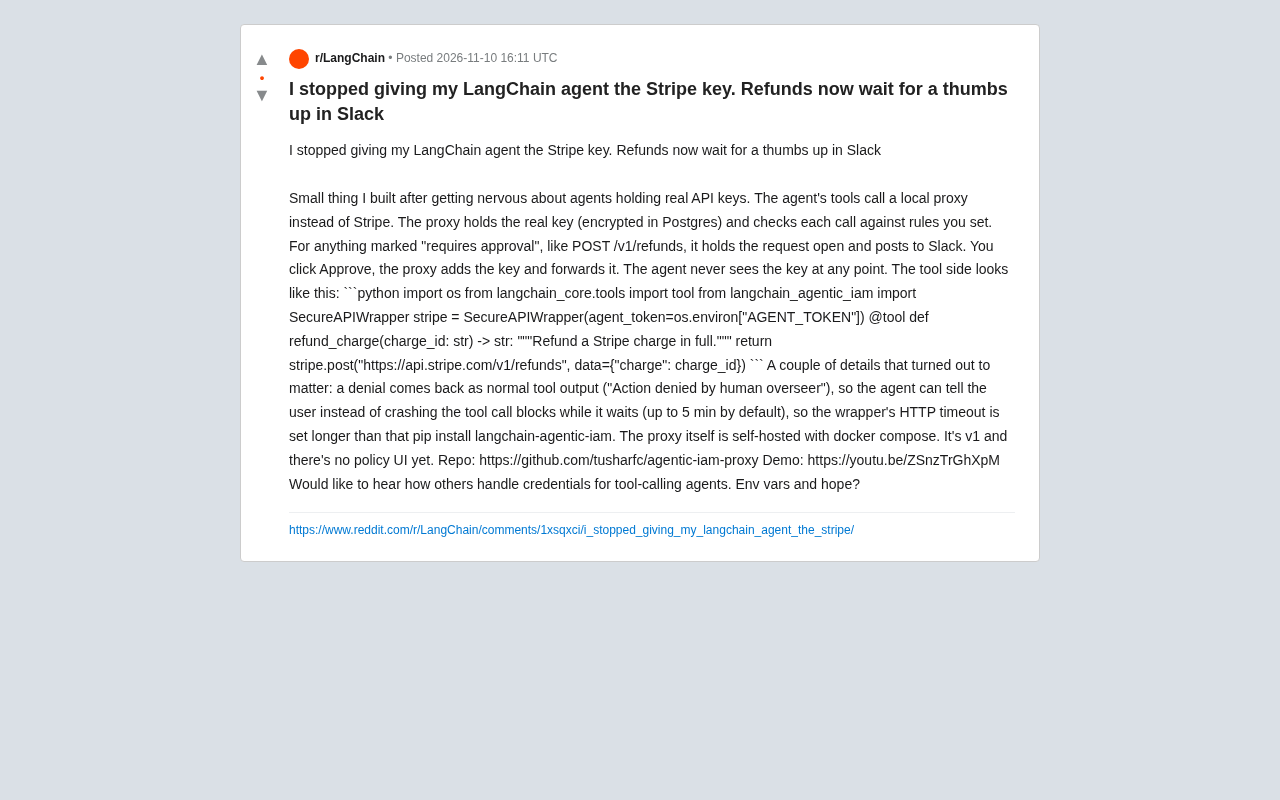
LangChain Agents No Longer Hold Stripe Keys: Refunds Require Slack Approval
A developer shares a credential management approach for LangChain agents: agents don't hold Stripe keys, and sensitive operations like refunds are forwarded through a local proxy and only executed after human approval in Slack, with code examples and engineering details.

Does LangChain Really Make Agent Development Easier? A Developer Reflects on the Cost of Abstraction
A Reddit developer reflects on the abstraction cost of LangChain and LangGraph in multi-agent workflows: easy to start, but StateGraph, state management, debugging, and cost control add new complexity. The discussion covers debugging methods, whether to mix native Python + model SDKs, and production trade-offs.