Opus 4.8 Fast Mode to Be Retired on November 30: A Migration Guide to Opus 5.5
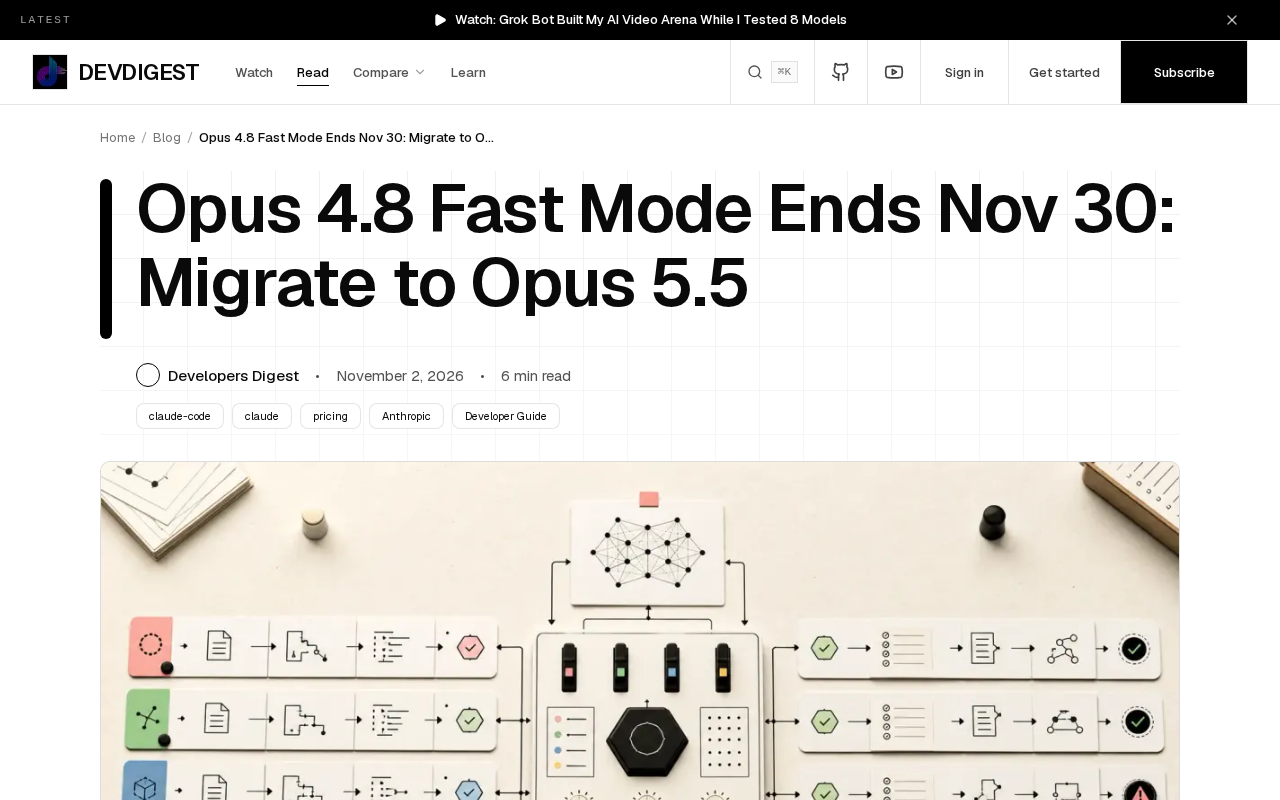
Claude Code's Opus 4.8 fast mode will be removed on November 30, and developers must migrate to Opus 5.5 fast.
Claude Code's Opus 4.8 fast mode was marked deprecated on October 30 and will be officially removed on November 30. After that, requests pointing to this mode will return errors directly, with no automatic downgrade. Developers have only about a one-month window to complete the migration, and the target model is Opus 5.5 fast, priced at $8 per million input tokens and $40 per million output tokens. The core migration action is to replace the model identifier, but you need to thoroughly search for hardcoded references in codebases, scripts, environment variables, configuration files, and scheduled tasks, and run regression tests in a test environment to verify output format and latency. The main risks are missing edge services, which could cause sudden errors after the deadline, and the impact of pricing changes on cost accounting. It is recommended to add alerts for model call errors and align with finance and budgeting.
Claude Code's Opus 4.8 fast mode was marked as deprecated on October 30 and will be officially removed on November 30. After that, any request still pointing to this mode will return an error directly. For developers who rely on low-latency responses, migrating to Opus 5.5 fast mode is the only option.
Deprecation timeline and scope of impact
According to the official notice, the deprecation of Opus 4.8 fast mode happens in two stages: it entered deprecated status on October 30 and will be fully removed on November 30. This means developers have a window of about one month to complete the migration. Once November 30 passes, all requests sent to Opus 4.8 fast will return errors, with no automatic downgrade or fallback to another model.
This change affects all projects that call Opus 4.8 fast through Claude Code. If your codebase, scripts, or automation pipelines hardcode this model identifier, you need to find and replace it as soon as possible.
Pricing and capabilities of Opus 5.5 Fast
The target model after migration is Opus 5.5 fast, priced at $8 per million input tokens and $40 per million output tokens. For production environments that require fast responses, this price point falls within an acceptable cost range.
Opus 5.5 fast maintains low latency while offering updated model capabilities. Although the original text does not go into detail on performance comparisons, based on the usual logic of version iteration, version 5.5 is generally expected to outperform 4.8 in reasoning quality and instruction following. Developers should prioritize testing the new model's output stability in their own business scenarios.
What is fast mode
Fast mode is a low-latency inference tier offered by Claude models. It shortens time-to-first-token and overall response time by optimizing the reasoning path, reducing internal thinking steps, or adjusting sampling strategies. The trade-off is usually a higher price per token than the standard tier, or slightly shallower reasoning on extremely complex tasks. For scenarios such as interactive coding assistants (like Claude Code), real-time completion, and automated pipelines, latency is often more critical than the ultimate quality of a single inference, making fast mode a common choice for these workloads.
MTok and token billing
MTok stands for Million Tokens and is the standard unit for billing large model APIs. A token is the smallest unit into which the model splits text for processing; English is roughly split by words or word fragments, while Chinese is usually split by characters or words. When pricing is written as "$8/$40 per MTok," the former refers to the unit price of input tokens and the latter to the unit price of output tokens. Output is usually more expensive because generation requires token-by-token decoding. When estimating costs, you need to separately count the number of input tokens (prompts, context, code files) and output tokens (model-generated content) in a request, then multiply by the corresponding unit prices. In long-context scenarios, input tokens account for a high proportion and are the focus of cost accounting.
How to complete the migration
The core action of the migration is to replace the model identifier. In Claude Code's configuration or API calls, simply change the model name pointing to Opus 4.8 fast to the identifier corresponding to Opus 5.5 fast. It is recommended to run a round of regression testing in a test environment first, confirming that the output format and latency performance meet expectations before going live.
For projects that use an SDK or a wrapper layer, check environment variables, configuration files, and hardcoded strings in the code. If your team has a unified model routing layer, a single change can cover multiple services.
Risks to watch out for
The migration window is only one month, which is not generous. The biggest risk is missing old model references in some edge services or scheduled tasks, causing sudden errors after November 30. It is recommended to complete a full search and replace before the deadline and to add alerts for model call errors to your monitoring.
In addition, pricing changes need to be reflected in cost accounting. The per-million-token price of Opus 5.5 fast should be aligned with finance or budget owners to avoid unexpected fluctuations in bills.
FAQ
Will Opus 4.8 fast switch automatically after November 30? No. Requests will return errors directly, and you need to migrate manually.
Do I need to change code logic after migration? Usually you only need to replace the model identifier, but it is recommended to run regression tests on output quality.
Is Opus 5.5 fast expensive? Input is $8 per million tokens and output is $40 per million tokens, which is standard pricing for fast mode.
Act early to avoid scrambling before the deadline.
Related articles
 Tech Frontiers
Coldframe: A Honeypot Disguised as a Supermarket Freezer Controller
Coldframe is a honeypot disguised as Danfoss AK-SM 800A and Dixell XWEB freezer controllers, built as a single Python file that detects CVE-2025-41450 attempts and is identified as real devices on Shodan.
 Tech Frontiers
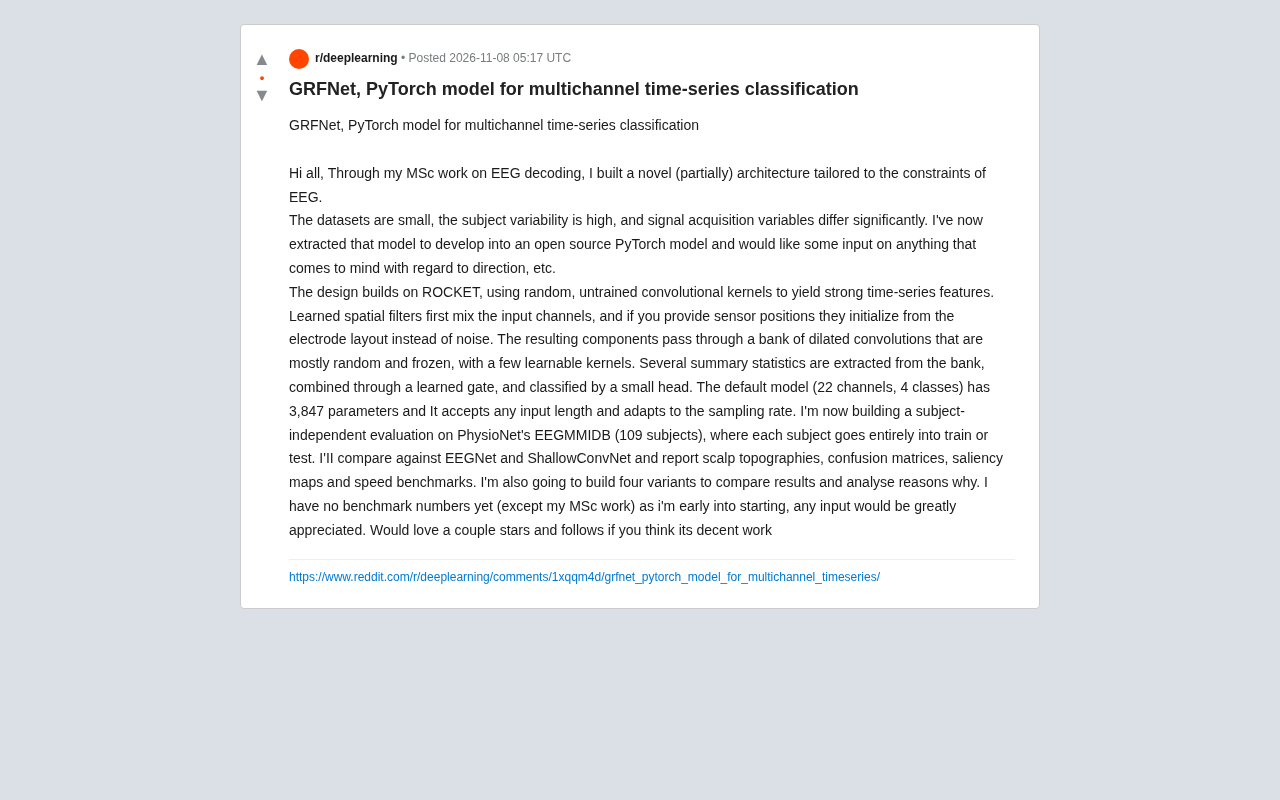
GRFNet: A Lightweight PyTorch Model Designed for Multichannel Time-Series Classification
GRFNet is a lightweight PyTorch model for multichannel time-series classification, originating from EEG decoding research. With only 3,847 parameters, it is based on the ROCKET architecture, combining random convolution kernels with learnable spatial filters, supports arbitrary input lengths, and will soon be evaluated on the PhysioNet dataset.
 Tech Frontiers
CUDA-Accelerated Rocket League Simulator: A Player-Made Hardcore Experiment
A Reddit post shows a "100% Accurate" Rocket League simulator accelerated with CUDA. We analyze its technical context, CUDA's value in game physics simulation, and the significance and limitations of such community projects.