Orbit: Fighting Mindless Scrolling with 'Task Unlocks'

Orbit prices scrolling with physical, social, and monetary costs to fight mindless scrolling through friction design.
Orbit is an iOS app that lets users preset app usage schedules that lock automatically; opening early requires earning back permission by holding a virtual orb, doing squats, asking a friend, paying incrementally, or winning a shift at The Gate. Its philosophy is replacing uncontrollable impulses with bearable friction costs. The article praises its not-deciding-for-users design while flagging undisclosed payment tiers, gameplay details, and social help-seeking as potential deterrents.
When Scrolling Becomes a "Cost"
Orbit, which hit #3 on Product Hunt's daily leaderboard with 134 upvotes, makes a blunt proposition: Doomscrolling is free. Orbit makes it cost something.
This iOS app is categorized under both Health & Fitness and Productivity. Its core mechanism: users first set up an app usage schedule, and when the time comes, the selected apps lock automatically. If they want to open them early, they must first "earn back" permission.
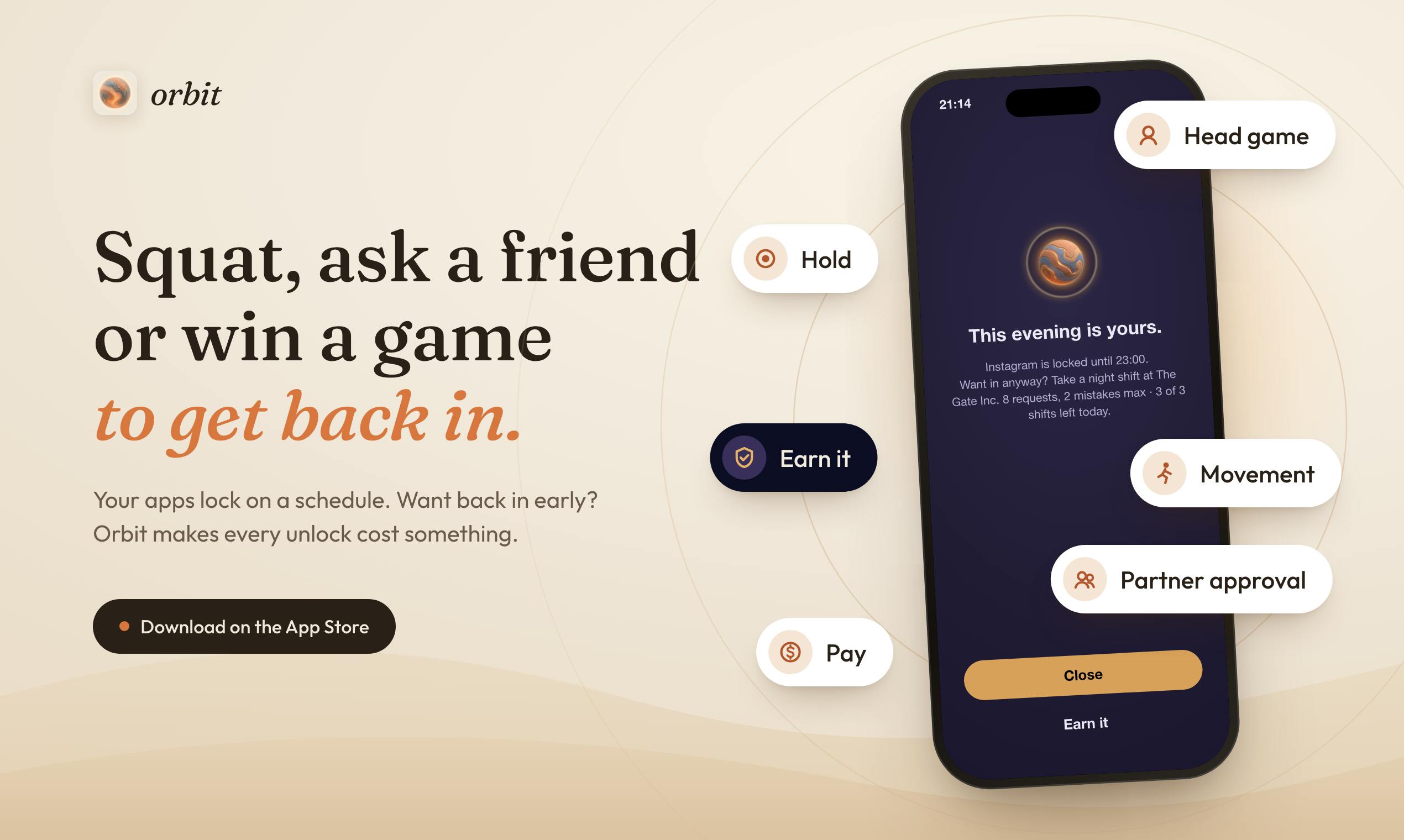
The idea isn't new, but Orbit turns "punishment" into a tiered menu of costs rather than a blunt forced lock screen.
Doomscrolling is a recently coined internet term combining "doom" and "scrolling." It refers to the unconscious, compulsive behavior of endlessly swiping through a phone screen consuming negative or trivial information. This typically happens in social media or news feeds, where users often spend large amounts of time without realizing it yet gain little real satisfaction. Psychological research suggests doomscrolling is linked to anxiety, stress, and fragmented attention, with an addiction mechanism similar to the "variable ratio reward" in gambling—each swipe might surface something novel or emotional, driving the brain to keep seeking the next hit. Orbit's framing of this behavior as a "free" activity that needs to be priced stems precisely from an understanding of its low-cost, high-reward nature.
Unlock Methods: From Physical Effort to Social Pressure to Money
Orbit offers five paths to early unlocking:
- Hold the orb (a virtual sphere within the product): maintain a sustained action, trading attention for entry.
- Do squats: tie unlocking to physical activity, offsetting the urge to scroll with exercise.
- Ask a friend for help: bring in a third party to add social friction.
- Pay a little more each time: the payment amount increases with each unlock, using economic cost to suppress impulses.
- Win a shift at The Gate: a gamified extra mechanism whose specific gameplay the original text doesn't detail.
The common logic behind these paths is creating friction. Doomscrolling is hard to quit because the cost of opening an app is essentially zero. Orbit rewrites "zero cost" as "requires physical effort, social face, or money," adding a layer of mental accounting before users unlock.
The product team offers a key judgment in their description: Most times, you'll stay out. This suggests they're not betting that users will complete the task to unlock every time, but rather that users will give up opening the app when faced with friction.
Friction in behavior design and product psychology refers to various interventions that increase or decrease the effort users must expend to complete a behavior. Common "reduce friction" designs include one-click ordering and auto-filled forms, aimed at lowering the barrier to action; "increase friction" does the opposite, using extra steps, wait times, or cognitive load to curb impulsive behavior. In digital health, friction is widely applied to counter addictive design—for example, requiring users to type a passage to turn off an alarm, or setting delayed loading of social media feeds. Orbit's five unlock paths are essentially concretizations of friction: holding the orb requires sustained attention, squats require physical exertion, asking a friend involves social cost, and paying directly creates economic loss. The shared premise of these designs is that when the cost of a behavior rises, the rational system has a chance to intervene, replacing automatic impulsive reactions.
Trade-offs and Questions in the Product Design
From a productivity tool perspective, Orbit's cleverness lies in not making decisions for users. It doesn't force uninstalls or crudely cut off the internet—it returns the choice to users, just putting a price tag on each option. This design respects individual differences more than simple screen time limits—some people are willing to do squats, some are willing to pay, and some just need a friend to say "stop scrolling."
But the questions are equally obvious. The pricing mechanism for paid unlocks isn't disclosed in the original text—it only says "pay a little more each time." If the amount increases too quickly, it may trigger user resentment; if too slowly, it loses its restraining power. The Gate's shift gameplay also lacks detail—whether it's a random reward or a task requiring time investment directly affects whether this system is sustainable.
Another easily overlooked issue: the boundaries of social help-seeking. Letting friends participate in unlocking means exposing private habits to others—a plus for some users, a deterrent for others.
Screen Time is a built-in feature on iOS and Android that allows users to set app usage limits, schedule downtime, or restrict specific content categories. Its core mechanism is "soft blocking": when the time limit is reached, app icons gray out, and users must tap "Ignore Limit" and enter a password to continue. However, the flaw in this design is that the "Ignore" button is too prominent and too easy to operate—users often bypass limits on impulse, rendering the intended constraint useless. Orbit's product positioning targets exactly this pain point, replacing the "ignore" action with multiple checkpoints that require real costs, thereby raising the psychological threshold before users re-enter an app. This also explains why Orbit doesn't adopt aggressive measures like forced uninstalls or internet cutoff, but instead chooses to layer a voluntary cost structure on top of the system level.
Who Orbit Is For
Judging from Product Hunt's categorization and comment section activity, Orbit targets people who are self-aware but lack follow-through. They've already recognized the doomscrolling problem and have tried the system's built-in screen time management, but always find the "Ignore Limit" button. Orbit's value is making the "ignore" action more troublesome.
It's not suitable for two types of people: first, users who need to be on call 24/7 and check work messages at any time; second, users who are unmoved by gamification mechanisms and may even feel offended by them. The product's core assumption is that people will rationally weigh costs when faced with friction—but this assumption doesn't hold for everyone.
Gamification refers to applying game design elements to non-game contexts to boost user engagement and motivation. Common elements include points, badges, leaderboards, quest challenges, and reward mechanisms. In health and productivity apps, gamification is often used to encourage exercise, learning, or habit formation—for example, converting daily step counts into virtual adventure progress, or earning rewards through consecutive check-ins. However, gamification has a dual nature: when extrinsic rewards dominate excessively, users may shift focus from intrinsic motivation (such as health improvement) to task completion itself, creating a substitute addiction of "unlocking for unlocking's sake." Orbit's "The Gate shift" mechanism and squat unlocks both carry gamification elements, and their success depends on whether the reward rhythm aligns with users' intrinsic goals. If task difficulty is too low or rewards too random, users may develop new compulsive behaviors rather than actually reducing screen time.
A Bit of Cool Reflection
Orbit's product philosophy can be summed up as: replace uncontrollable impulses with bearable costs. It doesn't promise abstinence—only an added pause. In today's intensifying attention economy, this "price-tagging scrolling" approach is more actionable than simply calling for self-discipline.
But a tool is ultimately just a tool. If users treat "squat to unlock" as a new check-in game, Orbit could shift from a constraint mechanism to another form of addiction—only this time, the addiction is to the unlock tasks themselves. Whether the product avoids this trap depends on its subsequent refinement of task difficulty and reward rhythm.
One-line Summary
Orbit prices scrolling with physical, social, and monetary costs, attempting to fight mindless scrolling through friction design.
Paragraph Summary
Orbit is an iOS app whose core mechanism lets users preset app usage schedules that lock automatically when the time comes; opening early requires "earning back" permission through five methods: holding a virtual orb, doing squats, asking a friend, incremental payments, or winning a shift at The Gate. Its product philosophy is replacing uncontrollable impulses with bearable friction costs, betting that users will mostly give up unlocking when faced with cost. The article analyzes the cleverness of this design—not deciding for users but pricing each option—while also noting questions: payment tiers and gameplay details aren't disclosed, and social help-seeking may deter some users. The target audience is people who are self-aware but lack follow-through, and the potential risk is that unlock tasks themselves could become a new object of addiction.
Related articles
Salesforce Acquires Rune for $375M: AI Logistics Tech Bolsters Defense Business
Salesforce reportedly acquires defense tech startup Rune for $375M. Rune's AI logistics tech will strengthen Salesforce's Missionforce defense platform, continuing its M&A spree.

Why Fair Use Benefits Everyone in the AI Era
Starting from a Hacker News discussion, this article analyzes the legal logic and controversies of the fair use principle in AI training and content creation, and its dual impact on creators and the tech ecosystem.

Mistral Large 4 Open-Sources a Trillion Parameters, Microsoft Offers Voluntary Severance to 60,000 Employees
Mistral Large 4 open-sources a trillion-parameter multimodal model with a coding agent score of 48; SanDisk earnings show AI inference reshaping NAND demand; Google Gemini adds in-app file editing, OpenAI raises Codex quotas, and Microsoft offers voluntary severance to 60,000 employees.