Paramount CEO: AI Will Surpass CGI as the Biggest Creative Unlock in Modern History

Paramount Skydance CEO says AI's impact on film will surpass CGI as the biggest creative unlock.
Paramount Skydance CEO David Ellison said on an earnings call that it's hard to imagine AI not having a greater impact on the film industry than CGI, positioning it as "the biggest creative unlock in modern history." The article notes that Ellison's perspective covers production as a whole rather than just post-production effects, with emphasis on creative expression rather than efficiency gains. This statement could influence studio budget allocation and partnership pacing, but copyright, union agreements, audience acceptance, and time scale remain real variables.
Starting from the Earnings Call: The Signal Behind "Hard to Imagine"
During Paramount Skydance's latest earnings call, CEO David Ellison was asked about the company's view on artificial intelligence. His response didn't stop at the usual platitudes like "we're paying attention" — instead, he offered a judgment anchored in historical perspective: it's hard to imagine that AI won't have a greater impact on the film industry than CGI.
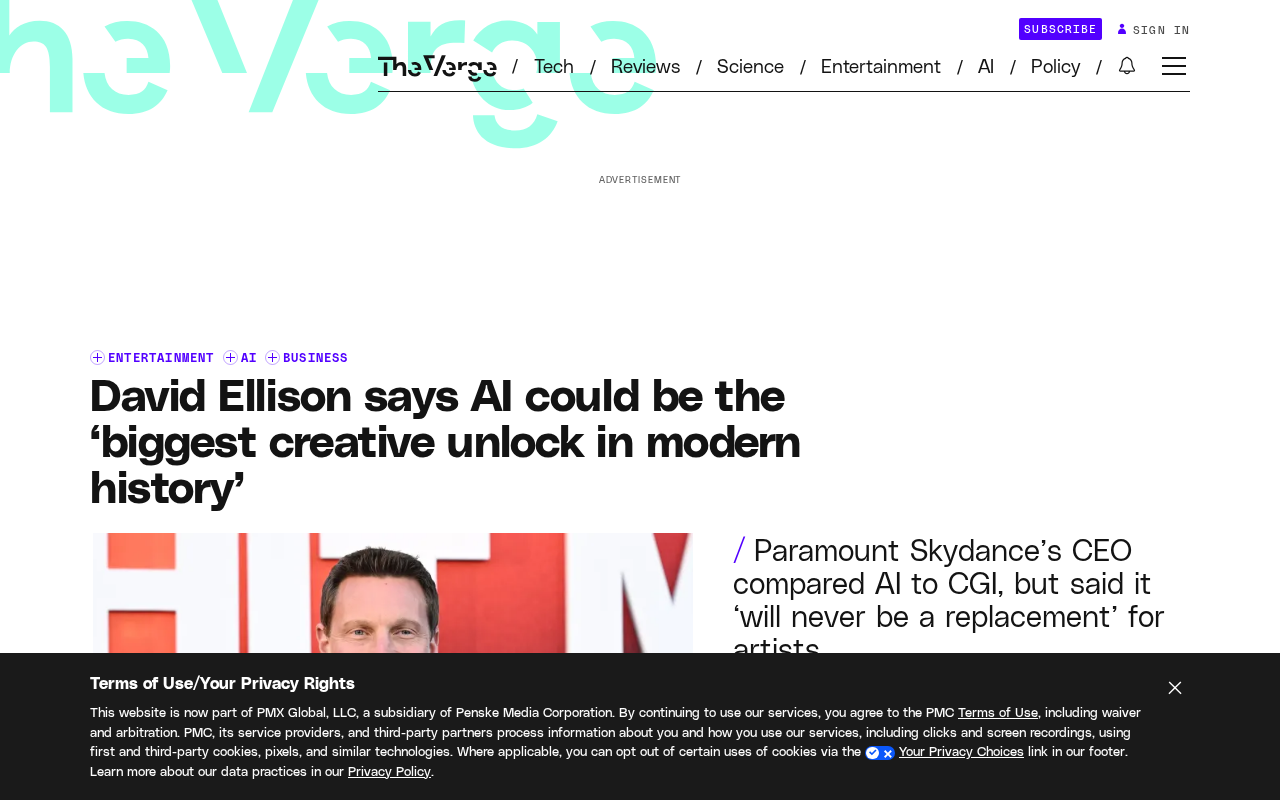
The weight of this statement lies in who said it. Ellison helms one of Hollywood's core studios, and his judgment isn't lab-bench technological optimism — it comes from someone who grapples daily with budgets, timelines, and creative decisions. By placing AI on the same scale as CGI, he's effectively acknowledging that this technology could reshape the fundamental logic of film production, not merely serve as an efficiency tool in the post-production pipeline.
AI Is More Than a Post-Production Tool: Ellison's "Production-Wide" Perspective
In his response, Ellison specifically noted the need to "zoom out and look at production." That phrasing deserves unpacking.
Traditionally, Hollywood's discussion of AI has centered on post-production visual effects, editing assistance, or marketing asset generation. But Ellison's perspective is clearly broader — he's talking about production as a whole. This means AI could intervene from early concept development, storyboarding and pre-visualization, to virtual production on set, and on through post-production compositing and localization of release versions. CGI changed "how images come to be," while AI could change "how production is organized."
This distinction determines the nature of the impact. CGI made impossible images visible, but it required massive specialized teams and lengthy pipelines. If AI can simultaneously drive creative generation and workflow orchestration, what it compresses isn't just point costs — it's the friction coefficient of the entire production chain.
Virtual Production has emerged rapidly in Hollywood's production workflow in recent years, with The Mandalorian's LED wall (StageCraft) as a typical example. Its core idea is to move post-production visual effects forward to the shooting stage: backgrounds are generated on LED screens through real-time rendering engines, so actors can see something close to the final result while filming, reducing the disconnect of green-screen performance and post-production rework. Virtual production has already blurred the traditional linear division of "pre-production — shooting — post-production," and AI's involvement could further accelerate this integration — for instance, automatically generating storyboard pre-visualizations, adjusting scene lighting in real time, or assisting asset creation. What Ellison means by "zoom out and look at production" is precisely to understand AI as an extension of this workflow restructuring, rather than viewing it as an isolated point tool.
Why "Surpassing CGI" Is a Bold Analogy
CGI's place in film history is undeniable: it spawned new genre grammar, reshaped audiences' expectations for visual spectacle, and redistributed studios' investment structures in technical teams. Comparing AI to CGI is itself a high-bar analogy.
But Ellison's phrasing was "biggest creative unlock in modern history." The emphasis falls on creative unlock, not "efficiency gains" or "cost reduction." In other words, he's betting not on AI doing work for people, but on AI enabling people to achieve creative expressions that were previously impossible.
Whether this judgment holds remains unanswered. But its value lies in providing a testable framework: if AI ultimately only makes visual effects cheaper, then it hasn't surpassed CGI; only when it opens new space in narrative structure, genre innovation, or creative barriers does this analogy truly deliver.
CGI (Computer-Generated Imagery) began large-scale application in the film industry in the 1990s, with the liquid metal T-1000 in Terminator 2: Judgment Day and the dinosaurs in Jurassic Park as landmark moments. Over the following nearly three decades, CGI not only became standard equipment for blockbuster production but also spawned entirely new visual languages and genre paradigms, such as superhero films and fully CG animated features. From an industrial structure perspective, CGI's proliferation redistributed studio budgets — visual effects companies became key links in the value chain, and global outsourcing pipelines took shape. Understanding this historical coordinate is essential to appreciating the weight of the "AI impact surpassing CGI" analogy: it concerns not just technical capability, but the restructuring of entire production organization models and industrial power dynamics.
What a Studio CEO's Statement Means
When executives discuss AI on earnings calls, there are usually two motivations: reassuring investors about cost-story expectations, or responding to external questions about technology implementation. Ellison's statement falls between the two but leans toward the latter — he offered this judgment when asked "how does the company view AI's prospects."
For the industry, the practical impact of such statements lies in resource allocation. When the CEO of a core studio publicly places AI at the level of a strategic creative issue, it influences internal budget directions, the pace of partnerships with AI companies, and creative teams' attitudes toward new technology. Hollywood's stance on AI has long been divided: writers and actors worry about replacement, technical teams see tool iteration, and management sees cost curves. Ellison's remarks shifted the discussion from "will it replace people" to "what creative possibilities can it unlock" — and this shift itself may be more important than the conclusion.
Real-World Problems Beyond the Optimistic Judgment
A brief note: Ellison's analogy doesn't address several key variables. The legality of copyright and training data, union agreements' constraints on AI use, and audience acceptance of AI-generated content are all real-world frictions Hollywood can't avoid when implementing AI. CGI's proliferation similarly went through a process of declining technical costs and union negotiations, and AI will likely follow a similar path.
Another unanswered question is the time scale. "The biggest creative unlock in modern history" is an outcome judgment, not a timetable. From technical capability to studio pipelines to audience-facing products, the conversion cycle in between could be measured in years. Ellison's optimism provides a directional anchor, but the actual pace of migration in the film industry still depends on the three-way game among cost, law, and creative inertia.
Hollywood union agreements' constraints on AI are key context for understanding the pace of implementation. In 2023, the Writers Guild of America (WGA) and SAG-AFTRA each held major strikes, with AI usage terms among the core disputes. The final agreements established informed consent and compensation mechanisms for AI-generated scripts and digital replication of actors' likenesses, while preserving room for further negotiation on training data use. This means studios cannot make decisions about deploying AI tools based solely on technical feasibility and cost — they must also consider contractual obligations with unions. Additionally, the U.S. Copyright Office currently tends to hold that purely AI-generated content is not eligible for copyright protection, with substantial human authorship as a prerequisite for rights recognition. This directly affects AI's role in the creative process — whether it replaces or assists creators — and the legal boundary is still taking shape.
One-line Summary
Paramount Skydance CEO says AI's impact on film will surpass CGI as the biggest creative unlock.
Paragraph Summary
Paramount Skydance CEO David Ellison said on an earnings call that it's hard to imagine AI not having a greater impact on the film industry than CGI, positioning it as "the biggest creative unlock in modern history." The article notes that Ellison's perspective covers production as a whole rather than just post-production effects, with emphasis on creative expression rather than efficiency gains. This statement could influence studio budget allocation and partnership pacing, but copyright, union agreements, audience acceptance, and time scale remain real variables.
Related articles
Behind Jensen Huang's Resignation: Where Does Nvidia's China Business Go?
Jensen Huang resigns as Nvidia CEO, but the original report notes the bigger story lies in Nvidia's China business dealings and the U.S. government's stance. This article sorts out the background and open questions.
Alzheimer's Is Preventable and Manageable: A Neurologist's Five Brain-Protection Rules
A neurologist says Alzheimer's is mainly a metabolic brain disease and highly preventable. Here are five controllable risk factors—from breaking medication dependency to moving more and eating better.

Uber Confirms Data Breach: Thousands of Drivers' License Information Stolen via Fireworks AI
Uber confirms thousands of drivers' license information stolen in a data breach, with data stored by AI cloud company Fireworks AI. This article analyzes AI supply chain security blind spots, risks of enterprise AI service procurement, and recommendations.