Particle-1 Lands on AI Gateway: A Token-Efficient Model Built for Software Engineering

Particle-1 is post-trained on DeepSeek V4.1 Flash, focused on completing software engineering tasks with fewer tokens, now live on Vercel AI Gateway.
Particle AI's Particle-1 is now available on Vercel AI Gateway. Post-trained on DeepSeek V4.1 Flash, its key selling point is token efficiency: shorter reasoning, fewer trial-and-error and fix cycles, and more focused exploration paths. It offers a 1M-token context window for debugging, planning code changes, and breaking down multi-step engineering problems. Developers set AI_GATEWAY_API_KEY and call model particle/particle-1 in AI SDK, Claude Code, Codex, or Cursor. AI Gateway provides a unified API, usage and cost tracking, retries, failover, budget management, and zero data retention, billed at provider prices with no markup. The piece sees this as reflecting a trend of vendors going deep vertically while gateways integrate horizontally.
A Model Purpose-Built for Software Engineering Tasks
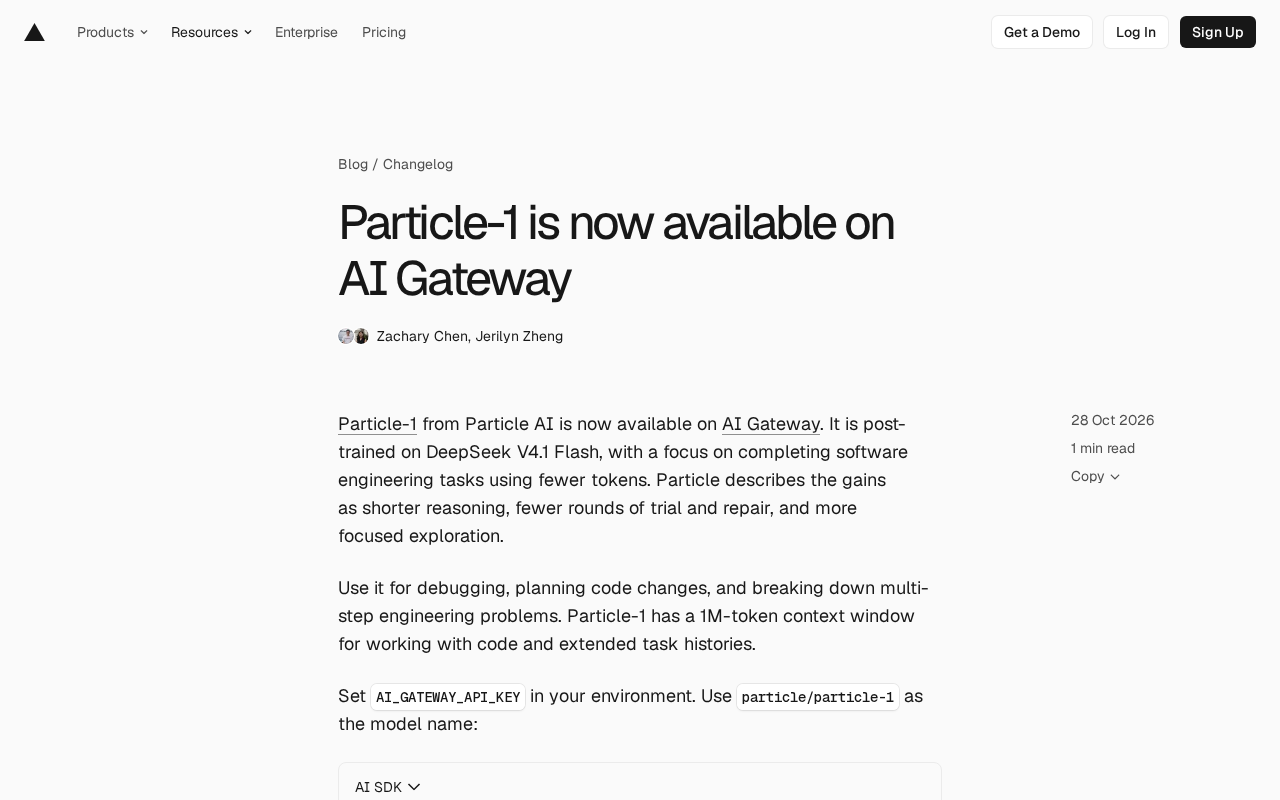
Particle AI's Particle-1 model is now available on Vercel AI Gateway. According to the official announcement, the model is post-trained on DeepSeekAd V4.1 Flash, with the core goal of completing software engineering tasks using fewer tokens. Particle describes the improvement as: shorter reasoning processes, fewer trial-and-error and fix cycles, and more focused exploration paths.
What makes this release noteworthy isn't just another model listing—it's the explicit bet on token efficiency. In coding agent scenarios, reasoning length and trial-and-error cycles directly determine invocation cost and response latency, and Particle-1's design orientation hits this pain point precisely.
Post-training refers to the second-stage training a model undergoes after large-scale pre-training, typically including supervised fine-tuning (SFT), reinforcement learning from human or AI feedback (RLHF/RLAIF), rejection sampling, and similar steps. Unlike pre-training, which learns general language and knowledge, post-training aims to align the base model's behavior to specific task distributions and preferences—for example, making outputs more concise, following instructions more closely, or improving first-attempt correctness on code tasks. Building Particle-1 via post-training on DeepSeek V4.1 Flash means it reuses the base model's general capabilities and knowledge while adjusting reasoning style and output strategy specifically for software engineering scenarios. Training cost is therefore far lower than training a new model from scratch, though the capability ceiling is also bounded by the base model.
Token efficiency measures the number of input plus output tokens required to complete a given task. In coding agent scenarios, cost and latency are almost linearly related to total token count: the longer the reasoning chain and the more retry cycles after failures, the greater the cumulative consumption. So "completing tasks with fewer tokens" isn't just about saving money—it also means shorter end-to-end response times and less context window occupancy, which is especially critical for multi-step, long-session engineering tasks.
Model Capabilities and Use Cases
According to the AI Gateway page, Particle-1 is suited for debugging, planning code changes, and breaking down multi-step engineering problems. These tasks typically require the model to maintain awareness of code structure and task history across a long context, and Particle-1 offers a 1-million-token context window for handling codebases and lengthy task histories.
In terms of positioning, Particle-1 doesn't aim for comprehensive coverage of general conversational capabilities; instead, it concentrates resources on execution efficiency for engineering tasks. Shorter reasoning means the model tends to give actionable solutions directly rather than lengthy analysis; fewer fix cycles point to higher first-attempt quality and reduced back-and-forth correction loops.
Context window refers to the upper limit of total tokens a model can process in a single invocation, covering the input prompt and generated output. A 1-million-token magnitude corresponds roughly to hundreds of thousands of lines of code or hundreds of files' worth of content, allowing the model to see multiple related files, dependencies, and historical conversation records in a single call without relying on retrieval or chunked concatenation. Note, however, that context window size doesn't equal actual "effective utilization" capability: content in the middle of long contexts tends to be overlooked by models (commonly called the lost-in-the-middle phenomenon), and input tokens are still billed. So even with a large enough window, in practice it's still advisable to include only code snippets and task history relevant to the current task, balancing cost and accuracy.
How to Call It on AI Gateway
Usage is quite straightforward: set AI_GATEWAY_API_KEY in your environment, then specify the model name as particle/particle-1. With AI SDK, for example, you can make a streaming call via streamText:
import { streamText } from 'ai';

const result = streamText({
  model: 'particle/particle-1',
  prompt: 'Suggest three fixes for a flaky API retry loop.'
});

for await (const text of result.textStream) {
  process.stdout.write(text);
}
To use it in coding agents like Claude Code, Codex, or Cursor, install the latest Vercel CLI and run npx vercel ai-gateway setup, then select particle/particle-1 in your agent. An official model playground is also available for direct testing.
Engineering Convenience Brought by AI Gateway
AI Gateway itself provides a unified API for invoking models, tracking usage and cost, and configuring retries, failover, and performance optimizations to deliver higher availability than a single provider. It includes built-in custom reports, Zero Data Retention support, API key budget management, routing rules, and more.
On billing, AI Gateway charges at provider prices as-is, with no markup and no platform fees for inference, and this also applies to Bring Your Own Key (BYOK) requests. For teams that need to switch between multiple models while controlling cost and availability, the value of this unified access layer lies in reducing the maintenance burden of building your own gateway.
Particle-1's arrival on AI Gateway reflects a trend: model vendors are starting to go deep in vertical scenarios, while the gateway layer takes on more and more responsibility for horizontal integration. For developers who work with code daily, models focused on token efficiency like this are worth adding to the toolbox for real testing—especially on tasks that easily consume large amounts of tokens, such as debugging loops and multi-step refactoring.
BYOK (Bring Your Own Key) means developers use API keys they've obtained from model providers and forward requests through the gateway. In this mode, billing is typically still settled by the original provider, and the gateway only handles routing and observability, so no additional markup is incurred. This contrasts with the gateway-procured model, where the gateway purchases and resells model invocation quotas. The value of BYOK is that teams can retain contracts, quotas, and compliance terms signed directly with providers while still gaining the gateway's unified logging, usage statistics, retries, and failover capabilities—avoiding lock-in to a single access layer.
Failover means that when the primary model or primary provider returns an error, times out, or triggers rate limiting, the gateway automatically switches the request to a backup model or endpoint. For production coding agents, this means a single point of failure isn't directly exposed to end users—but output style and quality may change after switching, so equivalent models need to be configured carefully in routing rules.
Related articles

Gemini 4 Carbon Tops Global Rankings as AI Productivity and Open-Source Ecosystems Surge
Google DeepMind's Gemini 4 Carbon tops global benchmarks, built for complex agents and system security. ByteDance launches Doubao Work integrated with Feishu, Anthropic's AI autonomously breaches 5 system-level attack chains, and ModelBest and Fudan open-source on-device multimodal and image generation models.

Overseas Creator Breaks Down N8n AI Agent Business Playbook: From Tooling to Monetization
An overseas creator breaks down the N8n AI agent business playbook: comparing Zapier, Make, and N8n, detailing four monetizable automation categories—lead capture, WhatsApp follow-up, booking, and content pipelines—plus agency pricing and a sales playbook.

Empacer: The Voice-First AI Assistant for Small Business Owners That Topped Product Hunt
Empacer is a voice-first AI assistant for small business owners: three-question setup, voice requests turned into customer replies, social posts, and invoices—all owner-approved. It won #1 Product of the Day on Product Hunt with 231 upvotes and 47 comments.