PCMag Pay-to-Play Awards Controversy: The Gray Industry Chain Behind Tech Media Awards

paint.net developer was asked for a $10,000 licensing fee after winning an award, exposing the tip of the iceberg of tech media pay-to-play awards.
Rick Brewster, developer of paint.net, received a PCMag Readers' Choice Award and found that linking to or citing it would cost $10,000, sparking debate in the tech community. The Lunduke Journal's analysis indicates that 90% of tech media awards involve payment, including pre-purchased awards and post-win paid promotion. The deeper issue is the collapse of tech media traffic: PCMag's X engagement is low and its followers appear largely fake. When ad revenue can't sustain operations, media turn to paid reviews, paid interviews, and paid awards, severely eroding their credibility as information filters and evaluators.
The credibility of tech media awards is being shattered by a single price quote. Recently, Rick Brewster, the developer of the well-known Windows painting software paint.net, received a "Readers' Choice Award" from PCMag and discovered that citing or linking to the award on his website would require paying a licensing fee of up to $10,000. The incident quickly gained traction in the tech community and lifted the lid on the award ecosystem of tech media.
The Incident: Pay to Win, Pay Extra to Link
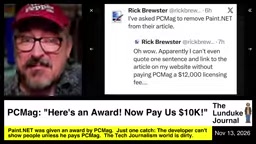
According to a joint analysis by Bilibili UP host and YouTube channel "The Lunduke Journal," Rick Brewster was initially excited about the award and planned to display it on his official website and share it with users. However, he later discovered that PCMag's terms stipulated that linking to the award article or quoting it directly would require a $10,000 licensing fee; covering all media formats would raise the cost to $15,000. Brewster expressed his dissatisfaction on social media and ultimately deleted his celebratory post, even asking PCMag to remove him from the award list.
The core contradiction here is that the award is granted by the media outlet, yet the recipient is required to pay in order to "use" the honor. Brewster pointed out that this essentially falls under fair use, but he was unwilling to bear the legal costs.
Fair Use is an important principle in U.S. copyright law that allows limited use of copyrighted works without the permission of the copyright holder, for purposes such as commentary, news reporting, teaching, and academic research. Whether a use constitutes fair use is typically judged on four factors: the purpose and character of the use (commercial or nonprofit), the nature of the work, the amount and substantiality of the portion used, and the effect on the potential market value of the work. Brewster believes that displaying the fact of the award on his official website and linking to the award article constitutes a legitimate citation of factual information and should not be subject to a licensing fee. However, fair use is an affirmative defense that requires case-by-case court judgment rather than an automatic exemption, which is why he was unwilling to incur legal costs.
Pay-to-Play Awards: An Open Secret in Tech Media
In its video, The Lunduke Journal stated bluntly that "90%" of tech media awards are paid, mainly in two forms: companies paying in advance to purchase awards, and media outlets informing recipients after the fact that they must pay to publicize the award. According to its observations, this model is extremely common in tech media and is an important source of revenue for many outlets.
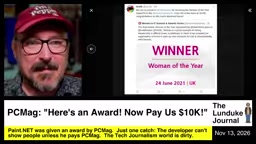
Another cited case comes from SUSE. It is said that after hiring a new CEO, SUSE paid an awards organization to grant her a "Woman of the Year" award, while simultaneously sponsoring other awards to avoid the appearance of directly buying that particular award. The UP host stated that at least 90% of the awards on many tech CEOs' resumes were purchased.
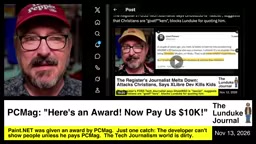
"Pay-to-Play Awards" refers to the phenomenon in which companies obtain award nominations or wins by paying fees, sponsoring events, or through other commercial partnerships. This model exists widely across industries, especially in tech, business, and PR. Common practices include: companies directly purchasing award slots, exchanging sponsorship for awards, or being required to pay for a "winner's licensing package" before publicizing an award. The controversy surrounding pay-to-play awards lies in the way they blur the line between objective evaluation and commercial promotion. For media outlets, award selection and licensing can become a revenue stream independent of advertising; for companies, awards are used as marketing endorsements. But when winners must pay to "use" an award, the credibility and symbolic value of the award are greatly diminished.
Traffic Woes and a Distorted Business Model
Pay-to-play awards are only the surface; the deeper problem is that the traffic base of tech media is collapsing. Using PCMag as an example, The Lunduke Journal noted that although its X account has nearly 400,000 followers, most posts receive only single-digit or double-digit engagement, with views mostly in the hundreds. In contrast, a personal account with far fewer followers than PCMag can get hundreds of likes for posting simple content.
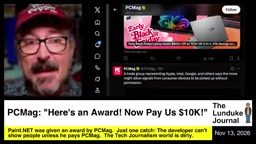
The analysis suggests that "over 99%" of PCMag's followers may be fake accounts, with very few real readers. When advertising revenue can no longer sustain operations, media outlets turn to charging companies: paid reviews, paid interviews, paid awards. The video also mentions that a tech video outlet called "the cube" conducts numerous interviews at conference venues, but most are pre-paid by companies with pre-set questions, the videos get very few views, and the main audience is the paying companies themselves.
Fake followers and engagement data fraud are common problems in the social media ecosystem. Fake accounts are typically registered in bulk by automated programs to artificially inflate follower counts and create an illusion of account influence. The ratio of engagement (likes, reposts, comments) to follower count on a platform is often used as a reference indicator of an account's true influence. When an account has hundreds of thousands of followers but individual posts consistently receive only single-digit or double-digit engagement, it often means a large number of "zombie followers" or inactive accounts. This data distortion directly affects the commercial valuation and advertising pricing of media accounts, and also puts tech media that rely on social media traffic monetization under more severe revenue pressure, further breeding dependence on paid content.
Industry Impact and Reflection
The discussion sparked by this incident goes far beyond paint.net itself. When awards can be bought, coverage can be paid for, and interviews can be arranged, the credibility of tech media as an information-filtering and evaluation mechanism is fundamentally called into question. For developers, awards were originally third-party endorsements of product quality; now they may become a "honor tax" that must be paid to unlock.
At the end of its video, The Lunduke Journal emphasized that it does not accept payment from any tech company in order to maintain its independence. But it is indeed true that pay-to-play awards and paid coverage have formed a gray industry chain in tech media, involving collusion among media outlets, PR firms, awards organizations, and corporate marketing departments.
For readers and developers, it has become more important to discern the true value of awards and media coverage. When an award costs money to cite, when an article costs money to appear, the so-called "Readers' Choice" and "Editors' Recommendation" lose their original meaning.
One-line Summary
paint.net developer was asked to pay a $10,000 licensing fee after winning an award, exposing the tip of the iceberg of the gray industry chain behind tech media pay-to-play awards.
Paragraph Summary
Rick Brewster, developer of the well-known painting software paint.net, received a "Readers' Choice Award" from PCMag and discovered that linking to or citing the award would require a $10,000 licensing fee, sparking heated discussion in the tech community. The Lunduke Journal's analysis points out that 90% of tech media awards involve payment, in the form of companies buying awards in advance and paying for publicity after winning. The deeper problem is the drying up of tech media traffic: outlets like PCMag show low engagement on X, with follower counts suspected to be largely fake. When advertising revenue can no longer sustain operations, media outlets turn to gray income models such as paid reviews, paid interviews, and paid awards, seriously undermining their credibility as information-filtering and evaluation mechanisms.
Related articles

Who Will Become the Next 'Face' of the AI Industry? A Vergecast Deep Dive
The Vergecast podcast discusses who will become the next face of the AI industry, ruling out Dario, Altman, Zuckerberg, Musk, Pichai, and Nadella, and arguing Jensen Huang remains the representative for now, though the industry urgently needs a new face from a model or product company.

Nvidia's Circular Financing: The Bubble Concerns Behind Chip-Collateralized Loans
The Vergecast podcast examines Nvidia's circular financing: customers borrow to buy chips, chips serve as collateral, but next-gen chips rapidly devalue that collateral—planting financial risk. Jensen Huang's forceful style masks bubble concerns.

Duncan's Viral Earworm: How an Impromptu Poetry Performance Became a Team Comedy Explosion
An impromptu poetry performance accidentally reveals Duncan's obsession with a Christmas song, as the team's viral "suck and blow" tune sparks laughter. We break down the humor codes and inside jokes in the video, showing how creators use low-cost interaction to build community resonance.