Perplexity's 10,000 Internal AI Teammates: A New Organizational Form at 20x Employee Count

Perplexity runs ~10,000 AI agent "teammates" — 20x its headcount — hinting workforce planning will be rewritten.
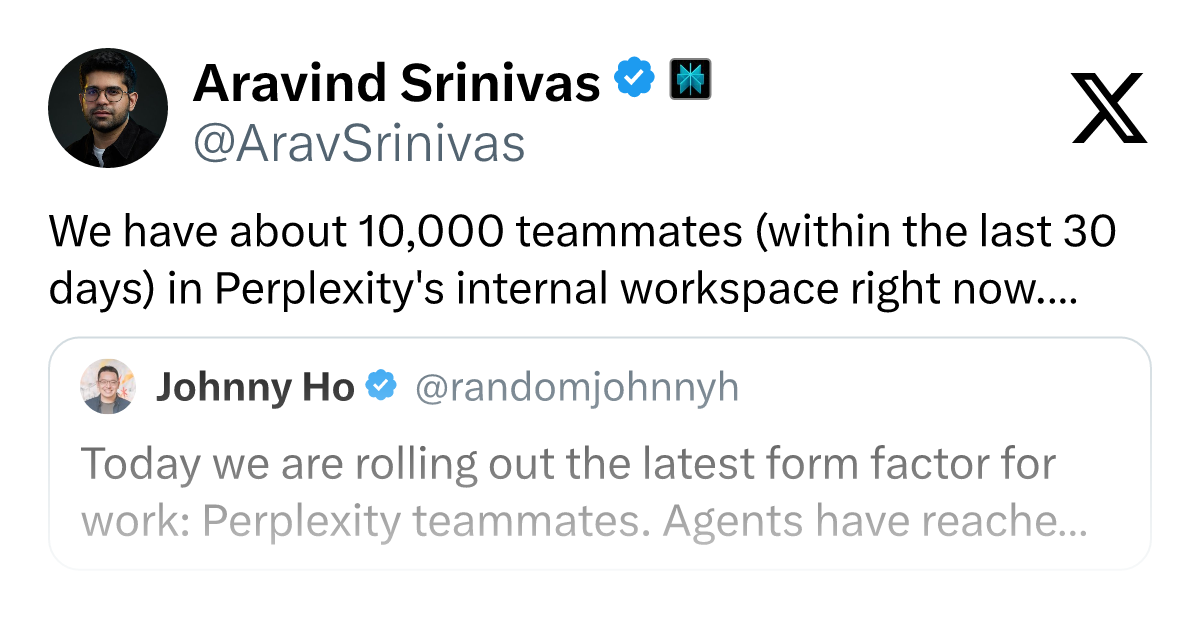
Perplexity disclosed that roughly 10,000 AI agent "teammates" were active in its internal workspace over 30 days — 20 times its actual headcount — with about 1,000 active yesterday. This signals AI agents shifting from efficiency tools to organizational members, raising new management questions around task allocation, output coordination, and human review. Perplexity says headcount planning will look very different, possibly shifting from "how many people to hire" to "how many agents and at what human-machine ratio." But the data is from one company's experiment, with an activity rate of about one in ten and no public quantitative conclusions yet — direction clear, paradigm not mature.
A set of figures disclosed by Perplexity forces a rethink of AI's place in organizations: its internal workspace has hosted roughly 10,000 active "teammates" over the past 30 days — 20 times the company's actual headcount — with about 1,000 still active yesterday. This is no longer the "give every employee an assistant" narrative; AI agents are entering the organizational chart as "colleagues."
What 10,000 "Teammates" Means
According to information Perplexity shared publicly on social media, these teammates are not human employees but AI agents deployed in the internal workspace. The figure of 10,000 is 20 times total headcount, showing that the scale of AI agents has far outstripped the human team. More important is activity: roughly 1,000 agents had actual activity yesterday, meaning a substantial portion are in continuous working states rather than sitting idle after one-off calls.
These figures point to a trend: the definition of an organizational "member" is expanding. Human employees handle goal-setting, judgment, and collaboration, while AI agents take on execution, retrieval, drafting, monitoring, and other tasks — both operating in parallel within the same workspace.
AI Agent differs fundamentally from an ordinary AI assistant: an assistant is a tool that passively responds to instructions, whereas an agent can decompose goals, perform multi-step reasoning, call tools, and execute autonomously — planning and completing a series of operations on its own once given a goal. Agents are typically driven by large language models combined with external tools such as retrieval, code execution, and API calls, forming a "perceive—plan—act" loop. In organizational settings, agents can be assigned fixed responsibilities (e.g., monitoring certain information, generating periodic reports) while retaining traceable execution records — precisely the technical prerequisite for being incorporated into a workspace as a "teammate." Metrics such as agent activity, task completion rate, and frequency of human intervention also form the baseline data for managing agents.
The Cognitive Shift from "Tool" to "Colleague"
In the past, when enterprises adopted AI, most treated it as an efficiency tool: a button, a dialog box, a backend service. The word "teammate" itself is worth noting — it implies that AI agents have identity, responsibilities, and traceable work records, and can be assigned tasks, have their output evaluated, and be incorporated into collaborative workflows.
When the number of agents reaches 20 times the human workforce, management questions follow: Who is responsible for assigning tasks to agents? How is output coordinated among agents? How do humans review agent behavior? Traditional IT management frameworks offer no ready answers; new organizational design is required.
The concept of "members" in organizational structure has traditionally been based on human positions, encompassing roles, responsibilities, reporting relationships, and performance evaluation. When AI agents enter the same workspace as "teammates," they are in effect reusing this membership framework: agents have identity labels, task queues, output records, and can even be "evaluated." This raises a new management question — how is an agent's "performance" defined? Is it the number of tasks completed, accuracy, or human hours saved? There is currently no industry-wide standard. Moreover, collaboration among agents (one agent's output becoming another's input) forms agent networks whose coordination complexity may exceed that of managing human teams, requiring mechanisms such as workflow orchestration, permission isolation, and audit logs.
Workforce Planning Logic Will Be Rewritten
Perplexity explicitly stated in its original post that in the coming years "the way we grow and plan headcount will look very different." The implication: when organizations can deploy large numbers of AI agents on demand, hiring cadence, team size, and budget allocation no longer revolve solely around human positions.
One likely shift is that team planning moves from "how many people to hire" to "how many agents to deploy, with what capabilities, and at what human-to-agent ratio." The core metric of workforce planning may shift from headcount to the combined efficiency of "human judgment" and "agent execution."
Workforce Planning traditionally refers to forecasting the number of people, skill structure, and cost budget required to meet business goals, with headcount and labor cost as core metrics. When AI agents can be deployed on demand, the planning object expands from "positions" to "capability units": humans provide judgment, creativity, and relationship maintenance, while agents provide standardizable execution capabilities such as retrieval, drafting, and monitoring. A natural extension is the concept of "human-machine ratio" — the numerical proportion and collaboration mode between humans and agents in each business process. This requires planners to simultaneously assess agents' marginal cost (compute, invocation fees) and marginal output, and to design quality gates where humans review agent output. Workforce planning tools and budget line items may also need separate entries for agents.
Early Signal, Not a Mature Paradigm
What warrants a sober view: this is still internal experimental data from a single company. Of the 10,000 agents, about 1,000 were active yesterday — an activity rate of roughly one in ten — suggesting many agents may be in low-frequency or standby states. There are no publicly available quantitative conclusions on the actual quality of agent output or their real impact on human collaboration efficiency.
But the direction is clear: AI agents are moving from peripheral tools to the organizational core, becoming a class of "members" that can be counted, managed, and planned for. For enterprises and teams, thinking early about the division of labor between humans and agents is more valuable than waiting for a mature paradigm.
One-line Summary
About 10,000 AI agents operate as "teammates" inside Perplexity — 20x headcount — signaling that workforce planning logic will be rewritten.
Paragraph Summary
Perplexity disclosed that roughly 10,000 AI agent "teammates" were active in its internal workspace over the past 30 days — 20 times its actual headcount — with about 1,000 still active yesterday. This marks AI agents' shift from efficiency tools to organizational members with identity and responsibilities, at a scale far beyond the human team. The article notes that the term "teammate" implies agents can be assigned tasks, have output evaluated, and join collaborative workflows, bringing new management challenges in task allocation, output coordination, and human review. Perplexity explicitly states that how it grows and plans headcount will look very different, with team planning potentially shifting from "how many people to hire" to "how many agents and at what human-machine ratio." Still, the data comes from a single company's experiment, the activity rate is about one in ten, and there are no public quantitative conclusions on output quality or collaboration impact — the direction is clear, but the paradigm is not yet mature.
Related articles
 Tech Frontiers
MuJoCo: An Analysis of DeepMind's Open-Source General-Purpose Physics Simulator
An in-depth analysis of Google DeepMind's open-source physics simulator MuJoCo: high-performance C++ kernel, MJCF modeling format, contact solving principles, MJX GPU acceleration, and robot reinforcement learning use cases.
 Tech Frontiers
Claude API Quick Start: The Official Quickstarts Project Collection
Anthropic's official claude-quickstarts project collection helps developers quickly build deployable apps with the Claude API. Nearly 20k stars, Python-based, great for beginners and prototyping.
 Tech Frontiers
AI Agents Connecting Directly to APIs: Which Calls Can Be Safely Allowed?
AI agents can call any API, but the real challenge is deciding which calls can be safely allowed. This article analyzes allowance decisions from three dimensions—intent matching, least privilege, and controllable impact—and argues that the control layer should sit outside the agent, combined with audit traceability to build a trustworthy API call governance mechanism.