Phishing Email Slips Past Gmail Filters—How Can an AI Assistant Intercept?
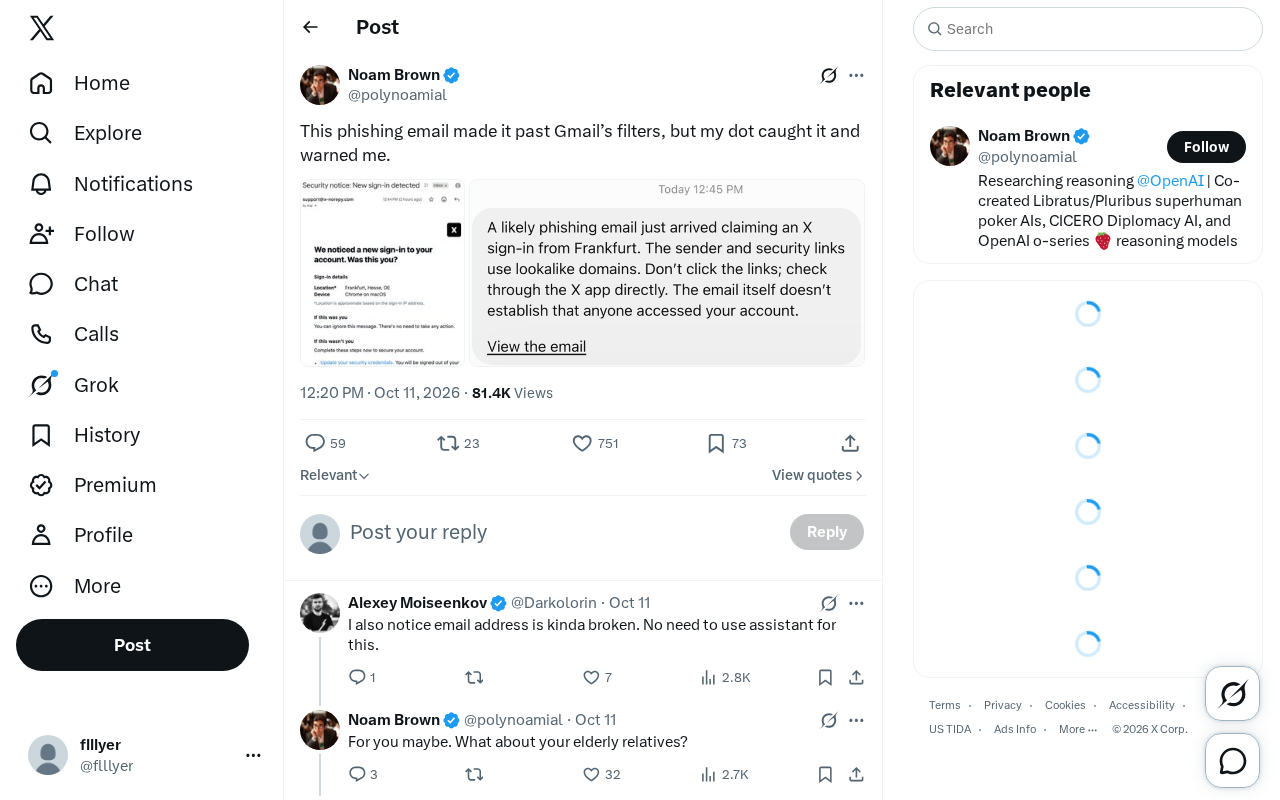
A phishing email bypassed Gmail's filters but was identified by the personal AI assistant dot, revealing a new security approach where universal filtering and personalized AI sentinels complement each other.
Starting from a Twitter user's account: a carefully disguised phishing email successfully bypassed Gmail's spam filter, but was identified and warned about by the user's personal intelligent assistant "dot." The author analyzes that Gmail relies on universal rules and massive data training, leaving blind spots for new domains, highly disguised templates, or social engineering tactics. Personal AI assistants like dot can make anomaly judgments based on users' personal email patterns, contact networks, and behavioral habits, precisely filling the gap of universal filters. However, the article also calmly points out that this case comes from a single user experience, lacking details such as email samples and dot's judgment logic, and its actual effectiveness is constrained by model capability and false positive rate. The final conclusion is: no single security layer is foolproof, and the future of email security may move toward a two-tier architecture of "universal filtering + personalized AI sentinel," while users' own vigilance remains the last line of defense.
Gmail's spam filter has always been an industry benchmark, but a recent user experience reminds us that even the strongest defenses can have blind spots. According to a Twitter user's account, a carefully disguised phishing email successfully bypassed Gmail's filtering mechanism, but was ultimately identified and warned about by their personal AI assistant "dot." This seemingly simple story opens up a discussion about the complementary relationship between AI security assistants and email filtering systems.
Why Can Phishing Emails Fool Gmail?
Gmail's filtering system relies on massive data training and rule matching, achieving an extremely high interception rate for known phishing patterns. But attackers are also constantly evolving: they may use entirely new domains, mimic email templates of legitimate services, or employ social engineering tactics to lower recipients' vigilance. When an email is "clean" enough in terms of content features and its sending infrastructure has no obvious red flags, the filter may let it through.
The user did not disclose the specific details of the email, but the phrase "made it past Gmail's filters" indicates that the email passed mainstream filter detection at least on surface features. This is not the first time Gmail has been bypassed, nor will it be the last—security offense and defense is inherently a dynamic game.
Social Engineering is a key concept for understanding why phishing emails can bypass technical filters. It refers to attackers exploiting human weaknesses—such as trust, curiosity, urgency, or obedience to authority—rather than technical vulnerabilities to manipulate targets. Common phishing tactics include disguising as account anomaly notifications, invoice attachments, shared document invitations, etc., inducing recipients to click links or provide credentials. The "payload" of such attacks is often not in malicious code in the email body, but in the recipient's psychological reaction, so filters that rely solely on content feature matching cannot fully intercept them. Prevention of social engineering attacks relies more on user security awareness training and contextual anomaly detection, which is exactly the scenario where a personal AI assistant may play a role.
What Is "dot"? The Early Warning Value of a Personal AI Assistant
The "dot" mentioned in the original text is what the user calls a personal intelligent assistant (from the context, it may be an AI application called Dot). Unlike Gmail's global filtering, dot's role is more like a personal security sentinel: it may make judgments based on the user's personal email communication patterns, contact networks, and behavioral habits, with higher sensitivity to "anomalies."
This difference is worth noting. Enterprise-level filters pursue universal rules, while personal assistants can learn "what your normal looks like." When an email deviates from the user's daily patterns in language style, sender relationship, or request type, even if it does not trigger any known threat features, the personal assistant may still flag it as suspicious. This personalized defense precisely fills the gap of universal filters.
False Positive Rate and Recall are two core metrics for evaluating any security detection system—including email filters and personal AI assistants. False positive rate refers to the proportion of legitimate emails incorrectly flagged as threats, while recall refers to the proportion of true threats successfully detected. There is usually a trade-off between the two: increasing sensitivity can capture more threats but also increases false positives, leading users to develop "alert fatigue" and ignore genuine dangers. For personal AI security assistants, due to the lack of large-scale labeled data and manual review processes that enterprise-level filters have, it is harder to achieve an ideal balance in this trade-off. The article mentions that dot's actual effectiveness is "constrained by model capability and false positive rate," which refers precisely to this technical reality.
The Boundaries and Limitations of AI Security Assistants
What needs to be viewed calmly is that this account comes from a single user's experience description, without providing email samples, dot's specific judgment logic, or false positive rate data. The actual effectiveness of personal AI assistants in security early warning still depends on their model capabilities and training data. If judgments are too sensitive, they may generate a large number of false positives; if judgments are too lenient, they may miss genuine threats.
Another practical issue is that most users do not simultaneously use Gmail and an independent AI security assistant. For ordinary users, enabling Gmail's built-in safe browsing features, enabling two-step verification, and remaining vigilant about emails requesting sensitive information are still the lowest-cost protective measures. Dot's early warning story is more of a directional hint: the future of email security may move toward a two-tier architecture of "universal filtering + personalized AI sentinel."
Implications for Ordinary Users
The core value of this case is not that "Gmail is failing," but rather a reminder that no single security layer is foolproof. When an email bypasses the filter and enters the inbox, the recipient's own judgment remains the last line of defense. AI assistants can serve as a reminder, but the final action of clicking a link or entering a password is still performed by a human.
For readers interested in AI security applications, it is worth paying attention to the progress of personal intelligent assistants in anti-phishing scenarios. Whether such tools can maintain high recall while reducing false positives will be the key metric for judging their practicality.
(This article is based on a single case shared by a Twitter user. The original email content and dot's official technical documentation were not obtained. The relevant analysis is for reference only.)
One-line Summary
A phishing email bypassed Gmail's filters but was identified by the personal AI assistant dot, revealing a new security approach where universal filtering and personalized AI sentinels complement each other.
Paragraph Summary
Starting from a Twitter user's account: a carefully disguised phishing email successfully bypassed Gmail's spam filter, but was identified and warned about by the user's personal intelligent assistant "dot." The author analyzes that Gmail relies on universal rules and massive data training, leaving blind spots for new domains, highly disguised templates, or social engineering tactics. Personal AI assistants like dot can make anomaly judgments based on users' personal email patterns, contact networks, and behavioral habits, precisely filling the gap of universal filters. However, the article also calmly points out that this case comes from a single user experience, lacking details such as email samples and dot's judgment logic, and its actual effectiveness is constrained by model capability and false positive rate. The final conclusion is: no single security layer is foolproof, and the future of email security may move toward a two-tier architecture of "universal filtering + personalized AI sentinel," while users' own vigilance remains the last line of defense.
Related articles
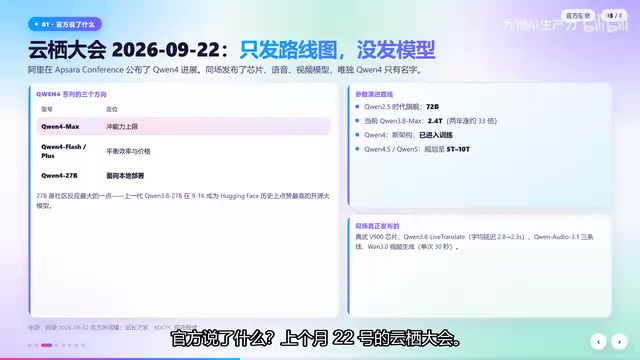
Qwen4 Architecture Preview Open-Sourced: 125B Parameters, 512 Experts, Designed for VRAM-Constrained Hardware
Qwen4 isn't released yet, but its architecture is previewed via open-source Qwen3.8 Flash Next: 125B params, 6B activated per token, 512 experts, 262K context, built for VRAM-limited hardware. This article covers official confirmations, key config.json metrics, and local deployment tests on 24G memory.
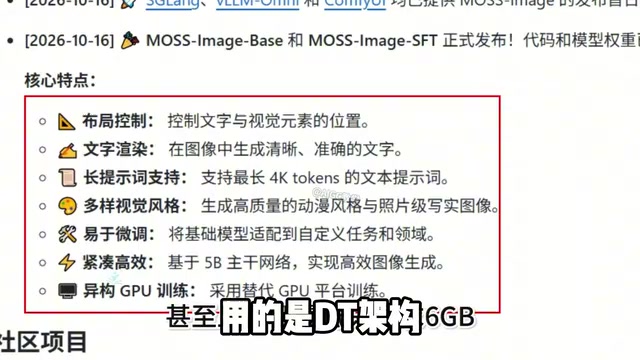
Run 8K Images on 6GB VRAM! Hands-On Test of Fudan's Open-Source MOSS-Image Model
Fudan OpenMouse team and Shanghai MOSS Intelligence open-source MOSS-Image, a 500M-parameter DT architecture text-to-image model that runs locally on 6GB VRAM with precise text rendering, structured layout control, and 4K Token prompt support—ideal for e-commerce posters and local deployment by individual creators.
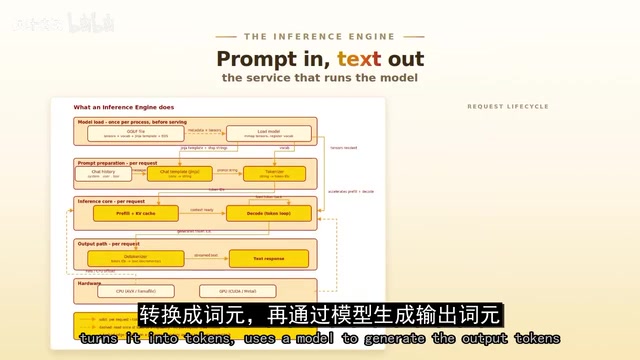
Overseas Blogger Tests Local Deployment of 100B-Parameter MoE Model: Key Lessons on Quantization and Tool Calling
Overseas blogger tests local deployment of Alibaba's Qwen 3.8 Flash Next 100B MoE model on a Strix Halo mini PC and CUDA workstation, revealing how quantization precision affects tool-calling success and the real-world performance of the Strata and GUFO inference engines.