Physics-Informed Surrogate Model: Accurate Prediction of p-n Junction Diode Characteristics

A physics-informed, uncertainty-aware surrogate model efficiently and accurately predicts p-n junction diode internal states.
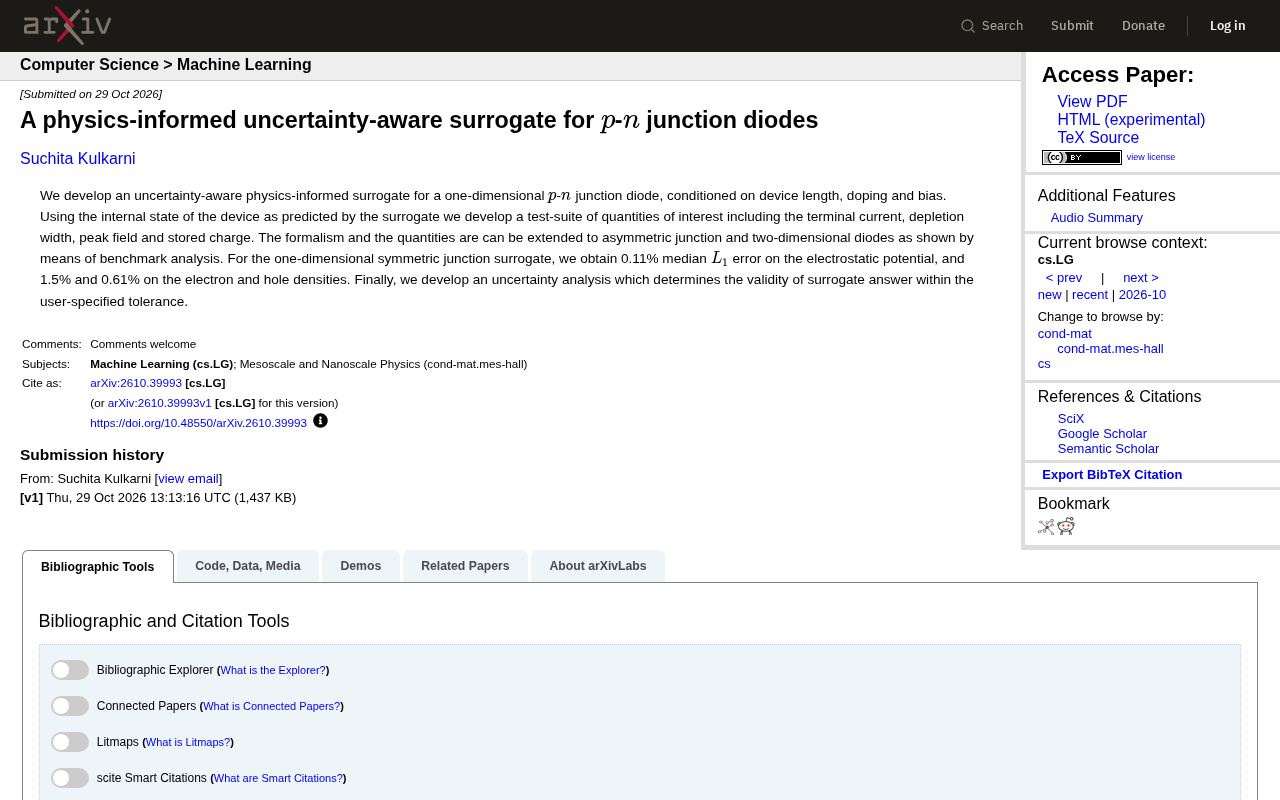
This study proposes a physics-informed and uncertainty-aware surrogate model for efficiently predicting the internal states of 1D p-n junction diodes under varying device lengths, doping, and bias. The model embeds physical laws as loss functions in neural network training, reducing dependence on simulation data, and uses uncertainty quantification to assess prediction confidence. On symmetric junction benchmarks, the median L1 error for electrostatic potential is only 0.11%, with electron and hole density errors of 1.5% and 0.61%. The study also builds a test suite covering terminal current, depletion width, peak electric field, and stored charge, and extends the method to asymmetric junctions and 2D structures. It shows that integrating physical constraints with data-driven methods significantly reduces computational cost while ensuring accuracy.
Introduction
In semiconductor device design, accurately predicting the behavior of p-n junction diodes is critical, but conventional numerical simulation (such as solving the drift-diffusion equations) is computationally expensive. A recent study proposed a physics-informed and uncertainty-aware surrogate model that can efficiently predict the internal states of one-dimensional p-n junction diodes under varying device lengths, doping, and bias conditions, while providing reliable error bounds. The study demonstrates the model's scalability through benchmark analysis and achieves extremely low error on symmetric junctions.
The drift-diffusion equations are a classical transport model in semiconductor device physics, formed by coupling the continuity equations for electrons and holes with the Poisson equation. They describe the drift motion of carriers under an electric field, the diffusion motion driven by concentration gradients, and the feedback of space charge on the electric field. Solving this system typically requires spatial discretization via finite element or finite difference methods, combined with Newton iteration to handle strong nonlinearity, so a single simulation often takes minutes to hours. For design optimization tasks that require repeated scans over device length, doping, and bias parameters, this computational cost becomes a major bottleneck—precisely the problem that surrogate models attempt to alleviate.
Model Architecture and Physics-Informed Integration
The core of this surrogate model lies in embedding physical laws into neural network training as loss functions, thereby maintaining physical consistency in predictions even when data are scarce. The model takes device length, doping concentration, and bias voltage as input conditions and outputs internal states such as electrostatic potential and carrier densities. This variant of a physics-informed neural network (PINN) not only reduces dependence on large amounts of simulation data but also assesses the confidence of predictions through an uncertainty quantification (UQ) mechanism, ensuring that the validity of the surrogate model's output can be judged within a user-specified tolerance.
Uncertainty quantification (UQ) aims to have the model provide not only a predicted value but also the degree of confidence in that prediction. Common approaches include Bayesian neural networks, deep ensembles, and Gaussian process-based posterior estimation. In the surrogate modeling context, the value of UQ lies in the fact that when input conditions fall into regions poorly covered by the training data, the model can proactively indicate that the prediction is unreliable rather than giving a seemingly precise but incorrect value. This directly corresponds to the engineering need to "judge output validity within a user-specified tolerance" and is also a key feature distinguishing this study from ordinary deterministic surrogate models.
Evaluation Metrics and Performance
Based on the internal states predicted by the surrogate model, the research team constructed a test suite covering terminal current, depletion region width, peak electric field, and stored charge. In benchmark tests on symmetric one-dimensional junctions, the model achieved a median L1 error of only 0.11% for electrostatic potential, with errors of 1.5% and 0.61% for electron and hole densities, respectively. These data indicate that the surrogate model achieves accuracy comparable to numerical solvers while maintaining physical plausibility. In addition, uncertainty analysis can dynamically determine the reliable range of predictions, providing a confidence reference for engineering applications.
L1 error refers to the average over the spatial grid of the absolute difference between predicted and reference values, expressed as a percentage relative to some normalization scale (such as the mean or peak of the reference values). Compared with mean squared error, L1 error penalizes local large deviations more mildly and better reflects the average degree of deviation of the overall field distribution. The median L1 error is the median of errors across multiple test samples, which avoids individual difficult samples inflating the average. Therefore, "median L1 error of 0.11% for electrostatic potential" means that on more than half of the test devices, the average relative deviation of the potential distribution is less than one part in a thousand—a magnitude already close to the level of the numerical solver's own discretization error.
Scalability and Benchmark Analysis
The authors further generalize the formalism to asymmetric junctions and two-dimensional diode structures, and verify the model's effectiveness through benchmark analysis. Although the complexity of two-dimensional scenarios increases significantly, the surrogate model can still capture key physical features, and the uncertainty framework can adapt accordingly. This scalability suggests that the method has the potential to be applied to a broader range of semiconductor device modeling, such as power diodes and heterojunction devices.
Conclusion and Outlook
This work demonstrates the potential of physics-informed surrogate models in semiconductor device simulation: by integrating physical constraints with data-driven methods, they significantly reduce computational cost while ensuring accuracy. Future research directions may include higher-dimensional device simulation, multiphysics coupling, and more efficient training strategies. For chip designers and EDA tool developers, such uncertainty-aware surrogate models are expected to accelerate device optimization workflows.
One-line Summary
A physics-informed and uncertainty-aware surrogate model efficiently and accurately predicts the internal states of p-n junction diodes.
Paragraph Summary
This study proposes a physics-informed and uncertainty-aware surrogate model for efficiently predicting the internal states of one-dimensional p-n junction diodes under varying device lengths, doping, and bias conditions. The model embeds physical laws into neural network training as loss functions, reducing dependence on large amounts of simulation data, and assesses prediction confidence through uncertainty quantification. In benchmark tests on symmetric junctions, the median L1 error for electrostatic potential is only 0.11%, with errors of 1.5% and 0.61% for electron and hole densities, respectively. The study also constructs a test suite covering terminal current, depletion region width, peak electric field, and stored charge, and extends the method to asymmetric junctions and two-dimensional structures. This work shows that integrating physical constraints with data-driven methods can significantly reduce computational cost while ensuring accuracy.
Related articles

Salesforce Acquires Rune for $375M: AI Logistics Tech Bolsters Defense Business
Salesforce reportedly acquires defense tech startup Rune for $375M. Rune's AI logistics tech will strengthen Salesforce's Missionforce defense platform, continuing its M&A spree.

Why Fair Use Benefits Everyone in the AI Era
Starting from a Hacker News discussion, this article analyzes the legal logic and controversies of the fair use principle in AI training and content creation, and its dual impact on creators and the tech ecosystem.

Mistral Large 4 Open-Sources a Trillion Parameters, Microsoft Offers Voluntary Severance to 60,000 Employees
Mistral Large 4 open-sources a trillion-parameter multimodal model with a coding agent score of 48; SanDisk earnings show AI inference reshaping NAND demand; Google Gemini adds in-app file editing, OpenAI raises Codex quotas, and Microsoft offers voluntary severance to 60,000 employees.