Pirating the Pirates: The Gray Zone of Content Circulation in the Digital Age

A MUBI article on piracy as cultural preservation ignites debate over copyright and digital archiving in the tech community.
MUBI Notebook's *Pirating the Pirates* earned 177 upvotes and 58 comments on Hacker News, sparking broad discussion about copyright and cultural preservation. The title highlights a real paradox: when out-of-print films, orphan works, or copyright-disputed content can only be found through pirated channels, 'pirating the pirates' shifts from commercial infringement to cultural rescue. The digital age presents a contradiction — content is easy to copy yet increasingly fragile, with streaming platforms able to pull titles at will and complex ownership leaving countless works unclaimed. This structural tension makes the question of whether unofficial preservation constitutes a public service an open ethical issue with no simple answer.
An Industry Observation That Sparked Debate
A recent article published by MUBI Notebook titled Pirating the Pirates gained significant traction on Hacker News, accumulating 177 upvotes and 58 comments. The title itself carries a thought-provoking paradox — pirating the pirates. The topic touches on the long-standing tension between digital content distribution, copyright protection, and cultural preservation.
Unfortunately, based on the available source material, only the article's link and engagement metrics are accessible — the full text was not included. This piece will therefore analyze the core issues the topic points toward, and explore the industry phenomena worth noting given the level of community discussion it generated.
The Core Issue Behind the Title
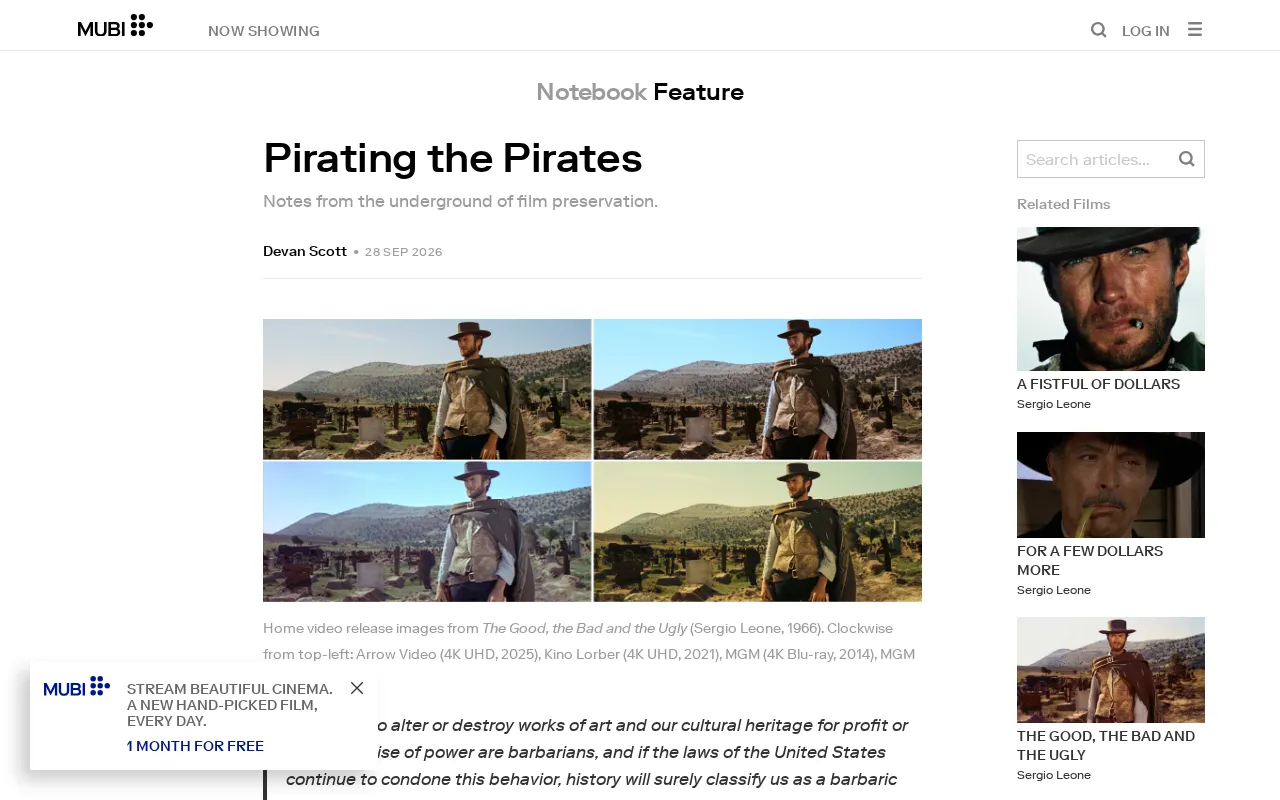
"Pirating the pirates" refers to a recurring phenomenon across film, music, software, and other content industries: when rare content — such as out-of-print films, underground releases, or materials trapped in copyright disputes — exists only through pirated channels, those pirated copies paradoxically become the sole vehicles for cultural preservation.
In this context, "pirating the pirates" is no longer simply commercial infringement — it evolves into something resembling cultural rescue. Many cinephiles, archivists, and researchers rely on these unofficial channels to access works that have long vanished from legitimate markets. This is precisely why a platform like MUBI, which focuses on arthouse cinema and film culture, would take a keen interest in this issue.
Why This Topic Resonates With the Community
The discussion activity on Hacker News — 58 comments and 177 upvotes — suggests this topic struck a nerve in the tech community. Technologists have historically paid close attention to copyright systems, the free flow of information, and digital preservation.
These discussions typically revolve around several threads: the long-term accessibility of content, whether copyright protection terms are reasonable, and whether unofficial preservation should be considered a public service when official channels have completely abandoned certain works. These questions have no simple answers, which is precisely why they continue to generate sustained and substantive debate.
MUBI (formerly known as The Auteurs) is a UK-based curated streaming platform known for its distinctive model of releasing one film per day, with each title available for only 30 days. It focuses on arthouse cinema, director retrospectives, and film culture. Unlike large platforms like Netflix that prioritize breadth of content, MUBI's user base is deeply engaged with film culture — exactly the kind of audience most likely to find their target films unavailable through mainstream channels and turn to unofficial sources instead. MUBI Notebook is the platform's film criticism and industry commentary publication, consistently publishing critically rigorous pieces. Its readership and the Hacker News tech community share a strong overlap in their value of free information flow, which explains why this article was able to resonate across communities.
The Long-Standing Conflict Between Digital Preservation and Copyright
The digital age has introduced a paradox: content has never been easier to copy and distribute, yet it has also never been more fragile. Streaming platforms can pull titles at any time, physical media degrades, and the complexity of copyright ownership frequently leaves vast quantities of work in a state of "unclaimed" limbo.
In this environment, unofficial content preservation efforts end up shouldering responsibilities that should belong to institutions. This explains why discussions about "piracy" are increasingly difficult to judge in simple terms of right and wrong. There is a deep, structural tension between the urgency of cultural preservation and the legitimacy of commercial copyright — one that resists easy resolution.
Legal scholars refer to works that cannot be legally distributed due to unclear copyright ownership, unreachable heirs, or broken licensing chains as "orphan works." It is estimated that a substantial portion of 20th-century films, sound recordings, and publications fall into this category — neither in the public domain nor obtainable through legitimate licensing. Under U.S. copyright law, standard protection lasts 70 years after the author's death; the EU framework is similar. This means a large volume of mid-20th-century works remains legally "locked" with no commercial entity motivated to organize and re-release them. Nonprofits like the Internet Archive and film preservation institutions have long operated in legal gray zones to carry out digital preservation work, and have faced repeated copyright litigation as a result. This systemic failure is precisely the underlying reason why the phenomenon of "pirating the pirates" tends to generate broad moral sympathy.
Conclusion
The discussion sparked by Pirating the Pirates is, at its core, a microcosm of content ethics in the digital age. It reminds us that the balance between copyright systems, cultural preservation, and technological capability remains a wide-open problem — far from resolved. For readers interested in the content industry and technology ethics, this is a topic well worth continued attention.
(Note: This article was written based on limited source material. For the full arguments of the original piece, readers are encouraged to visit the MUBI Notebook article directly.)
Related articles

Vibe Coding Full-Stack in Practice: AI Programming from Beginner to Enterprise Deployment
From Cursor to Claude Code, this Bilibili AI programming course uses four progressive projects to cover full-stack development, open-source secondary development, and team collaboration. The article analyzes the shock to frontend roles, the efficiency shift from 50 people to 5, and the methodology required for enterprise-grade projects.

David Blaine's Global Quest for Real Magic: From South Africa to Japan and India
David Blaine travels to South Africa, Japan, and India in his Do Not Attempt special, documenting Spinning drivers, black mamba rescuers, iaijutsu masters, and ascetics—exploring the boundary between magic and real human极限 challenges.

Is a Touchscreen MacBook Coming? Vergecast Reveals Apple Executive's Response
Vergecast podcast reveals a conversation between a reporter and Apple executive John Ternus about a touchscreen MacBook and Apple Pencil support. Ternus says iPad is the best device for a stylus, while the reporter bets MacBook will eventually support Apple Pencil.