Pluralistic Agents: Amplifying Public Policy Participation with AI Representation

Pluralistic agents let AI represent individuals in policy deliberation—effective in experiments, but influence is swayed by prompts.
The article introduces research on "pluralistic agents": AI agents that represent specific individuals in AI policy deliberation, aiming to bring more diverse perspectives into discussions, especially for issues requiring specialized training or depending on private information. Experiments show agents can reliably push policy toward persona preferences, but influence is highly sensitive to prompt style—more verbose or uncooperative instructions amplify influence, posing a risk. In a 746-person preregistered study, participants found agents useful and fair and preferred them over a single-model baseline; yet most preferred to participate themselves, with agents recovering 68% of the satisfaction gap and 82% of the fairness gap. Researchers recommend cautious exploration, positioning agents as amplifiers of human input rather than replacements.
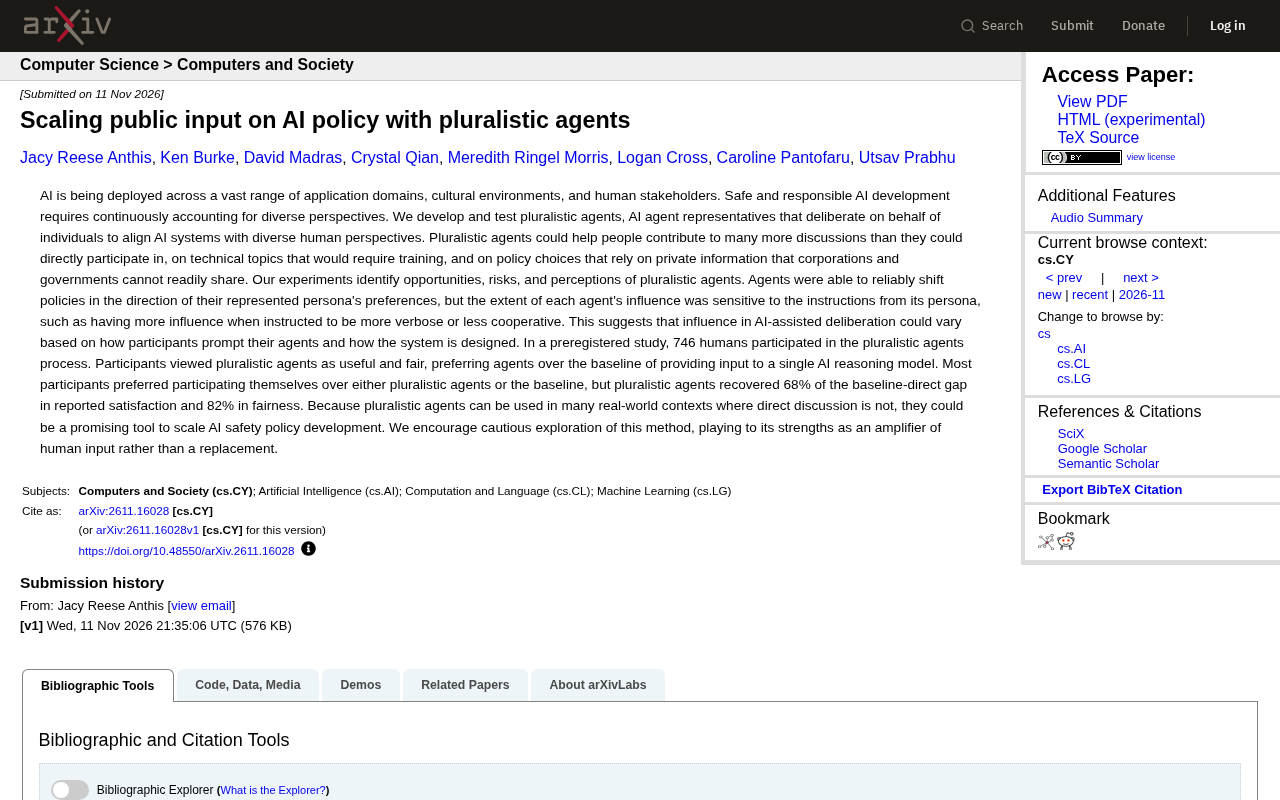
AI is being deployed across a wide range of application domains, cultural contexts, and stakeholder groups. Making AI safe and responsible requires continuously incorporating diverse perspectives. But in reality, the public struggles to directly participate in every discussion about technical details or policy trade-offs—some topics require specialized training, and some decisions depend on private information that companies and governments cannot easily disclose. A new study proposes "pluralistic agents" to bridge this gap: AI agents that represent individuals in deliberation, bringing more people's preferences into AI policy discussions.
What Pluralistic Agents Are and Why We Need Them
Pluralistic agents are a class of AI agent representatives that participate in discussions on behalf of a specific person, with the goal of aligning AI systems with diverse human perspectives. In the paper, the research team writes that such agents can help people participate in far more discussions than they could directly attend, including technical topics requiring specialized training and policy choices that depend on private information.
The reasoning behind this is straightforward: AI's impact is too broad, and having a handful of experts or a single model make decisions can hardly reflect real-world diversity. If everyone could have an agent acting on their own preferences to "represent" them, the scale of public input could potentially be amplified.
Preregistration refers to the research norm in which researchers publicly register their hypotheses, methods, sample sizes, and analysis plans before data collection and analysis. Its core purpose is to prevent "storytelling after the fact"—that is, adjusting hypotheses or filtering data after seeing results to obtain significant conclusions (p-hacking, HARKing). Preregistered studies typically leave a timestamped record on independent platforms (such as OSF, AsPredicted), allowing reviewers and readers to verify whether the research was conducted as planned. The 746-person study in this article adopted this design, meaning its conclusions have high credibility in terms of methodological transparency rather than being a cherry-picked demonstrative experiment.
Persona here refers to the role description and behavioral instructions set for an agent, including the individual preferences, positions, and expressive style (such as "more verbose" or "more uncooperative") of the person the agent represents. An agent's statements and positions during deliberation are driven by its persona, so the persona is both a vehicle for representing individual preferences and a manipulable lever of influence.
Experimental Findings: Agents Can Push Policy, but Influence Can Be Swayed by "Prompts"
The research team tested the actual performance of pluralistic agents through experiments. The core conclusion is that agents can reliably push policy toward the direction preferred by the persona they represent. But each agent's degree of influence is quite sensitive to instructions from the persona—for example, when instructed to be "more verbose" or "more uncooperative," the agent's influence increases.
This detail deserves caution. It shows that in AI-assisted deliberation, influence may depend on how participants prompt their agents and how the system is designed. In other words, the representational effect is not entirely neutral: whoever is better at writing prompts may give their agent an edge. This is a risk aspect that the method itself must confront.
Prompt Sensitivity refers to the phenomenon where model outputs vary with the wording, length, tone, and format of prompts. In large language models, this can manifest both as fluctuations in answer accuracy and as differences in output style and persuasiveness. The finding in this article that "more verbose or more uncooperative instructions amplify agent influence" is precisely a manifestation of prompt sensitivity in multi-party deliberation scenarios: the same position, packaged with different expressive strategies, may achieve different persuasive effects. This suggests that when evaluating AI agents' performance in deliberation, one cannot only measure "what is said" but also how "how it is said" affects outcomes, and system design should consider constraining or balancing prompt styles.
746-Person Preregistered Study: Useful and Fair, but People Still Want to Participate Themselves
The research team also conducted a preregistered study in which 746 human participants completed the pluralistic agent process. Participants generally found pluralistic agents useful and fair, and preferred the agent approach over the baseline of "providing input to a single AI reasoning model."
However, most participants still preferred to participate themselves rather than using pluralistic agents or the baseline approach. Even so, pluralistic agents recovered 68% of the satisfaction gap and 82% of the fairness gap relative to the baseline. These two numbers show that agents cannot fully replace firsthand participation, but they can significantly narrow the experience gap caused by being unable to attend in person.
Baseline in controlled experiments refers to the reference condition used for comparison. The baseline in this article is "providing input to a single AI reasoning model," that is, directly feeding participants' opinions to a general-purpose model without individual agents. The evaluation metric for pluralistic agents, "gap recovery," is calculated relative to this baseline: 68% recovery in satisfaction means the agent approach closed 68% of the distance from the baseline level toward the "firsthand participation" level of participant satisfaction; similarly 82% for fairness. This "gap recovery rate" framing better illustrates the extent to which agents compensate for the loss of not being able to participate in person than absolute ratings alone.
Application Prospects and the Caution Required
Pluralistic agents can be used in many real-world scenarios—precisely those where direct discussion is difficult to achieve. For this reason, the research team believes it has the potential to become a tool for scaling AI safety policymaking.
But the paper's stance is "cautious exploration" rather than comprehensive promotion. The authors explicitly recommend treating this method as an amplifier of human input, not a replacement. Combined with the experimental findings on prompt sensitivity, this reminder is especially important: if poorly designed, a mechanism that amplifies input could also amplify the voices of a few.
For those concerned with AI governance, pluralistic agents offer an actionable approach—when it is impossible to seat everyone at the table, use agents to bring more preferences into the discussion. But its fairness, manipulability, and boundaries of representativeness still need to be continuously tested in real-world scenarios.
Key Takeaways
- Pluralistic agents let AI represent individuals in policy deliberation, scaling public input into AI policy.
- Experiments show agents can reliably push policy toward persona preferences, but influence is affected by prompt style.
- In a 746-person preregistered study, participants found agents useful and fair, and preferred agents over the single-model baseline.
- Most people still prefer to participate themselves; agents recovered 68% of the satisfaction gap and 82% of the fairness gap.
- Researchers recommend cautious exploration, positioning agents as amplifiers of human input rather than replacements.
One-line Summary
Pluralistic agents let AI represent individuals in policy deliberation—experiments show they are effective, but influence is swayed by prompts.
Paragraph Summary
This article introduces research on "pluralistic agents": AI agents that represent specific individuals in AI policy deliberation, aiming to bring far more diverse perspectives into discussions than a handful of experts could cover—especially for issues requiring specialized training or depending on private information that the public cannot directly participate in. Experiments show that agents can reliably push policy toward the preferences of the persona they represent, but the degree of influence is highly sensitive to prompt style—influence is greater when instructed to be more verbose or more uncooperative, which constitutes a risk aspect of the method itself. In a 746-person preregistered study, participants generally found agents useful and fair, and preferred the agent approach over the baseline of providing input to a single AI model; however, most still preferred to participate themselves, and agents recovered 68% of the satisfaction gap and 82% of the fairness gap respectively. Researchers therefore recommend cautious exploration, positioning agents as amplifiers of human input rather than replacements.
Related articles

How Fast Can AI Become an Expert? Lessons from Napoleon and Rockefeller
From Napoleon's victories at 27 to Rockefeller running a major refinery at 25, we explore why AI can accumulate experience far faster than humans: reading a company's entire history in days, reaching top performance in months, and the real bottleneck of serial feedback.

US Air Traffic Control Keeps Breaking Down—Can Canada's Model Fix It?
A botched copper cable upgrade grounded thousands of US flights. Vox analysis: aging equipment, overworked controllers, and the FAA's annual funding battles are the root causes—Canada's 1996 nonprofit ATC model offers a way out.

Why Can't an AI with 20 PhDs Get Anything Done in the Enterprise?
OpenAI co-founder Greg Brockman uses the "20 PhDs with no data access" analogy to reveal the core bottleneck of enterprise AI: business context and permission guardrails are both essential. This article covers his conversation with the Databricks CEO and the Genie product's implementation approach.