Pre-training Knows "What," Simulation Teaches "How": ZAP Achieves 96.7% Success Rate with Zero Real-World Data
ZAP uses a pre-trained vision-language model to understand tasks and simulation to learn actions, achieving a 96.7% success rate with zero real-world data.
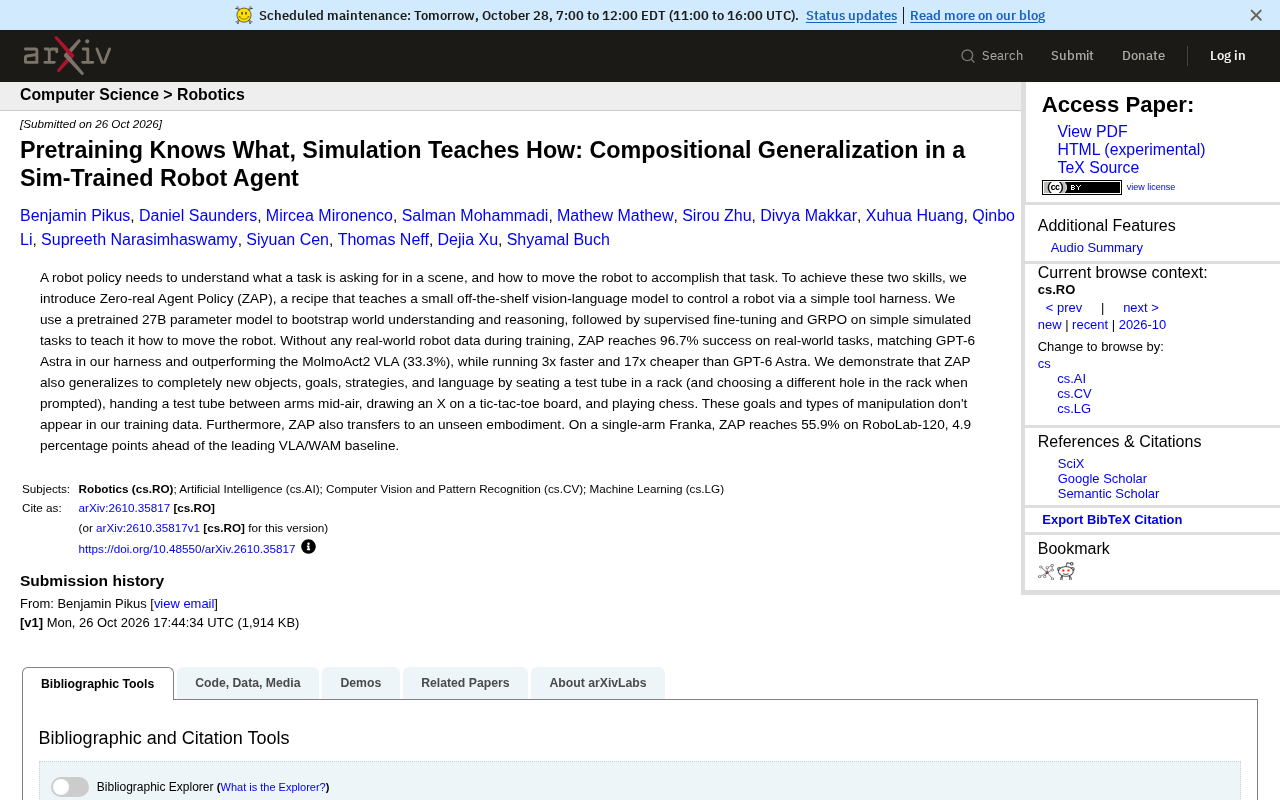
ZAP proposes a decoupled robot policy: a pre-trained vision-language model understands "what" the task is, while simulation teaches the robot "how to move," without any real robot data. It achieves a 96.7% real-task success rate, on par with GPT-6 Astra but 3x faster and 17x cheaper, far exceeding MolmoAct2 VLA's 33.3%. It also shows compositional generalization, completing unseen tasks like test tube hole changes, mid-air handovers, drawing an X, and chess, and reaches 55.9% on an unseen Franka robot. The key insight: task performance may depend less on model scale than on how training signals are organized.
Robot policies need to understand two things at once: "what" the task requires in the current scene, and how to control the robot's body to accomplish it. Traditionally, these two capabilities are often trained jointly on large amounts of real robot data. But a recent study from rss proposes a different approach—Zero-real Agent Policy (ZAP)—which uses a pre-trained vision-language model to provide world understanding and a simulation environment to teach motor skills, never touching real robot data throughout, yet achieving a 96.7% success rate on real tasks.
One Model, Two Sources: The Core Idea of ZAP
ZAP's starting point is to decompose the cognitive burden of robot control. The research team argues that "knowing what the task requires" and "knowing how to move" are two decoupled types of knowledge. The former comes from large-scale pre-trained models' understanding of the world, while the latter can be efficiently acquired in simulation.
In implementation, ZAP uses a small off-the-shelf vision-language model (27B parameters) and controls the robot through a simple tool-calling framework. The training pipeline has two steps: first, the pre-trained model is used to "bootstrap" world understanding and reasoning capabilities; then, through supervised fine-tuning and GRPO (a reinforcement learning method), the model is taught how to move the robot on simple simulation tasks. No real-world robot data participates in the entire process.
The benefit of this design is straightforward: the pre-trained model has already seen massive visual and linguistic concepts and does not need to learn from scratch what a "test tube" or "chessboard" is; the simulation environment, meanwhile, provides low-cost, massively repeatable action learning signals.
GRPO (Group Relative Policy Optimization) is a reinforcement learning algorithm that does not require a value network and was originally used for reasoning alignment in large language models. It samples a group of outputs for the same prompt and estimates policy gradients using relative advantages within the group, avoiding the need to train an additional critic model and significantly reducing memory and computation overhead. In ZAP, GRPO is used to fine-tune the vision-language model in a simulation environment so that its output action sequences receive higher task rewards. Compared with traditional PPO, GRPO is better suited to models with larger parameter scales and higher sampling costs, which also explains why ZAP can complete motor skill learning at lower cost on a 27B model.
Simulation Training, Real-World Deployment: What 96.7% Success Rate Means
ZAP achieves a 96.7% success rate on real-world tasks, a number that needs to be understood in comparison. Under the same tool framework, its performance is on par with GPT-6 Astra, but it runs 3x faster and costs 17x less. In contrast, the specialized vision-language-action model MolmoAct2 VLA achieves only 33.3%, a significant gap.
More notably, ZAP has only 27B parameters and qualifies as a "small off-the-shelf model," yet within the harness it matches a larger general-purpose model. This suggests that the key to task performance may not lie in model scale, but in how training signals are organized—pre-training provides semantic priors, simulation provides action experience, and each plays its own role.
On the single-arm Franka robot, an unseen embodiment, ZAP reaches 55.9% on the RoboLab-120 benchmark, leading the state-of-the-art VLA/WAM baseline by 4.9 percentage points. Cross-embodiment transfer capability is an important threshold for making robot policies practical. ZAP achieves this under zero real-data conditions, indicating that what it learns is not action memory for a specific robot, but more general task execution logic.
Embodiment in robot learning refers to the physical body on which an agent relies and its sensor and actuator configuration, such as the number of joints on a robotic arm, camera positions, gripper types, and so on. Different embodiments mean differences in action spaces and observation distributions. If a policy overfits to a specific body, performance drops sharply when transferred to a new robot. ZAP's zero-shot transfer performance on the single-arm Franka indicates that its policy is not memorizing specific joint trajectories, but learning task execution logic decoupled from body morphology. This cross-embodiment generalization capability is one of the key indicators for evaluating the practicality of robot foundation models.
Compositional Generalization: Completing Tasks Not in the Training Set
ZAP's most noteworthy capability is compositional generalization. The research team demonstrated several tasks that do not appear at all in the training data:
- Placing a test tube into a test tube rack and selecting different holes when prompted;
- Handing over a test tube between two arms in the air;
- Drawing an X on a tic-tac-toe board;
- Playing chess.
These tasks involve entirely new objects, goals, strategies, and language instructions, all outside the training distribution. ZAP's ability to complete them shows that the "what" understanding provided by the pre-trained model and the "how" skills acquired in simulation can be composed into new behaviors. In other words, the model does not memorize trajectories for specific tasks, but learns a general interface for "understanding instructions—planning actions."
This generalization path is instructive for robot learning: rather than exhaustively enumerating real scenarios, it is better to delegate semantic understanding to pre-training and motor skills to simulation, allowing compositional ability to emerge naturally.
Compositional Generalization refers to a model's ability to recombine learned concepts, skills, or subtasks to solve new tasks outside the training distribution. Unlike simple interpolation generalization, compositional generalization requires the model to understand the structure of tasks rather than merely fitting input-output mappings. In robotics, this means the policy can recognize new objects, follow new instructions, and plan new action sequences. ZAP's ability to complete tasks such as changing test tube holes and mid-air handovers is precisely evidence that its pre-trained semantic understanding and simulation-acquired motor skills can be decoupled and recombined, and it is also an important criterion for judging whether a robot policy has a "reasoning—execution" interface.
Consensus and Divergence Across Multiple Perspectives
According to the research report from the rss source, ZAP's core claim is that simulation training plus pre-trained understanding is sufficient to support real robot control. This conclusion is supported by data in both cross-embodiment transfer and compositional generalization, especially the 96.7% real-task success rate and 55.9% Franka transfer performance, which constitute a relatively strong factual basis.
However, a single source also means that some conclusions still require independent verification. For example, the 96.7% success rate was achieved on a specific task set and under a specific tool framework; whether task complexity and environment diversity are sufficient to represent real deployment scenarios is not elaborated in the original text. The comparison with GPT-6 Astra is also limited to the same harness, and the fairness of cross-framework comparisons requires more information. These are aspects that cannot currently be confirmed from a single source, and readers should exercise caution when citing them.
Harness here refers to the reasoning and execution shell built around the vision-language model, responsible for parsing model outputs, calling tool interfaces, and driving robot actions. It usually includes components such as prompt templates, tool definitions, state management, and safety constraints. ZAP's comparative experiments emphasize being on par with GPT-6 Astra "under the same tool framework," meaning that performance differences mainly come from the model itself rather than peripheral engineering. But this also suggests that in cross-framework comparisons, harness design can significantly affect success rates and costs, and readers should note differences among studies in tool calling, retry mechanisms, and task termination conditions.
Implications for the Robot Learning Paradigm
ZAP's value is not only in the numbers. It proposes a reproducible recipe: use pre-trained models to solve "what," use simulation to solve "how," and replace end-to-end large models with small off-the-shelf models plus a tool harness. The cost structure of this path is very different—a 17x cost gap means the same budget can support more iterations and larger-scale simulation training.
Of course, the simulation-to-reality gap has always been a hard problem in robotics. ZAP trains on simple simulation tasks yet can transfer to the real world, suggesting that its simulation task design may capture the key structure of motor learning rather than relying on high-fidelity physical simulation. If this is confirmed by subsequent work, it will greatly lower the barrier to robot policy training.
At present, ZAP's details are still presented from a single source, and the boundaries of compositional generalization, failure modes, and adaptability to more complex long-horizon tasks all await more independent analysis. But based on the available evidence, the division of labor between pre-training and simulation offers a pragmatic route worth following for robot foundation models.
One-line Summary
ZAP uses a pre-trained vision-language model to understand tasks and simulation to learn actions, achieving a 96.7% success rate with zero real-world data.
Paragraph Summary
ZAP proposes a decoupled robot policy: a pre-trained vision-language model is responsible for understanding "what" the task is, while a simulation environment teaches the robot "how to move," without using any real robot data throughout. It achieves a 96.7% success rate on real tasks, on par with GPT-6 Astra but 3x faster and 17x cheaper, far exceeding MolmoAct2 VLA's 33.3%. The model also demonstrates compositional generalization, completing tasks not present in the training set such as changing test tube holes, mid-air handovers, drawing an X, and playing chess, and reaches 55.9% on an unseen Franka robot. Its core insight is that the key to task performance may not lie in model scale, but in how training signals are organized.
Related articles

The Truth Behind Titanic's Sinking: Key Decisions and Communication Failures in the National Geographic Documentary
National Geographic's The Unsinkable Ship uses survivor testimony to reconstruct Titanic's fatal decisions—from the missing MSG telegram prefix and the broken boiler-room-to-bridge link to how 'unsinkable' thinking delayed damage control and evacuation.

74M-Parameter Open-Source Model Partially Outperforms Jev AI in Testing
Fastino AI's Glider 2.5 models, with just 74M–300M parameters, reportedly outperform Jev AI in some guardrail benchmarks per YouTube testing, run on consumer hardware, and even play Doom. We analyze small models' competitiveness and deployment value on specific tasks.

Gemini 4 Argon Hands-On: Aggressive Pricing, 3D Capabilities Need Coaching
Gemini 4 Argon hands-on: limited-time $2/$10 pricing, million-token output, strong 3D and reverse-engineering work, but weak front-end aesthetics and zero-shot ability need coaching.