Pressure: Let Two AI Models Debate and Give You a Second Opinion

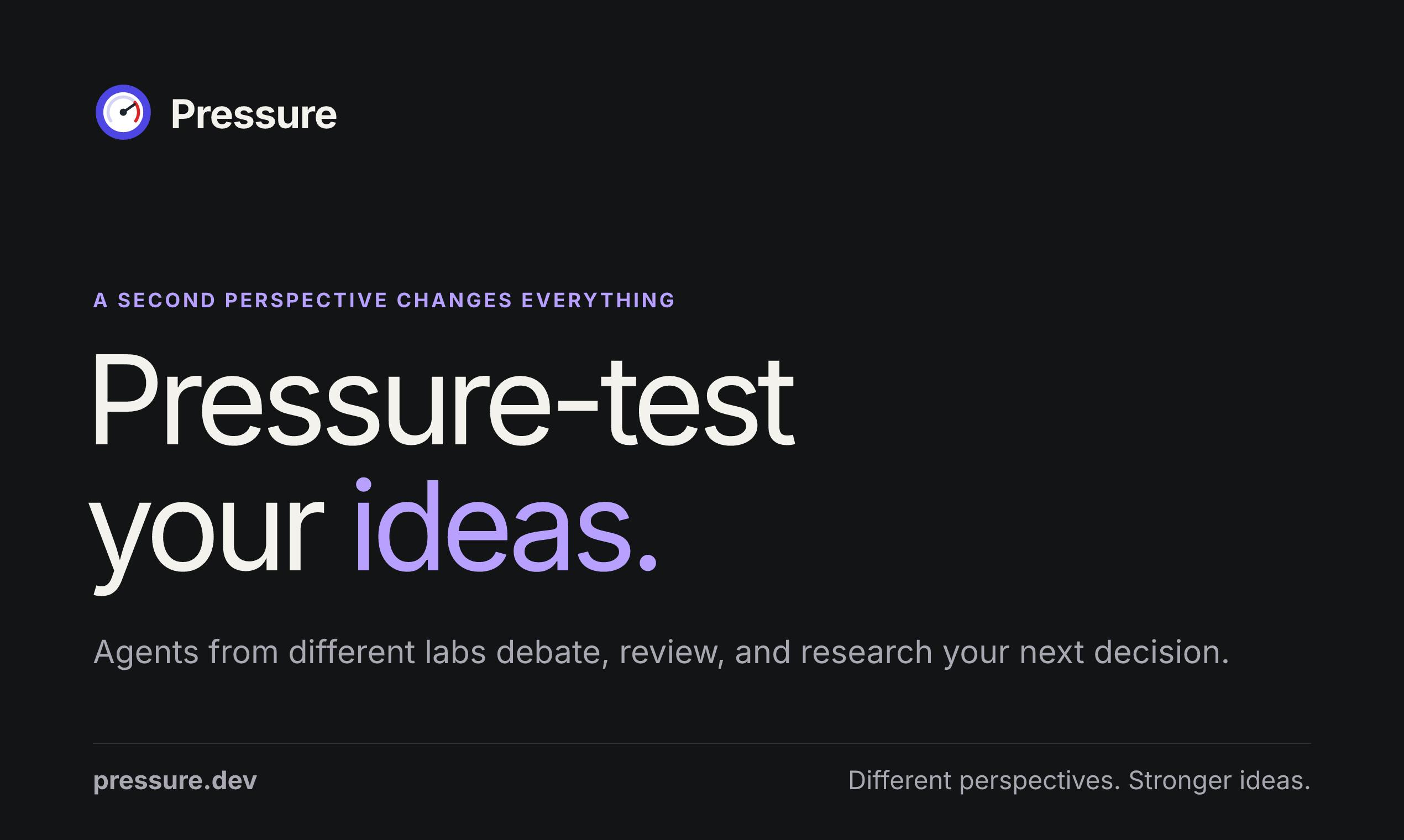
Pressure makes two AI models from different labs debate and outputs a structured brief with positions, concessions, and open questions.
Pressure is a Product Hunt product that lets two AI models from different labs debate a user's topic over multiple rounds, then generates a "pinned summary" with each side's position, concessions, conclusion, and open questions. It emphasizes surfacing disagreement rather than pursuing false consensus, using differences in training data and alignment strategies to expose single-model blind spots. It offers a no-registration web app, a Claude connector, and a CLI, targeting both knowledge workers and developers. It launched with 72 upvotes and ranked 19th in its category—a moderately above-average early performance. Potential limits include doubled inference cost, higher latency, opaque model-pairing strategy, and possible bias in summary generation.
When AI Models Disagree, Who Gets the Final Say?
When facing complex decisions or vague ideas, we often want a "second opinion." But a single AI model may confidently give a one-sided answer. A product called Pressure on Product Hunt tries to solve this with "debate": you submit a topic, two AI models from different labs each build their case and rebut each other, and the system finally produces a structured "debate minutes" with a summary.
According to its Product Hunt page, Pressure's use cases include: debating a decision, reviewing a spec document, doing research with cited sources, or stress-testing a rough idea. After launch, it received 72 upvotes, ranked 19th in the Productivity category that day, and had 8 comments.
How the Two-Model Debate Works
The core mechanism of Pressure is not complicated: the user submits a topic or question, and two AI models from different vendors play the two sides of the debate across multiple rounds. After the debate, the user receives a "pinned summary" that includes:
- Each side's position: the core claims and arguments of both sides;
- Concessions: which side acknowledged the other's points as reasonable, and on what;
- Conclusion: the judgment that converges after the exchange;
- Open questions: which points of contention were not fully resolved.
This structured output is more valuable than simply asking one model to "think again"—it forces the model to expose weaknesses in its reasoning chain. Models from different labs differ in training data, alignment strategies, and knowledge cutoffs, so having them challenge each other often reveals blind spots a single model would miss.
A Notable Design Choice: The Conclusion Is Not an "Average Score"
Many multi-model products tend to average or vote across multiple answers, but Pressure emphasizes showing "concessions" and "open questions." This means it does not pursue a false consensus but presents disagreement itself as information. For decision-making scenarios, this is more useful than a bland, compromise answer.
Multi-Agent Debate is a reasoning framework in which multiple AI models each generate answers to the same question and criticize and revise one another. Its core assumption is that different models' error patterns do not fully overlap; through multiple rounds of "propose a view—face challenge—update position," it can reduce single-model hallucinations and improve factual accuracy. Representative research such as Du et al. 2023, "Improving Factuality and Reasoning in Language Models through Multiagent Debate," shows that debate mechanisms outperform single-model self-consistency sampling on arithmetic, logic, and factual QA tasks. Pressure productizes this research paradigm, replacing debates among homogeneous models with two models from different vendors to maximize the error-correction gains from knowledge differences.
The common "average score" strategy in multi-model ensembles refers to voting on multiple models' outputs, taking the majority opinion, or averaging probability distributions. Such methods pursue consensus but easily mask minority yet correct views—especially on problems requiring deep reasoning, where the majority of models may share the same blind spot. Pressure does the opposite: by preserving "concessions" and "open questions," it essentially structures disagreement into reviewable evidence. This aligns with the diversity principle in "collective intelligence" research: the quality of group judgment depends on the independence of members' errors, not on simple aggregation of opinions; showing disagreement helps users calibrate their trust in the answer more than forcing convergence.
Three Access Methods Covering Different Workflows
Pressure offers multiple access paths to suit different user habits:
- Web: start a debate directly in the browser without registration, lowering the barrier to try it;
- Claude connector: add Pressure as a connector in Claude to invoke debate capabilities directly in the conversation workflow;
- Command-line tool (CLI): a one-line-install CLI for Claude Code and Codex users, making it easy for developers to embed debate capabilities into coding or research workflows.
From its positioning, Pressure targets both ordinary knowledge workers and developers. The web version is suitable for quickly validating ideas, while the CLI and connector target power users—especially those already using Claude Code or Codex for AI-assisted programming.
The Team Behind the Product and Market Signals
Pressure was launched by multiple creators including Jeff Bird (some maker information is hidden on the Product Hunt page). Judging from its category tags, it is classified under Productivity, Developer Tools, and Artificial Intelligence, indicating the team intends to cover users ranging from efficiency tools to developer tools.
A score of 72 upvotes and rank 19 is a moderately above-average early performance on Product Hunt—not a breakout hit, but enough to prove that the need for "multi-model cross-validation" genuinely exists. The 8 comments also suggest discussion is still early, and the product may still be iterating rapidly.
Product Hunt's ranking mechanism is not purely based on vote count; it is a weighted calculation combining new upvotes that day, comment activity, and community interaction, and category leaderboards usually show only the top few. 72 upvotes and 19th in the category mean the product gained some exposure on launch day but has not yet entered the mainstream. For early tools, data at this stage is more about validating demand signals and collecting seed-user feedback than measuring final market performance; the low engagement of 8 comments also suggests the product is still in a cold-start phase, and subsequent retention and word-of-mouth will be the key indicators to watch.
The Value and Limits of Multi-Model Debate
Multi-agent debate is not a new concept; academic research has shown that having multiple models question each other can improve factual accuracy and reasoning quality. Pressure productizes it, packaging "debate" as a low-barrier consumer feature—that is its smart move.
But several questions are worth watching:
- Cost and latency: multi-round dialogue between two models means doubled inference cost and longer response times; how the product balances experience and expense is not yet clear;
- Model selection strategy: different topics suit different model combinations; whether Pressure lets users specify models or automatically pairs them is not detailed in the official description;
- Reliability of the summary: the final summary is generated by the system; if the summarization model itself has biases, it could distort the actual course of the debate.
The answers to these questions may require actual use to judge. But at least Pressure proposes a valuable product direction: rather than pursuing an "omniscient" AI, let multiple AIs check and balance each other and return judgment to the user.
For scenarios needing a second opinion—whether reviewing a spec document or stress-testing a rough startup idea—having two AIs argue first may be more efficient than repeatedly questioning the same model yourself.
Related articles
 Tech Frontiers
MuJoCo: An Analysis of DeepMind's Open-Source General-Purpose Physics Simulator
An in-depth analysis of Google DeepMind's open-source physics simulator MuJoCo: high-performance C++ kernel, MJCF modeling format, contact solving principles, MJX GPU acceleration, and robot reinforcement learning use cases.
 Tech Frontiers
Claude API Quick Start: The Official Quickstarts Project Collection
Anthropic's official claude-quickstarts project collection helps developers quickly build deployable apps with the Claude API. Nearly 20k stars, Python-based, great for beginners and prototyping.
 Tech Frontiers
AI Agents Connecting Directly to APIs: Which Calls Can Be Safely Allowed?
AI agents can call any API, but the real challenge is deciding which calls can be safely allowed. This article analyzes allowance decisions from three dimensions—intent matching, least privilege, and controllable impact—and argues that the control layer should sit outside the agent, combined with audit traceability to build a trustworthy API call governance mechanism.