Privacyboard: An Auto-Pilot Privacy Compliance Tool That Generates a Privacy Policy in Minutes

Privacyboard uses automated detection and document generation to turn privacy compliance from a legal Excel into a product workflow.
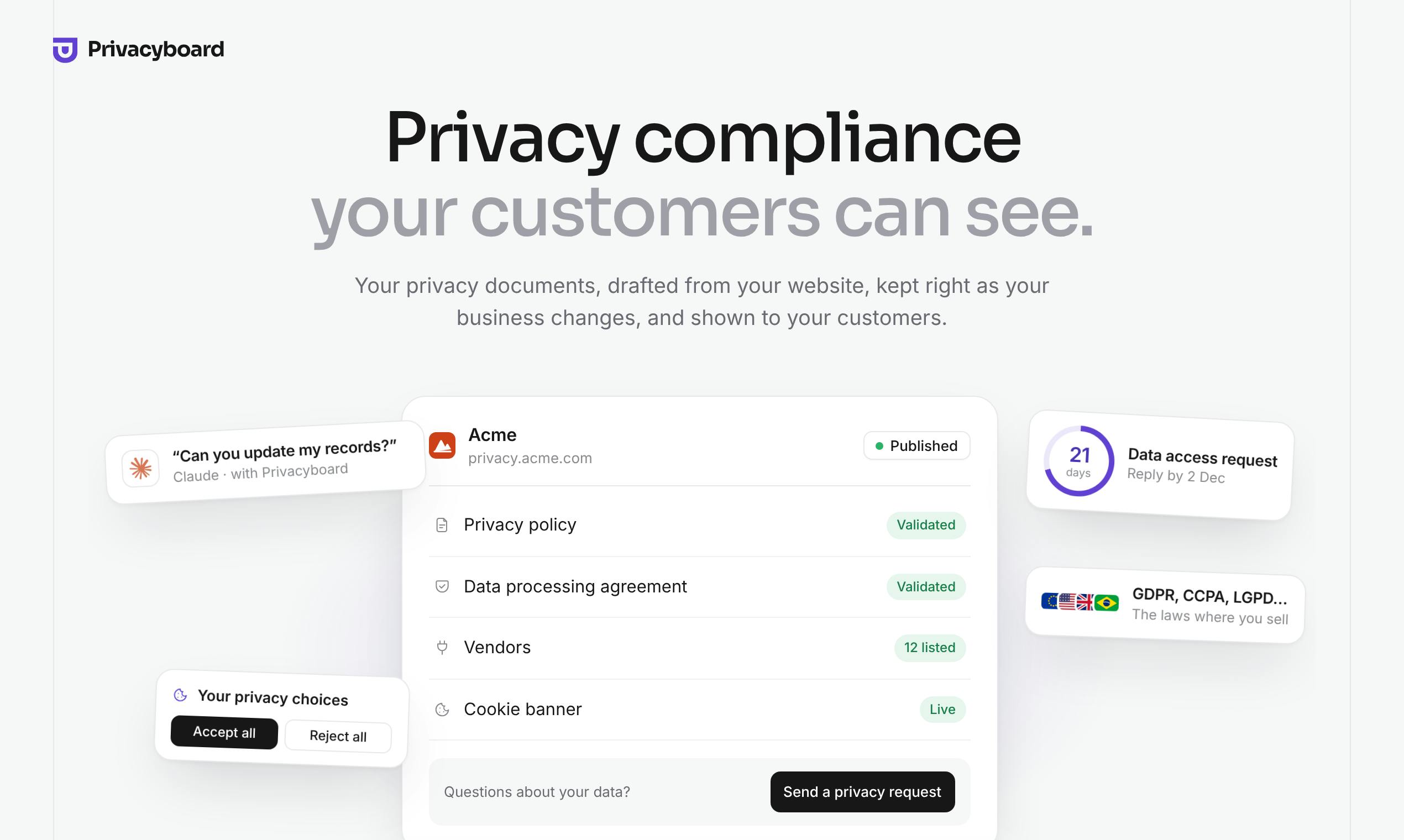
Privacyboard is a privacy compliance automation tool for the European market. After users enter a URL, it automatically detects third-party tools and trackers on the site, drafts a privacy policy, cookie banner, records of processing activities, and DPA, and monitors vendor changes and compliance deadlines daily. A built-in AI assistant fills coverage gaps, and a free plan is available with data hosted in the EU. The article notes that its value lies in turning ongoing compliance work into a workflow, but automated detection may not cover all trackers, and generated drafts still require legal review—especially for contractual documents like DPAs. With 71 upvotes, 4 comments, and a #13 ranking on Product Hunt, it suits independent developers and early-stage SaaS teams as a compliance starting point and monitoring console, not as a substitute for legal advice.
Privacy compliance is shifting from a legal department's Excel spreadsheet to an automated product workflow. Privacyboard, ranked #13 on Product Hunt, aims to compress privacy policies, cookie banners, records of processing activities, and DPAs into a matter of minutes through a "enter your URL → automatic detection → document generation" path.
The Pain Point of Privacy Compliance: Tools Take Off While Documents Crawl
SaaS products targeting the European market share a common dilemma: by the time a website goes live, it has integrated analytics tools, ad pixels, customer support plugins, and payment gateways—yet the privacy policy often remains stuck at the stage of "copying a paragraph from a template." Behind these tools are different types of vendors, each with their own data processing terms, storage locations, and compliance statuses that keep changing. Manual maintenance simply can't keep up.
Privacyboard targets exactly this time gap. Users only need to enter a website URL, and the tool automatically identifies the services and trackers running on the site, then drafts a privacy policy, cookie banner, records of processing activities (records), and a Data Processing Agreement (DPA) accordingly.
How Far Automation Can Reach
Privacyboard's core logic can be broken down into three layers:
Detection layer: Scans the third-party tools and scripts loaded by the website to build a vendor list. This step replaces the manual work of sorting out "which data processors do we use."
Document layer: Generates a privacy policy, cookie banner copy, records of processing activities, and a DPA draft based on the detection results. The original text emphasizes "drafts"—generating drafts rather than final versions, leaving room for human review.
Monitoring layer: Vendors are tracked daily, and compliance deadlines are recorded and reminded. Privacy compliance is not a one-time deliverable; vendor term changes and regulatory milestones both require continuous vigilance. This is the key differentiator from static template generators.
In addition, the product includes a built-in AI assistant to fill in gaps that detection and drafts cannot cover.
Records of Processing Activities and DPA: Records of Processing Activities (ROPA) is a document required by Article 30 of GDPR. Organizations must record the purposes of processing activities, categories of data, recipients, storage periods, etc., and supervisory authorities may request them at any time. A DPA (Data Processing Agreement) is a contract between a controller and a processor that specifies the processor's obligations—processing data only on the controller's instructions, ensuring security measures, assisting with data subject rights—and is legally binding. Both are core GDPR compliance documents, but they differ in nature: ROPA is an internal record, while a DPA is an external contract. Automated generation tools can quickly draft the framework of these documents based on the detected vendor list, but the allocation of liability and indemnification clauses in a DPA must be customized to the specific business relationship. Hence the "draft" positioning is reasonable—it lowers the barrier to entry but cannot replace legal review.
Free Plan and EU Data Hosting
On the commercialization side, Privacyboard offers a free plan and explicitly states that data is stored within the EU. For users in the GDPR context, data residency is itself part of the compliance narrative—if a privacy tool stores its own data outside the EU, its persuasiveness would be significantly undermined. Whether this point was discussed in the Product Hunt comments section cannot be determined from the available material.
The product is built by Antoine Milkoff and currently has 71 upvotes, 4 comments, and ranks #13 for the day. This vote count is above average on Product Hunt, suggesting the concept resonates but hasn't yet generated explosive discussion. The 4 comments also mean the community feedback sample is limited, and the product's real-world reputation still needs more validation.
GDPR and Data Residency: GDPR (General Data Protection Regulation) is the EU's personal data protection regulation that took effect in 2018. It imposes strict obligations on organizations processing data of EU residents, including data minimization, purpose limitation, and restrictions on cross-border transfers. "Data residency" refers to the requirement that data be physically stored in a specific geographic region. GDPR itself does not mandate that data must remain within the EU, but transfers to third countries must meet conditions such as adequacy decisions or standard contractual clauses, which carry higher compliance costs. Therefore, hosting data within the EU has become a common strategy to simplify the compliance narrative—it directly avoids the complex assessment of cross-border transfers and signals "privacy-first" to users. For privacy compliance tools, their own data residency choices have a demonstrative effect: if the tool itself stores user data outside the EU, its credibility would be questioned.
Where Are the Boundaries of Automated Compliance
The real value of such tools is not in "generating a privacy policy" but in turning ongoing compliance work into a workflow. However, it's important to be clear-headed:
- Automated detection may not cover all trackers, especially those delivered server-side or via lazy loading;
- Generated drafts still require review by legal professionals, especially for documents with contractual effect such as DPAs;
- Daily vendor monitoring is a plus, but there is still human work between "a change being detected" and "a response being completed."
Privacyboard is positioned more as a starting point and monitoring console for compliance work rather than a substitute for legal advice. For small and medium teams with limited resources that are just entering the European market, it automates the most tedious sorting and drafting steps, already saving considerable upfront costs. Whether it can build a sufficiently deep moat in long-term monitoring depends on the breadth of its vendor database coverage and update quality—areas for which there is no specific data in the currently available public information.
Cookie Banners and Consent Management: GDPR and the ePrivacy Directive require websites to obtain explicit user consent before setting non-essential cookies (such as analytics and ad tracking). Cookie banners are the common interface for obtaining consent. A compliant banner must meet requirements including: no pre-checked boxes by default, reject options as prominent as accept, granular control by category, and recording of consent evidence. The cookie banner copy generated by Privacyboard after detecting trackers is a lightweight alternative to a consent management platform (CMP)—it solves the "having a banner" problem, but complete consent management also involves consent record storage, withdrawal mechanisms, and integration with tag managers. For newly launched sites, an auto-generated banner can serve as a starting point, but for large-scale ad tracking, a dedicated CMP remains the safer choice.
Who It's For
Independent developers, early-stage SaaS teams, and product organizations without dedicated legal counsel are the most direct audience for this type of tool. If your site has just launched and you're catching up on privacy compliance, or if you need a lightweight monitoring tool that continuously watches for vendor changes, Privacyboard is worth adding to your candidate list for comparison and trial. However, for formal compliance audits or high-risk data processing scenarios, it should still be treated as an auxiliary tool rather than a final authority.
Related articles

ClawDOS: Bringing AI Coding Capabilities to DOS
ClawDOS is an AI coding agent project for DOS, exploring the possibility of bringing AI coding assistance into resource-constrained retro computing environments. This article analyzes its positioning, use cases, and community response.

Baseten Releases Bison-1 and Groundhog-1, Topping the Decision Model Leaderboard
Baseten releases open-weight decision models bison-1 and groundhog-1 built on Gemma 4; bison-1 scores 76 on the AA Decision Index v2.1 to top the leaderboard. Both support 128k context and image input—here we analyze their capability combination, benchmark significance, and selection advice for developers.

Cline CLI v3.0.75 Released: Yolo Mode Now Default for One-Shot Runs
Cline CLI v3.0.75: one-shot runs now default to yolo mode, --timeout and Ctrl+C can interrupt the first round, read_files is no longer truncated to 8k chars, plus reasoning parameter fixes and 94 new providers.