Programmers in the AI Era: How Deep Should You Learn Legacy Tech?

Under AI's impact, programmers should embrace tools and shift to project-driven learning, with depth defined by projects.
The article notes that AI's impact on programming has concentrated within about two months; rather than seeking a safe haven, programmers should accept it and leverage it. The creator breaks "embracing AI" into a gradient from daily chatting and AI-assisted side projects to Agent development, fine-tuning, and algorithm research, stressing that not everyone needs to go all the way. The most direct impact is on learning: the old detail-first path can be compressed by AI, technical barriers built on mastering details are weakening, and thresholds for junior and mid-level technical roles (including testing and hardware) have dropped noticeably. Learning thus shifts from process-driven to project-driven (PBL), and how deep to learn legacy tech should be decided by project needs, with the value of fundamentals moving toward framework judgment and integration under AI collaboration.
AI's impact on programming has gone from "the wolf is coming" to "the wolf is at the door." A Bilibili creator offered an intuitive time scale in a recent share: the whole industry felt the shift in roughly two months. That judgment may not apply to every team, but it points to a fact—change doesn't happen at a constant rate; it suddenly accelerates at a certain point.
Faced with this acceleration, programmers show two typical reactions: one is to keep asking "which jobs won't be hit by AI" in search of a safe haven; the other is to start adjusting how they learn and work, embedding AI tools into daily life. The problem with the first approach is that individual power is very limited in the face of technological trends. Rather than looking for a place to dodge the impact, it's better to accept that the impact has already happened and then consider how to leverage it.
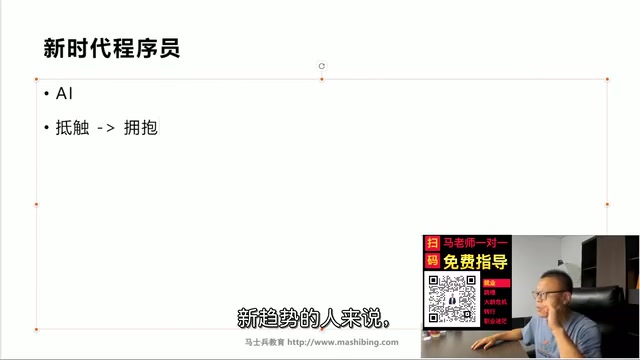
The Levels of Embracing AI: From Chatting to Algorithm Research
"Embracing AI" sounds like a slogan, but the creator broke it down into an actionable gradient. The shallowest level is using ready-made tools—even just chatting with Doubao daily counts as a preliminary understanding. Higher up is using AI to assist side projects or personal interest projects, like creating self-media content or making comic dramas. Deeper still is learning Agent development, then model fine-tuning and model secondary modification, and the deepest is model creation and algorithm research.
What's worth noting about this gradient is that it doesn't require every programmer to go to the deepest level. The creator explicitly said there's no need for everyone to research algorithms. Embracing can be all-around, but the landing point varies by person. For most developers, what really affects daily work is probably the middle layers—using AI to assist development, understanding how Agents are built, and calling model capabilities in projects.
He also gave a cross-disciplinary example: someone originally unfamiliar with hardware can, with AI assistance, try designing a piece of hardware—even starting with a small smart switch at home. This shows that AI lowers not only the barrier to programming but also the barrier to cross-domain practice.
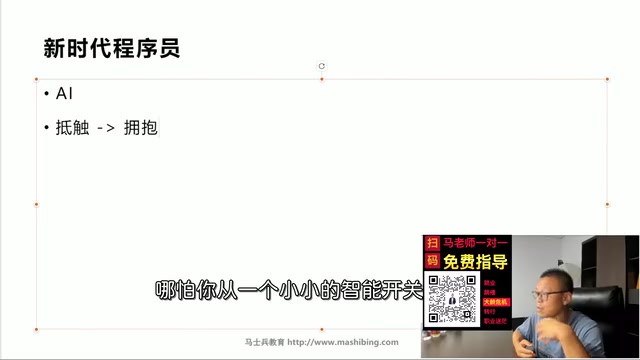
Agent development refers to building AI systems that can autonomously perceive the environment, make plans, and call tools to complete multi-step tasks. Typical forms include tool-calling agents based on large language models (such as automatically retrieving information, executing code, and operating software). Unlike single-turn dialogue, Agents need to handle task decomposition, memory management, tool selection, and result validation, so they demand more system design capability from developers.
Model fine-tuning is continuing to train a pre-trained large model with domain-specific data so that it better fits a certain task or style; model secondary modification may involve adjusting structure, quantization compression, or connecting external knowledge bases (such as RAG). These two layers sit between "knowing how to use tools" and "researching algorithms from scratch," and are suitable for teams with clear business scenarios that need customized capabilities.
Learning Has Changed: From "Process-Driven" to "Project-Driven"
The most direct impact of AI on programmers, according to the creator, is first not at the work level but at the learning level. In the past, learning a new language or technology started from details: you had to figure out the punctuation in configuration files, understand every interface, chew through it step by step before starting. Now this path can be compressed—if code has a bug, throw it directly to a large model and let AI explain it sentence by sentence, draw flowcharts, or even generate animations.
He mentioned a claim he hasn't personally verified: a certain new version of a model performs best at code generation. The information itself isn't important; what matters is the trend it points to—efficiency in code generation and bug localization will continue to improve. So learning new things with AI assistance becomes easier, not harder.
This brings a chain reaction: the technical barriers originally built on "mastering details" are being weakened. Barriers for junior and mid-level technical positions—not just programmers, but also testing, hardware development, etc.—will drop noticeably. In the past, writing a program required a very clear understanding of the language and interfaces; now, as long as you understand the general framework, you can build things with AI assistance.
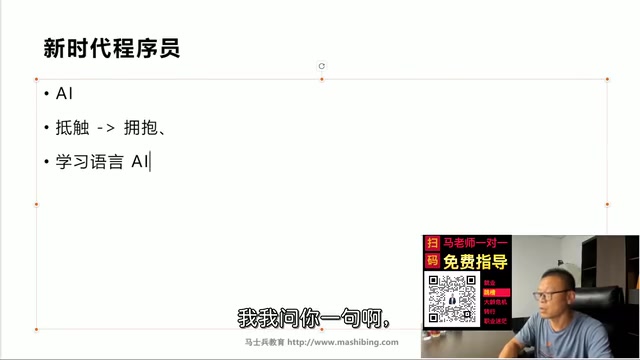
Why PBL Makes More Sense Today
The creator mapped this shift to PBL in education—Project Based Learning, learning driven by projects. He used building a car as an analogy: traditional learning starts from parts, first learning the details of each part, then assembling parts into components, components into core modules, and finally into a whole car; the new way starts from the project "I want to build a car" and works backward to what needs to be learned, asking AI when encountering details you don't understand.
The key to this analogy is the reversal of learning order. It used to be process-driven—walking step by step along the knowledge chain; now it's project-driven—first have a goal, then fill in as needed. For programmers, this means the question "how deep should you learn legacy tech" itself needs a new answer: depth is decided not by the textbook table of contents but by project needs.
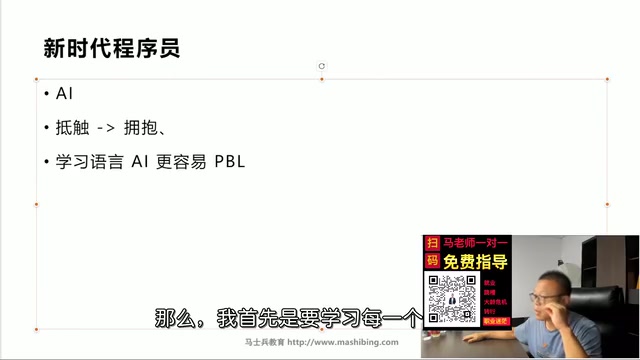
PBL (Project Based Learning) emphasizes organizing learning around real projects as the main thread. Learners acquire knowledge on demand while completing projects, rather than systematically finishing theory first and then applying it. Its difference from traditional "discipline-driven" teaching is that knowledge is no longer unfolded linearly according to textbook tables of contents; instead, the learning path is derived backward from project goals. AI tools play the role of a "teaching assistant you can ask anytime," reducing the interruption cost when encountering detail obstacles and making the project-driven learning loop easier to maintain. This also explains why PBL is more feasible with AI assistance than before—the biggest resistance in past project-based learning was often getting stuck on a detail with no one to ask.
The Depth of Legacy Tech Is Decided by Projects, Not Tables of Contents
Back to the title question: as programmers transform, how deep should they learn legacy tech? Following the logic of this share, the answer is neither "don't learn" nor "learn to the end," but to let the specific project define the learning depth. Underlying principles still have value, but the way that value is realized has changed—it's no longer expressed as "I can hand-write every detail" but as "I can judge whether the solution AI gives is valid and make trade-offs at the framework level."
The creator didn't give a precise depth ruler, and that's exactly honest. Lower technical barriers don't mean technology is unimportant; rather, the distribution of importance has shifted: from memorizing details to understanding frameworks, from independent implementation to judgment and integration under AI collaboration. For those willing to embrace change, this is indeed a new opportunity.
One-line Summary
Under AI's impact, programmers should embrace tools and shift to project-driven learning, with learning depth defined by projects.
Paragraph Summary
The article notes that AI's impact on the programming industry has concentrated within about two months. Rather than seeking a "safe haven," programmers should accept the impact and leverage it. The creator breaks "embracing AI" into a gradient from daily chatting, AI-assisted side projects, Agent development, and model fine-tuning to algorithm research, stressing that not everyone needs to go to the end. The most direct impact is at the learning level: the old path of chewing through details can be compressed by AI, technical barriers built on mastering details are weakening, and the threshold for junior and mid-level technical positions (including testing and hardware) has dropped noticeably. Learning therefore shifts from process-driven to project-driven (PBL), and how deep to learn legacy tech should be decided by specific project needs. The value of underlying principles shifts toward framework judgment and integration under AI collaboration.
Related articles

OpenAI Releases GPT-6.2 Dual Models Astra and Sol, API Price Cut by 20%
OpenAI releases GPT-6.2 Astra and Sol, with Astra's API price cut 20% to $8/$40 per million tokens and ranking second on the Artificial Analysis Intelligence Index. This article analyzes the dual-model strategy, price-cut impact, and developer selection advice.

Perplexity Computer Launches Multiagent: 16 AI Agents Cross-Validate Each Other
Perplexity launches Multiagent mode for Computer: a lead agent orchestrates up to 16 sub-agents on Claude, GPT, and Gemini, sharing findings and cross-validating work with effort above Ultra.

Amazon and Google to Jointly Hold Nearly 30% of Anthropic
After Anthropic's IPO, Amazon will hold just under 15% with an option to increase, and Google nearly 14%, together controlling close to 30%. This article analyzes the strategic logic, governance challenges, and impact on AI competition.