Prompt Engineering from Beginner to Practice: Core Concepts and Limitations Explained

Prompts are the direct means of controlling AI; prompt engineering is the methodology for making it reliably produce usable results.
Based on the first lesson of a Bilibili prompt engineering tutorial, this article clarifies the difference between prompts and prompt engineering. A prompt is any text instruction given to AI, playing four roles: communication bridge, task navigation, style control, and boundary constraints—but it is one-off, and there is no universal prompt. Prompt engineering is a six-step process that does not modify model parameters but only designs inputs to make AI reliably output results: requirement decomposition, solution design, execution and testing, effect evaluation, strategy iteration, and sedimentation for reuse, with goals of improving accuracy, reducing hallucinations, enhancing stability, and lowering costs. The article also emphasizes its low-barrier, high-leverage value and systematically outlines technical limitations such as capability ceilings, unstable output, hallucinations, context length, complex tasks, and long-term memory, as well as implementation pitfalls like mistaken safety blocks, difficulty in engineering, and token costs.
Many people think prompting is just sending messages to AI, but a systematic prompt engineering tutorial on Bilibili offers a different answer: prompts are your most direct means of controlling AI, while prompt engineering is a methodology for making AI reliably produce usable results. This article, based on the first lesson of that tutorial, outlines the nature of prompts, the workflow of prompt engineering, and the limitations that are often overlooked.
What Is a Prompt: More Than Just "Sending a Message"
The tutorial's definition of a prompt is simple: any text instruction you give to AI, whether a question or a description, is a prompt. But it uses a more vivid analogy—prompts are like "neuron signals" sent to AI; whatever signal you send, AI thinks in that direction.
With the same AI, some people can only get it to write elementary-school essays, while others can obtain professional industry reports. The difference lies not in the model itself but in the input instructions. The tutorial breaks down the role of prompts into four levels:
- Communication bridge: Translating vague needs in your head into clear instructions AI can understand. It's like ordering takeout—you can't just say "bring me some food"; you have to specify the dish, spice level, and whether to add rice.
- Task navigation: Telling AI specifically what to do. "Help me process this file" is an ineffective instruction—AI doesn't know whether to do statistical analysis, visualization, or write a summary, so it just picks one at random.
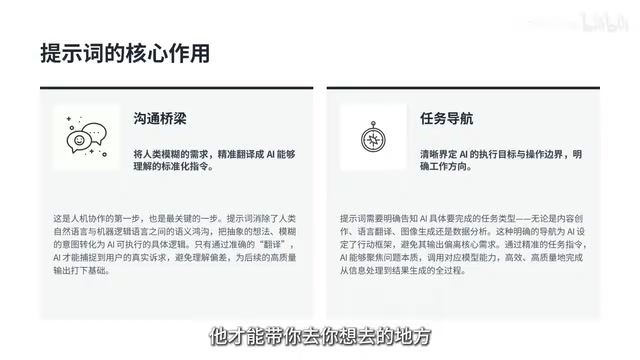
- Style control: For the same topic, a business email and a social media post have completely different styles. Through prompts, you can make AI imitate a specific style and reduce later editing.
- Boundary constraints: One of the most effective ways to counter AI "nonsense." Clearly telling AI what it can and cannot say makes the output more focused.
The tutorial gives an intuitive comparison: the basic prompt "write an article about spring" is too broad—southern or northern? prose or preface? how long? what style? AI can only guess, resulting in cookie-cutter output. The optimized version first sets the identity (prose writer), word count (800 words), scene (spring in Jiangnan), and style (beautiful, lyrical language, focusing on the misty, rainy water-town atmosphere), turning vague requirements into executable rules.
Prompt vs. Prompt Engineering: One-off Tricks vs. Systematic Methods
This is a distinction the tutorial repeatedly emphasizes. A prompt is one-off, like writing a line of code that runs once—change the question and it may no longer work. The tutorial states it directly: "Many people say they have a universal prompt, but that's a lie. There is no universal prompt, only prompts suited to specific scenarios."
Prompt engineering, by contrast, is a complete process that does not modify AI's own code or parameters, but only designs input instructions to make AI reliably output the desired results.
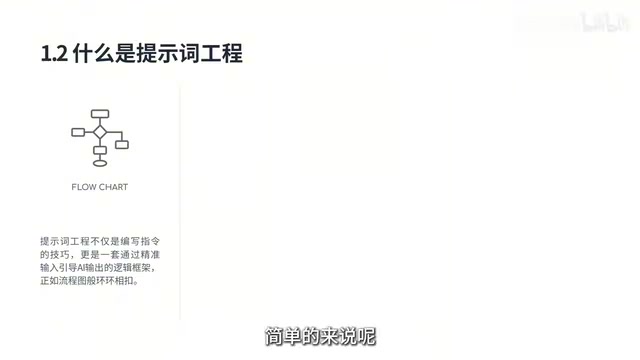 It relies on method rather than inspiration, solving not one problem but a class of problems. The six-step process given by the tutorial is: requirement decomposition (break a big problem into small problems AI can solve), solution design (design corresponding prompts and roles), execution and testing, effect evaluation (use specific criteria to judge results), strategy iteration, and sedimentation for reuse (save good solutions for direct use on similar problems). This process is much like software development, except what you write is natural language, not code.
The four goals of prompt engineering also form the criteria for evaluating a solution: improve accuracy, reduce hallucinations, enhance stability (similar results regardless of who uses it or when), and lower costs (get the best results with the fewest tokens).
Hallucination refers to large models generating content that seems plausible but is factually incorrect or fabricated. It stems from the model's probabilistic generation mechanism: the model predicts the most likely next token rather than retrieving from a factual database, so more confident-sounding content is not necessarily more reliable. Common mitigation methods include providing reference materials, requiring uncertainty to be flagged, and limiting the answer scope, but these only reduce the probability and cannot eliminate it. For critical information such as data, citations, and regulations, human verification remains necessary.
Why Learn It Now: Low Barrier, High Leverage
The tutorial cites a statistic: over 90% of users only use AI for basic Q&A. It uses an analogy—buying a sports car but only driving it in first gear.
The barrier to prompt engineering is extremely low. You don't need to know programming or algorithms—just being able to speak and explain things clearly is enough. The most direct benefit is efficiency: what used to take a day may be done in an hour, and you can handle professional reports, complex data analysis, and other tasks AI previously couldn't manage.
 In terms of commercial value, the tutorial lists several directions: helping businesses and self-media optimize prompts or generate content with AI as a side hustle; one person using AI to do the work of a whole team, lowering the cost of entrepreneurial trial and error; and self-media creators going from writing 10 posts a month to dozens, quickly building a following.
The Limitations of Prompts: Not a Master Key
The tutorial devotes considerable space to limitations, a part many introductory materials skip.
The capability ceiling cannot be broken. AI training data has a cutoff date; ask it about things after that and it doesn't know. No matter how much you optimize the prompt, it cannot solve the most complex math problems.
Output is unstable. Changing one word can produce a completely different result; if the prompt is too long, AI "forgets"—it doesn't remember what was said earlier.
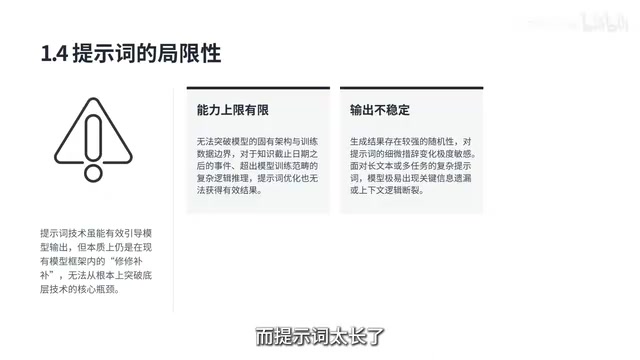 Hallucinations can only be reduced, not eliminated. Any large model will inevitably make things up; for important matters you must verify yourself.
At the technical level, there are three hard constraints: limited context length, like a phone's RAM—open too many apps and the system kills background processes; multi-step complex tasks tend to skip steps and break logic, so they must be split into smaller tasks; and there is no true long-term memory—each conversation is brand new, unable to remember user preferences and prior context, which can only be solved with an additional database. The tutorial's conclusion is that these three problems are determined by the technical foundation, and prompts can only optimize and alleviate them, not cure them.
At the implementation level, there are also three pitfalls. First, safety and alignment restrictions: illegal or non-compliant content absolutely cannot be generated, but completely legitimate requests may also be mistakenly blocked. Second, pure prompting cannot be engineered: it's fine for personal use, but making it into a product for hundreds or thousands of users won't work—there's no version management or issue tracing, and it can't handle large-scale batch tasks. Enterprise applications must combine prompts with code. Third, the cost trap: AI charges by token, so the longer the prompt, the more expensive it is, and hidden costs become terrifying with high-frequency calls.
The value of this tutorial is that before explaining "how to do it," it clarifies "what it is" and "what it is not." For those new to AI applications, building a correct understanding that includes limitations is more useful than saving a bunch of so-called "universal prompts."
Context length refers to the maximum amount of text a model can process in a single pass (usually measured in tokens). You can think of it as the model's "working memory": conversations, documents, and instructions all consume this quota, and beyond it the earliest content is truncated or forgotten—this is the direct reason for "AI forgets things when the prompt is too long" mentioned in the article. Context windows vary greatly across models, from a few thousand to over a million tokens, but no matter how large, it is not unlimited memory. Long-document tasks still require chunking or external retrieval.
Token is the basic unit of text processed by large models, roughly understandable as a "word piece." A Chinese character usually takes 1 to 2 tokens, and English words are often split into multiple tokens. APIs charge by the total number of input and output tokens, so the longer the prompt and the more frequent the calls, the higher the cost. This is also why the article lists "get the best results with the fewest tokens" as one of the goals of prompt engineering.
Related articles
 Tech Frontiers
Coldframe: A Honeypot Disguised as a Supermarket Freezer Controller
Coldframe is a honeypot disguised as Danfoss AK-SM 800A and Dixell XWEB freezer controllers, built as a single Python file that detects CVE-2025-41450 attempts and is identified as real devices on Shodan.
 Tech Frontiers
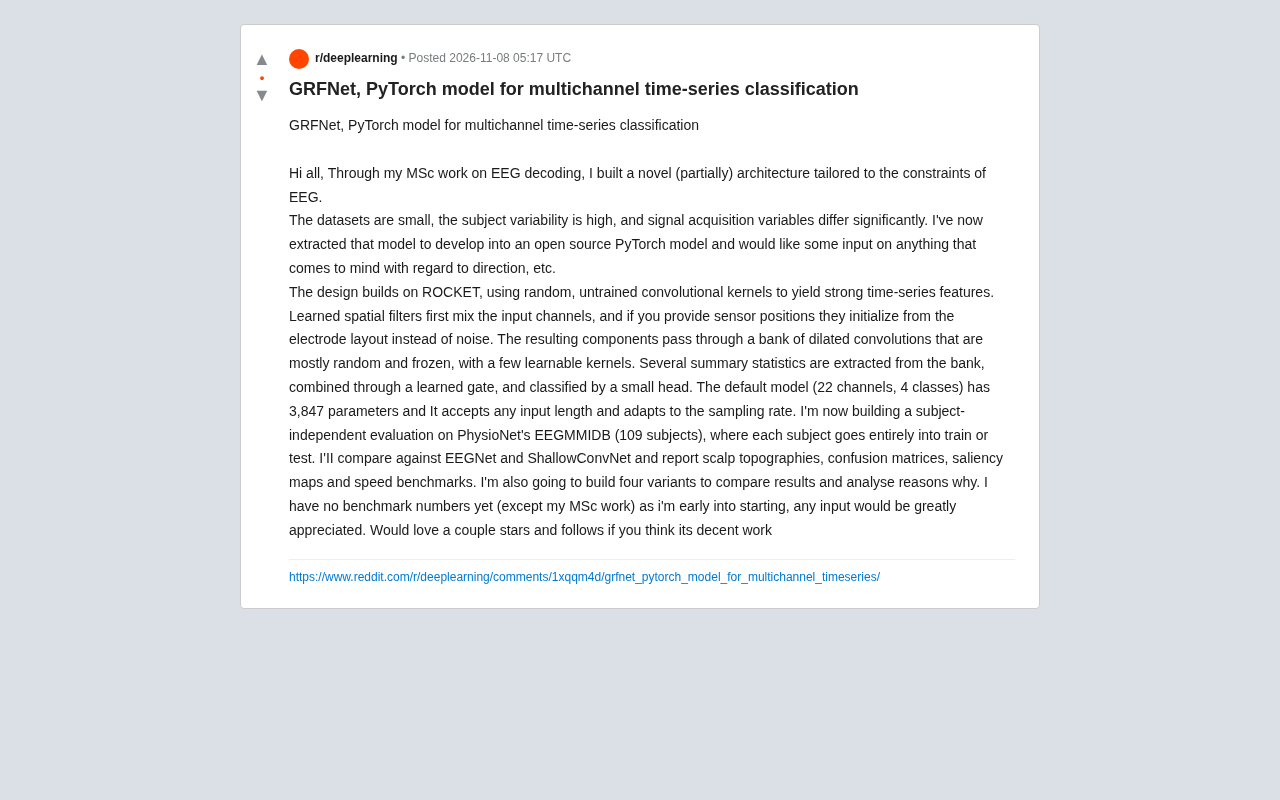
GRFNet: A Lightweight PyTorch Model Designed for Multichannel Time-Series Classification
GRFNet is a lightweight PyTorch model for multichannel time-series classification, originating from EEG decoding research. With only 3,847 parameters, it is based on the ROCKET architecture, combining random convolution kernels with learnable spatial filters, supports arbitrary input lengths, and will soon be evaluated on the PhysioNet dataset.
 Tech Frontiers
CUDA-Accelerated Rocket League Simulator: A Player-Made Hardcore Experiment
A Reddit post shows a "100% Accurate" Rocket League simulator accelerated with CUDA. We analyze its technical context, CUDA's value in game physics simulation, and the significance and limitations of such community projects.