Putin Praises Musk as a 'True Genius' as Russia's Starlink Rival Rassvet Cooperation Emerges

Putin praises Musk as a genius and reveals contact on Russia's Starlink Rassvet, highlighting satellite internet geopolitics.
The article starts with Putin's public praise of Musk as a 'true genius' and disclosure of 'close contact' on Russia's satellite internet project Rassvet, analyzing the satellite internet competition landscape. Rassvet, seen as Russia's Starlink, positions low-orbit broadband with strategic value for vast Russia but still requires external technical references. The article notes praise does not equal cooperation: Russia aims to reduce dependence on external communications, while Starlink is American, creating structural tension. Putin's wording signals communication while accelerating autonomous construction. The core conclusion is that satellite internet competition is evolving from corporate races into a complex intertwining of national capabilities and commercial innovation.
The Hidden Satellite Internet Thread Behind a Cross-Industry Compliment
According to an RSS source report, Russian President Vladimir Putin has publicly praised Elon Musk as a "true genius" and revealed that the two maintain "close contact" regarding Russia's satellite internet project Rassvet. This news may appear to be mere pleasantries between celebrities, but in the context of global satellite internet competition and geopolitical tech rivalry, it carries significant implications.
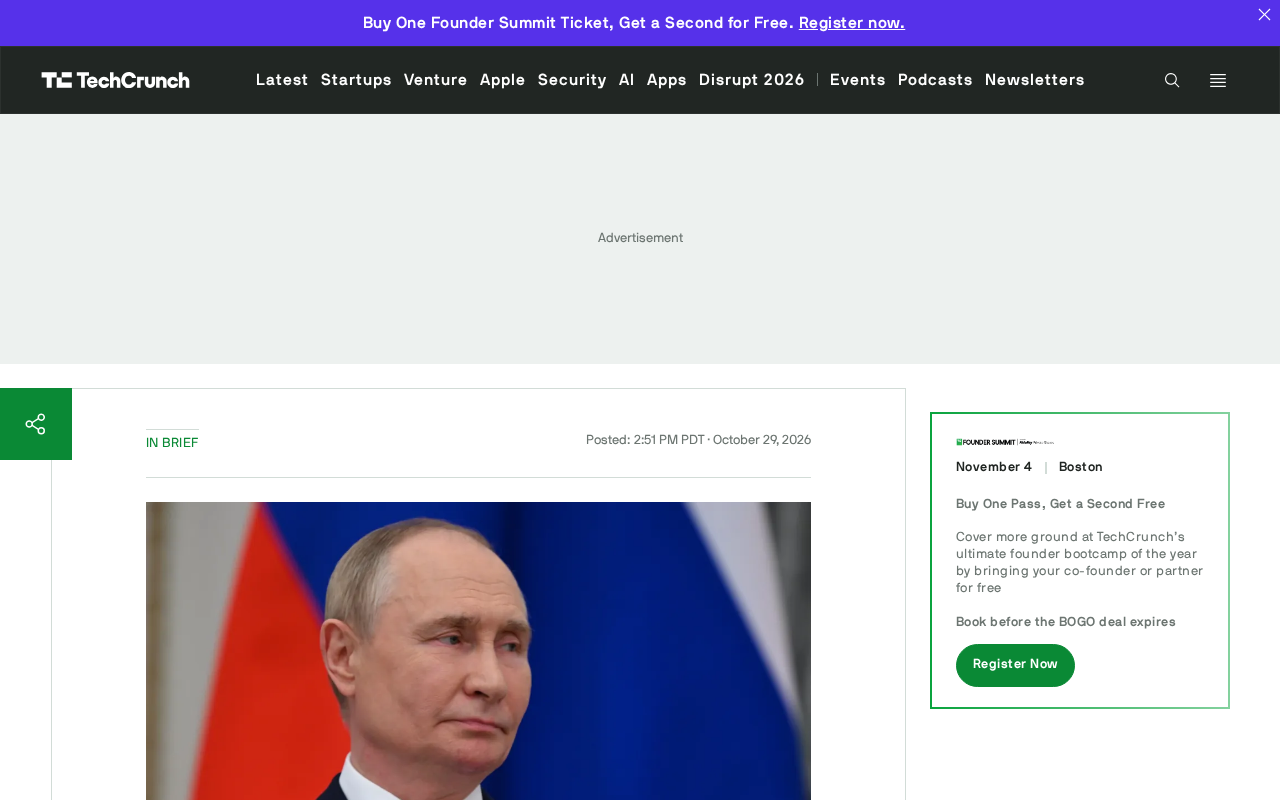
Putin's remarks are not an isolated event. Rassvet is described externally as Russia's version of Starlink, aiming to provide similar low-Earth-orbit satellite broadband connectivity services. SpaceX's Starlink, under Musk, has already secured a first-mover position in the global satellite internet market, and the emergence of Rassvet means this track is expanding from commercial competition to national capability building. Putin's proactive mention of "close contact" with Musk at least indicates that Russia is not averse to external experience on this project.
Rassvet: Where Russia's 'Starlink Counterpart' Stands
Rassvet's core positioning is satellite connectivity services, with direct comparability to Starlink in functionality. For Russia, a country with vast territory and high ground network coverage costs, low-orbit satellite internet has inherent strategic value—it can serve remote areas and provide communication redundancy when infrastructure is damaged.
Based on public information, Rassvet is still at a stage requiring external technical and experiential references. Putin's use of "close contact" to describe communication with Musk is intriguing: he neither confirmed formal cooperation nor denied technical exchanges. Such ambiguous phrasing in diplomatic contexts often means both sides are exploring some form of interaction, but implementation remains distant.
Low Earth Orbit (LEO) satellite internet refers to deploying communication satellites in near-Earth orbits approximately 300 to 2,000 kilometers above the ground, providing broadband access through large-scale constellation networking. Compared to traditional geostationary orbit satellites (about 36,000 kilometers), LEO satellites can reduce transmission latency to tens of milliseconds, closer to ground fiber experience, but at the cost of smaller single-satellite coverage, requiring hundreds or thousands of satellites for networking, and shorter satellite lifespan (about 5 years), demanding extremely high launch costs and mass manufacturing capabilities. Starlink achieved the first in-orbit deployment of thousands of satellites thanks to low-cost launches enabled by reusable rockets. The threshold for this model lies not in single-satellite technology but in the comprehensive capabilities of launch economics, constellation operations, and terminal mass production—core obstacles that latecomers like Rassvet must overcome.
Musk's 'Genius' Label and Transnational Tech Influence
Putin's praise for Musk focuses on personal ability rather than corporate cooperation. The evaluation "true genius" from a political figure known for cautious wording is itself newsworthy.
Musk simultaneously controls SpaceX, Tesla, and platforms like X, and his influence has long exceeded commercial boundaries. Starlink's practical application in conflict zones has transformed satellite internet from a technical product into infrastructure with geopolitical implications. Putin's praise can therefore be interpreted as a pragmatic stance: on satellite connectivity, Musk's experience and discourse power cannot be bypassed.
Starlink's application in conflict zones has made it a landmark case of satellite internet geopoliticization. After the Russia-Ukraine conflict erupted in 2022, Starlink terminals were used to maintain communications in parts of Ukraine, and Musk himself publicly commented multiple times on service scope and costs. This event made countries realize that low-orbit satellite broadband is not just a commercial service—its开关 (on/off), coverage, and operator nationality can all become variables in conflicts. Consequently, multiple countries began promoting autonomous satellite internet constellations to reduce dependence on single foreign operators. Understanding this background is essential to grasp why a head of state's evaluation of an American company founder carries geopolitical meaning beyond pleasantries.
Cooperation and Caution in Geopolitical Tech Rivalry
It is important to view calmly that praise does not equal cooperation implementation. The underlying logic of Russia's push for Rassvet is to reduce dependence on external satellite communication capabilities, while Starlink's operator is an American company. Structural tension exists between the two.
The timing and wording of Putin's mention of "close contact" seem more like releasing a signal—Russia is willing to maintain communication channels in satellite internet while accelerating the construction of autonomous capabilities. For readers concerned about the global satellite internet landscape, Rassvet's progress and whether substantive technical interaction exists between Russia and SpaceX are observation points worth tracking.
The value of this news lies not in "Putin praised Musk" itself, but in revealing a possible connection between Russia's Starlink project and international commercial space forces. Satellite internet competition is evolving from a race between companies into a complex intertwining of national capabilities and commercial innovation.
One-line Summary
Putin praises Musk and reveals contact on Russia's Starlink Rassvet, reflecting satellite internet geopolitical rivalry.
Paragraph Summary
The article starts with the news that Putin publicly praised Musk as a "true genius" and revealed "close contact" on Russia's satellite internet project Rassvet, analyzing the satellite internet competition landscape behind it. Rassvet is seen externally as Russia's Starlink, positioning low-orbit satellite broadband services with strategic value for vast Russia, but still at a stage requiring external technical and experiential references. The article notes that praise does not equal cooperation: Russia's underlying logic for autonomous satellite capabilities is to reduce dependence on external communications, while Starlink's operator is American, creating structural tension. Putin's wording seems more like releasing communication signals while accelerating autonomous construction. The core conclusion is that satellite internet competition is evolving from corporate races into a complex intertwining of national capabilities and commercial innovation.
Related articles

Vibe Coding Full-Stack in Practice: AI Programming from Beginner to Enterprise Deployment
From Cursor to Claude Code, this Bilibili AI programming course uses four progressive projects to cover full-stack development, open-source secondary development, and team collaboration. The article analyzes the shock to frontend roles, the efficiency shift from 50 people to 5, and the methodology required for enterprise-grade projects.

David Blaine's Global Quest for Real Magic: From South Africa to Japan and India
David Blaine travels to South Africa, Japan, and India in his Do Not Attempt special, documenting Spinning drivers, black mamba rescuers, iaijutsu masters, and ascetics—exploring the boundary between magic and real human极限 challenges.

Is a Touchscreen MacBook Coming? Vergecast Reveals Apple Executive's Response
Vergecast podcast reveals a conversation between a reporter and Apple executive John Ternus about a touchscreen MacBook and Apple Pencil support. Ternus says iPad is the best device for a stylus, while the reporter bets MacBook will eventually support Apple Pencil.