Quadruped Robots + Robotic Arms Play Capture the Flag? The Tag of Flag Concept Demo
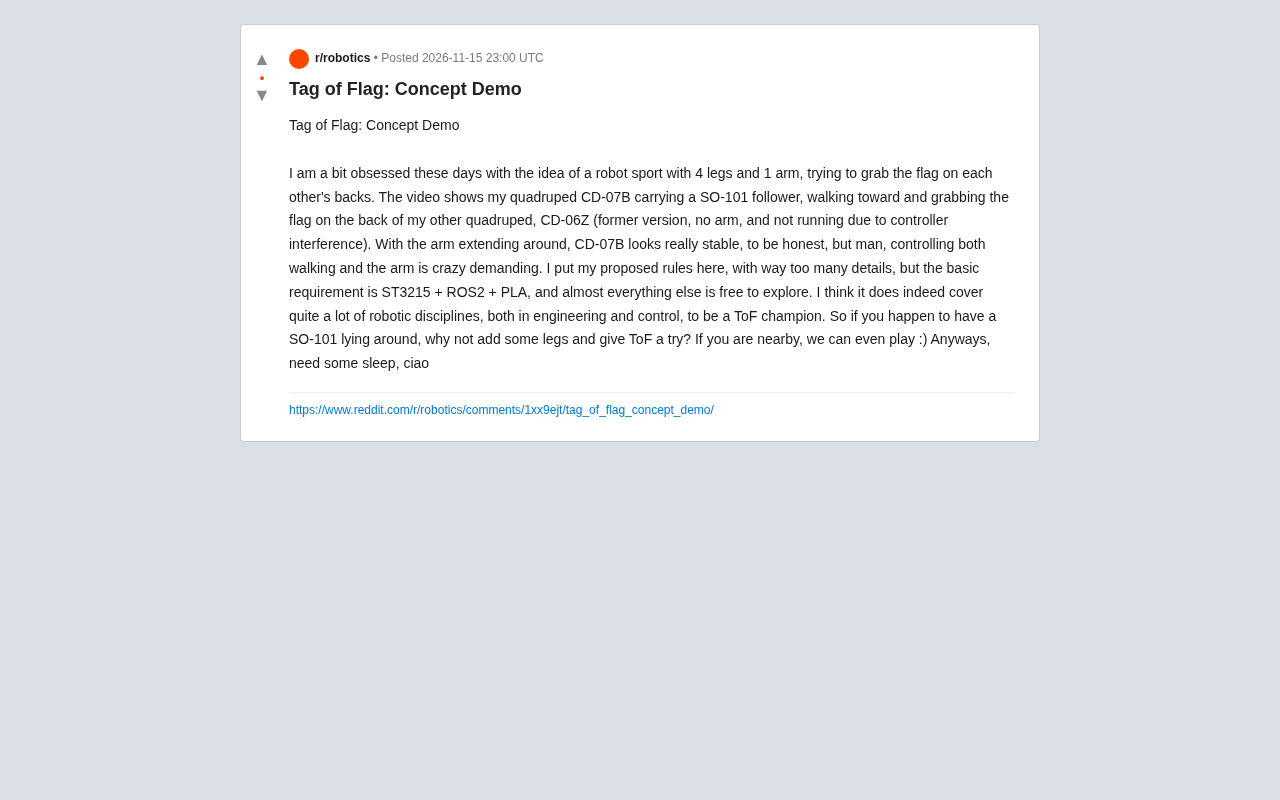
Enthusiast proposes Tag of Flag, a single-arm capture-the-flag sport for quadruped robots, releasing a prototype demo and low-barrier draft rules.
The article introduces an emerging robot sport called Tag of Flag (ToF): two quadruped robots each carry a flag on their back and use a single arm to grab the opponent's flag. The author uses CD-07B (equipped with an SO-101 robotic arm) walking toward CD-06Z and successfully grabbing the flag to demonstrate prototype feasibility, while admitting that simultaneously controlling walking and the robotic arm is extremely difficult. The draft rules require only ST3215 servos, ROS2, and PLA material, leaving the rest open for free exploration—low barrier, ample space. The sport fuses mobility and manipulation, involving mechanical design, whole-body control, visual servoing, and other disciplines, and is seen as an ideal platform for testing embodied intelligence; the author invites community participation and plans to continue refining the rules and prototype.
A robotics enthusiast has recently become obsessed with a novel robot sport: quadruped robots carrying flags on their backs, using a single arm to grab the flag off their opponent's back. The video he posted shows a prototype CD-07B (equipped with an SO-101 robotic arm) walking toward another quadruped robot, CD-06Z, and successfully grabbing the flag, while also publishing preliminary rules in an attempt to bring this sport, called Tag of Flag (ToF), to the community.
From Inspiration to Prototype: A Quadruped + Single-Arm Capture-the-Flag Duel
The author describes himself as "a bit obsessed" with this idea: two quadruped robots, each with a flag fixed to its back, with the goal of extending an arm to grab the flag off the opponent's back. In the video, CD-07B, carrying the SO-101 arm on its back, walks toward CD-06Z—the latter being an older version without a robotic arm that couldn't run due to controller interference. Despite the opponent being stationary, CD-07B maintained surprising stability as it extended its robotic arm around to the back to grab the flag. The author admits that simultaneously controlling walking and the robotic arm is "extremely grueling," which precisely reflects the sport's challenge to control algorithms.
The core appeal of this sport lies in how it fuses two major fields: mobile robotics and manipulation robotics. The quadruped platform provides omnidirectional mobility, while the robotic arm demands precise spatial manipulation; only through their coordinated operation can the goal of "grabbing the flag" be accomplished.
SO-101 is an open-source, low-cost robotic arm launched by TheRobotStudio, an iteration of the SO-100 that uses 3D-printed structural parts and Feetech series serial bus servos (such as the STS3215), and can be quickly assembled and programmed through frameworks like LeRobot. Its single arm typically has 5–6 degrees of freedom, a payload of a few hundred grams, and millimeter-level repeat positioning accuracy, making it suitable for desktop-level manipulation tasks. In the ToF scenario, the SO-101 is mounted on the back of a quadruped robot and must grab dynamic targets despite the base sway caused by walking, which places higher demands on the arm's stiffness, control bandwidth, and coordination with the quadruped platform than desktop applications.
Draft Rules: Low Hardware Barrier, Plenty of Room to Explore
In the post, the author attached a "detail-heavy" draft of the rules, but the basic requirements are quite concise: ST3215 servos + ROS2 + PLA material. Beyond that, almost everything can be freely explored. The ST3215 is a common serial bus servo often used in low-cost robotics projects; ROS2 provides a standardized software framework; and PLA refers to 3D printing filament, meaning the robot's structure can be rapidly iterated.
This "low barrier, high freedom" design philosophy aims to attract more enthusiasts to participate. The author believes that to become a ToF champion, one needs to cover many disciplines of robotics—from mechanical design and embedded control to motion planning and visual servoing, both engineering and control are indispensable.
ST3215 is a serial bus servo launched by Feetech, supporting TTL half-duplex communication, cascade control, and built-in position, speed, and load feedback. Its operating voltage is typically 6–12.3V, with a stall torque of about 30kg·cm. Compared to PWM servos, it requires only a pair of signal wires to connect dozens of nodes in series, greatly simplifying the wiring of multi-joint robots, and enables closed-loop control by reading the current position. In low-cost quadruped and robotic arm projects, the ST3215 is often used as joint actuation; combined with ROS2's hardware interface layer (ros2_control), it enables unified state reading and command dispatch—one of the reasons ToF rules list it as baseline hardware.
Technical Challenges: Balancing Walking and Manipulation
Judging from the demo, CD-07B's stability is commendable, but the author emphasizes that simultaneously controlling walking and the robotic arm is "maddeningly demanding." A quadruped robot already needs to maintain dynamic balance while walking, and extending the robotic arm changes the center of gravity and inertia distribution, making control difficulty rise exponentially. This requires developers to design robust whole-body control strategies, perhaps combining model predictive control (MPC) or reinforcement learning.
Furthermore, grabbing the flag off the opponent's back requires precise relative pose estimation. The opponent may move or turn, so visual tracking and prediction are essential. If both sides are in motion, the adversarial nature intensifies further, akin to the game theory in competitive sports.
Whole-Body Control (WBC) is a strategy framework that coordinates the control of a mobile platform and robotic arm as a single integrated system. Its core idea is to unify the end-effector's task (such as extending the arm to grab a flag) and the base's motion task into a single optimization problem, subject to dynamic constraints (such as foot friction cones, joint torque limits, and the center-of-gravity support polygon). Common methods include hierarchical quadratic programming based on null-space projection, or combining with model predictive control (MPC) to form a hierarchical MPC-WBC architecture. For motions like ToF that require extending an arm to grab while walking, WBC can automatically adjust footholds and torso posture when the arm's extension shifts the center of gravity—a key technical path for maintaining stability and completing manipulation.
Community Participation: Idle SO-101s Get a New Game
At the end of the post, the author extends an invitation to the community: if you happen to have an idle SO-101 on hand, why not give it legs and try ToF? If you live nearby, you could even play a match face to face. This open and sharing attitude embodies the spirit of the maker community—pushing technical boundaries through fun challenges.
The project is currently still in the concept demo stage, but it has already sketched a clear outline. As more enthusiasts join, the rules and hardware solutions may evolve rapidly. Perhaps in the near future, we'll see ToF competitions at robot enthusiast gatherings.
Future Outlook: A New Branch of Robot Sports
Robot sports already include soccer, combat, and racing, but a capture-the-flag game combining quadruped mobility with robotic arm manipulation is still novel. It requires robots to perform movement, perception, decision-making, and manipulation in dynamic environments, making it an ideal platform for testing embodied intelligence. The author plans to continue refining the rules and prototype and welcomes community feedback.
If you're interested in robot competition, you might want to follow this project—or modify your own quadruped robot. After all, who wouldn't want to watch two robots go at it over a flag?
Related articles
WorkBuddy for Absolute Beginners: A Hands-On AI Agent Tutorial
Based on a Bilibili tutorial series, this guide explains WorkBuddy AI agent's core positioning, four-layer architecture, and real-world performance, comparing its execution capabilities with chat tools like Doubao, and analyzing its three advantages: zero configuration, free quota, and ecosystem integration—ideal for beginners exploring AI agent automation for office work.
GLM 5.5 Arrives: Has Claude Cracked the 167-Year-Old Riemann Hypothesis?
Claude and a mathematician claim to have proved the 167-year-old Riemann Hypothesis, Zhipu's GLM 5.5 is imminent, Google's Loop agent surfaces, and Thinking Machines open-sources Inkling 2 Mini.

AI Coding Made Building Cheap, but Not Maintenance
AI coding agents make internal tools cheap to build but not to maintain. This article examines the hidden liabilities of tool sprawl and proposes three governance principles: inventory, ownership, and reuse first.