Quest: Not an AI Assistant, But Your Personal AI Advisor

Quest is a personal AI advisor that first understands who you are, then helps you make value-aligned decisions.
Quest is the fourth-ranked AI product on Product Hunt, taking a path opposite to mainstream productivity tools: rather than rushing to complete tasks, it first understands users' personality, values, aspirations, and motivations, then participates in reflection and life choices as an advisor. Categorized under Artificial Intelligence, Virtual Assistants, and iMessage Apps, it embeds into everyday communication as an iMessage app to lower the barrier to use. Its capabilities span three layers: building a personal profile, supporting reflection and decision-making, and aligning with personal values. The article also flags three questions to be verified: the accuracy of the personalized model, the balance between "not giving answers" and providing effective help, and the privacy and trust challenges of highly sensitive data.
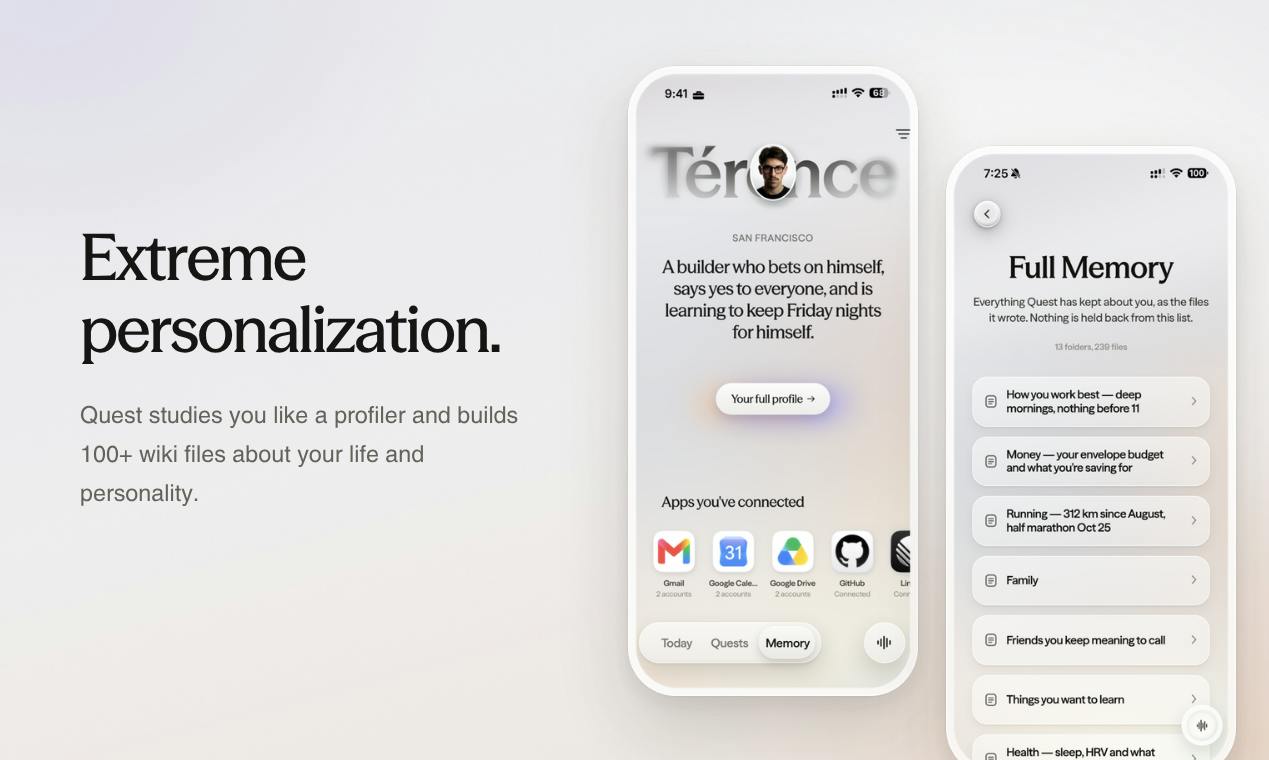
Most AI products on the market are solving the question of "how to do things faster": helping you write emails, summarize meeting notes, and generate code. But Quest, ranked fourth on Product Hunt, has taken the opposite path—it doesn't rush to complete tasks for you, but instead spends time understanding who you are, and then helps you make decisions that better align with your own values.
When AI Shifts from "Executor" to "Advisor"
Quest's positioning is clear: your personal AI advisor, helping you live a more intentional life. One line in its official description is worth pondering—"not another assistant telling you what to do, but a thoughtful advisor who helps you find your own path."
This distinction may seem subtle, but it points to two entirely different product philosophies. The value of mainstream AI assistants lies in execution: you give instructions, and it outputs results. Quest's value lies in understanding: it first builds an awareness of your personality, values, aspirations, and motivations, and then participates in your decision-making process based on that understanding. In the product's own words, it doesn't just "remember conversations"—it understands who you are as a person.
In terms of product categorization, Quest falls under three tags: Artificial Intelligence, Virtual Assistants, and iMessage Apps. The iMessage app attribute indicates that it tries to embed itself into everyday communication scenarios rather than requiring you to open another standalone app—lowering the barrier to use and making "chatting with an advisor" a convenient thing to do.
"Intentional life" is a commonly used concept in the personal growth and coaching field, referring to individuals consciously choosing how to allocate their time, energy, and attention with full awareness of their own values and goals, rather than being driven by external inertia or immediate impulses. It emphasizes that "why to do" comes before "how to do," contrasting with efficiency-oriented "productivity optimization." By putting this phrase into its official positioning, Quest is effectively declaring that its measure of value is not task completion volume, but the degree to which users' decisions align with their own values. This also explains why the product deliberately downplays execution capability: within the framework of an intentional life, making quick decisions on behalf of users may actually weaken their self-awareness—advisory-style intervention is the reasonable product form.
What Specific Problems It Solves
Quest targets those moments when "AI assistants can't help": facing two good but mutually exclusive choices, needing to review an experience, or wanting to think through what you truly care about regarding an important decision. These kinds of questions have no standard answers. General assistants typically offer a pros-and-cons list, while Quest attempts to provide a perspective based on long-term understanding of you.
Its core capabilities can be broken down into three layers:
Building a Personal Profile
Quest claims to spend time understanding users' personality, values, aspirations, and motivations. This is not simply recording preferences, but attempting to build a model of "you" that can be used for judgment. The product emphasizes that it doesn't just remember conversation content, which means it does an additional layer of interpretation beyond memory.
User modeling in conversational AI typically refers to extracting and continuously updating user attributes from interaction history, such as preferences, goals, personality tendencies, and constraints. A simple approach is recording explicit preferences (like "I don't like getting up early"), while a more complex one is inferring implicit traits based on behavioral and language patterns. Quest's emphasis on "not just remembering conversations" points to the latter: summarizing scattered conversations into a stable model that can be used for reasoning. The difficulties of this kind of modeling lie in cold start (insufficient information initially), drift (people's values change), and interpretability (users find it hard to verify whether the model is accurate). The ceiling of profile quality often determines the relevance of all subsequent suggestions.
Supporting Reflection and Decision-Making
After gaining sufficient understanding, Quest participates in users' reflection processes and difficult choices. The key phrase here is "help you reflect" rather than "decide for you"—the product repeatedly emphasizes not giving instructions and only helping users find their own path, which is both a product philosophy and a restraint against AI overstepping.
Non-directive AI draws on the "non-directive principle" in psychological counseling: the counselor does not make decisions for the client, but helps them reach their own conclusions through questioning, restating, and clarifying. Client-centered therapy since Carl Rogers is centered on this principle. Transplanting this principle to AI products means the system needs the ability to ask follow-up questions and respond empathetically, while restraining the impulse to give conclusions. The risk is that models lacking professional training may execute "not judging" as "being vague," leaving users feeling like they're spinning their wheels when they need concrete support. Therefore, the success of non-directive design depends on the quality of follow-up questions rather than the stance itself.
Aligning with Personal Values
The ultimate goal is to make decisions "consistent with who you are." This brings Quest closer to the role of a life coach or consultant rather than an extension of a productivity tool. A result of 91 upvotes and 2 comments on Product Hunt represents a state of being noticed but not yet sufficiently discussed, indicating that the concept is attractive but the feedback sample for actual experience is still very small.
Several Questions Worth Noting
Accuracy of the personalized model: How deeply AI can understand a person directly determines the value ceiling of advisory-style products. If the profile is off, all subsequent suggestions will be off-target. The product has not disclosed its specific modeling approach, and the actual effectiveness of this part requires real use to judge.
The boundary of "not giving answers": Not being a directive assistant is a good stance, but users expect effective help after paying. How to strike a balance between "helping you find your own path" and "providing sufficiently specific support" is a common challenge for this type of product.
Privacy and trust: A product that claims to understand your personality, values, and motivations holds information far more sensitive than ordinary tools. iMessage integration is a plus for convenience, but it also means conversation data flows through messaging channels, and users will have higher expectations for how data is handled. The official page does not elaborate on this part, which is a point to keep in mind.
Who Should Try It
If you already use AI for journaling, reviewing, or decision clarification, Quest's positioning falls right at the intersection of these scenarios. If you're expecting an efficiency tool that generates solutions in one sentence, it's probably not what you're looking for.
Ranking #4 on Product Hunt shows that the "AI advisor" direction has struck a chord with some people's needs—as execution-oriented AI becomes increasingly homogeneous, moving in the direction of "understanding people" may be the entry point for the next wave of product differentiation. Whether Quest can deliver on the promise of "a more intentional life" depends on whether its personalized model truly understands people well enough.
One-line Summary
Quest is a product positioned as a personal AI advisor that first understands who you are, then helps you make decisions aligned with your values.
Paragraph Summary
Quest is the fourth-ranked AI product on Product Hunt, taking a path opposite to mainstream productivity tools: rather than rushing to complete tasks for users, it first understands users' personality, values, aspirations, and motivations, then participates in reflection and life choices as an advisor. The product is categorized under Artificial Intelligence, Virtual Assistants, and iMessage Apps, embedding itself into everyday communication as an iMessage app to lower the barrier to use. Its capabilities are divided into three layers: building a personal profile, supporting reflection and decision-making, and aligning with personal values. The article also points out three questions yet to be verified: the accuracy of the personalized model, the balance between "not giving answers" and providing effective help, and the privacy and trust challenges brought by highly sensitive data.
Related articles
 Tech Frontiers
MuJoCo: An Analysis of DeepMind's Open-Source General-Purpose Physics Simulator
An in-depth analysis of Google DeepMind's open-source physics simulator MuJoCo: high-performance C++ kernel, MJCF modeling format, contact solving principles, MJX GPU acceleration, and robot reinforcement learning use cases.
 Tech Frontiers
Claude API Quick Start: The Official Quickstarts Project Collection
Anthropic's official claude-quickstarts project collection helps developers quickly build deployable apps with the Claude API. Nearly 20k stars, Python-based, great for beginners and prototyping.
 Tech Frontiers
AI Agents Connecting Directly to APIs: Which Calls Can Be Safely Allowed?
AI agents can call any API, but the real challenge is deciding which calls can be safely allowed. This article analyzes allowance decisions from three dimensions—intent matching, least privilege, and controllable impact—and argues that the control layer should sit outside the agent, combined with audit traceability to build a trustworthy API call governance mechanism.