Qwen 4.5 and Qwen 5 Roadmap Leaked: Parameter Sizes Keep Growing, Will the 27B Size Survive?

Qwen 4.5 and Qwen 5 will keep scaling up parameters, and the community worries that small and mid-sized tiers like 27B will be marginalized.
A Reddit post citing a screenshot of Qwen's official announcement notes that Tongyi Qianwen's future Qwen 4.5 and Qwen 5 will continue pushing toward larger parameter scales. The post author has mixed feelings: the good news is that model capabilities are expected to improve with scale; the bad news is that developers with limited resources may lose access to usable small and mid-sized models. They specifically hope Qwen will keep the 27B tier or offer reasonable mid-sized MoE options. The article analyzes the logic behind the parameter race—larger parameter counts typically bring stronger capabilities, but training and inference costs and deployment barriers rise accordingly. The community's core demand isn't opposition to bigger models, but rather a desire for the product line to maintain a gradient so users with different resource conditions all have choices. Qwen needs to balance pushing the capability ceiling with maintaining ecosystem accessibility.
Parameter Inflation Is a Done Deal: The "Point of No Return" for Qwen 4.5 and Qwen 5
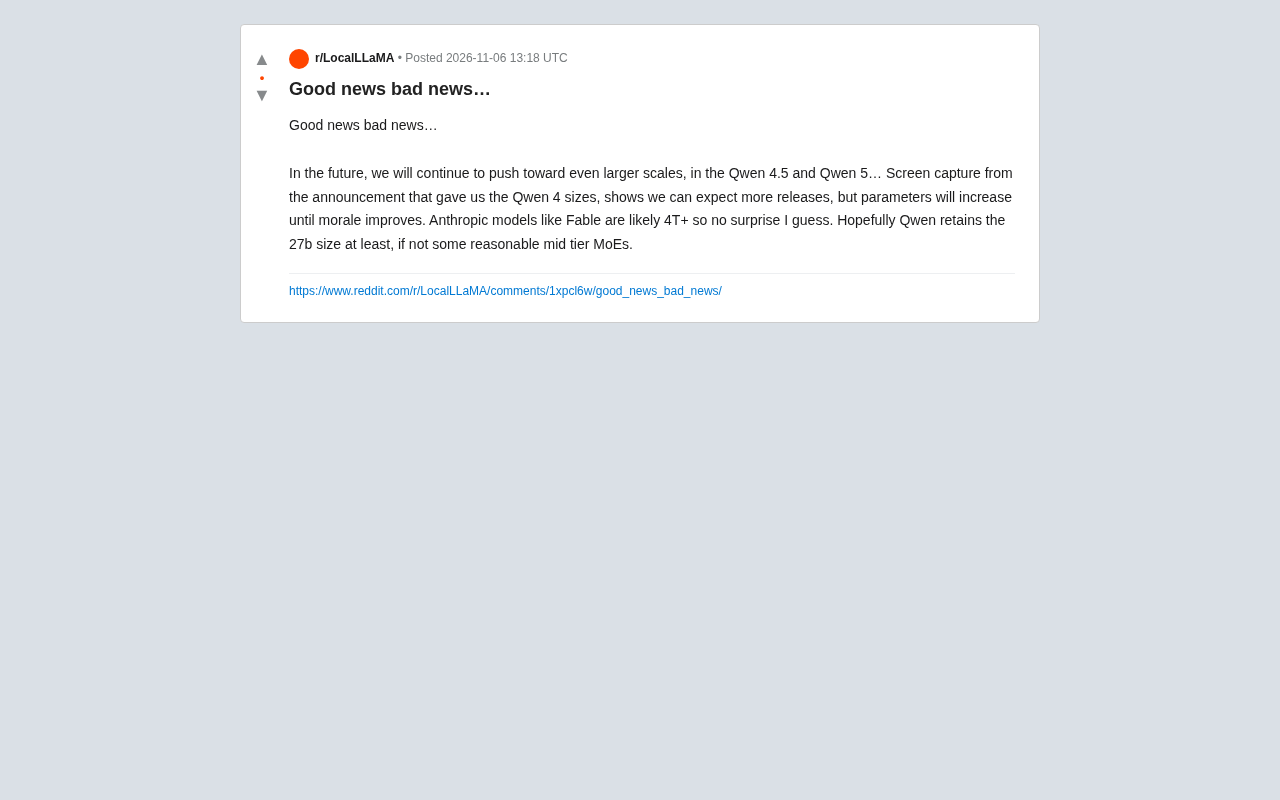
A recent Reddit post titled "Good news bad news…" has sparked widespread discussion. Citing a screenshot of an official announcement, the post notes that the Tongyi Qianwen team has made it clear they will continue pushing toward larger scales with Qwen 4.5 and Qwen 5. The screenshot shows that alongside revealing the Qwen 4 series sizes, the team shared expectations for future releases, wryly noting: parameters will keep growing until morale improves.
The "good" news is that the Qwen series is still iterating, and model capabilities are expected to strengthen further with scale. The "bad" news is that for developers and individual users with limited resources, available small and mid-sized models may become increasingly scarce. The post author admits that Anthropic's Fable and similar models are said to have reached parameter scales of 4T+, so Qwen's expansion isn't surprising. But they still hope Qwen will at least keep the 27B tier, or offer some reasonable mid-sized MoE (Mixture of Experts) models.
Why Is Every Large Model Racing to Add Parameters?
Looking at industry trends, parameter inflation isn't unique to Qwen. The Anthropic model mentioned in the post is said to reach 4T+, and while that figure hasn't been officially confirmed, it's an open secret that leading vendors are pushing trillion-scale and larger models. The logic isn't complicated: larger parameter counts typically mean greater knowledge capacity and reasoning potential, making it easier to gain an edge in benchmarks and complex tasks.
However, the costs of this path are equally obvious. Training costs, inference costs, energy consumption, and deployment barriers all rise with parameter scale. For cloud providers and well-funded AI labs, these are bearable investments; but for developers relying on local deployment or limited compute,超大 models are simply out of reach. This is precisely why the post author is so focused on whether the 27B tier survives—this range strikes a good balance between performance and resource consumption, making it a "sweet spot" size for many practical applications.
MoE (Mixture of Experts) architecture is key context for understanding current discussions about model scale. Traditional dense models activate all parameters during each inference, while MoE models divide parameters into multiple "expert" subnetworks and use a gating mechanism to activate only a few experts per forward pass. This means a model's total parameter count can be very large, but the actual computation per inference (i.e., activated parameters) remains relatively manageable. For example, an MoE model with hundreds of billions of total parameters might activate only 20B-30B parameters per inference, significantly reducing inference costs while maintaining strong capabilities. This is exactly why the community is calling for "reasonable mid-tier MoEs": they can deliver near-large-model performance under limited compute, making them an important compromise for resource-constrained scenarios.
27B and Mid-Tier MoE: What the Community Really Cares About
The two recurring keywords in the post are "27b size" and "reasonable mid tier MoEs." This reflects the core demand of community users: they're not opposed to models getting bigger, but they want the product line to maintain a gradient so users with different resource conditions all have options.
A 27B-class dense model can run on a single GPU or a small number of GPUs, making it suitable for fine-tuning and deployment by small and mid-sized teams. Mid-sized MoE models, meanwhile, use sparse activation to call only some parameters during inference, keeping large total parameter counts while controlling computation—seen by many as a way to balance performance and efficiency. If Qwen 4.5 and Qwen 5 only evolve toward ultra-large parameters and cut these intermediate tiers, migration costs for community users will rise significantly.
The 27B-class dense model has become the community's "sweet spot size" largely because of its hardware compatibility. At FP16 precision, a 27B model requires roughly 54GB of VRAM, which can be compressed to about 14-16GB with 4-bit quantization—just enough to run on a single 24GB consumer GPU (such as an RTX 3090/4090) or a small number of professional cards. This size offers strong cost-performance for fine-tuning, local inference, and small-to-mid-scale deployment: it's not as capability-limited as a 7B model, nor does it require multi-GPU parallelism like 70B+ models. For open-weight models, keeping this tier means maintaining an active developer ecosystem, so research and application innovation don't have to rely entirely on cloud APIs.
Concerns and Hopes Amid the Scale Race
Judging from the wording in the announcement screenshot, the official attitude toward parameter growth carries a hint of self-deprecation, but the direction is clear. For an open-weight model series like Qwen, large-scale and small-to-mid-scale versions can actually coexist—the former to push the capability ceiling, the latter to keep the ecosystem active.
The post's discussion also reflects a common mindset in the open-source model community: excitement about the capability leaps that stronger models bring, alongside worry that the sizes they commonly use will be marginalized. Which sizes Qwen 4.5 and Qwen 5 will ultimately offer, whether the 27B tier will be kept, and whether mid-tier MoE will become the new mainstay all remain unknown. But one thing is certain: the parameter scale race won't stop anytime soon, and how to balance "bigger" with "usable" will be a question the Qwen team needs to answer seriously.
One-line Summary
Qwen 4.5 and Qwen 5 will continue expanding parameter scale, with the community worried that small and mid-sized tiers like 27B will be marginalized.
Paragraph Summary
A Reddit post citing a screenshot of Qwen's official announcement notes that Tongyi Qianwen's future Qwen 4.5 and Qwen 5 will continue pushing toward larger parameter scales. The post author has mixed feelings: on one hand, model capabilities are expected to improve with scale; on the other, developers with limited resources may lose access to usable small and mid-sized models. They specifically hope Qwen will keep the 27B tier or offer reasonable mid-sized MoE options. The article analyzes the logic behind the parameter race—larger parameter counts typically bring stronger capabilities, but training and inference costs and deployment barriers rise accordingly. The community's core demand isn't opposition to bigger models, but rather a desire for the product line to maintain a gradient so users with different resource conditions all have choices. Qwen needs to balance pushing the capability ceiling with maintaining ecosystem accessibility.
Related articles
 Tech Frontiers
Coldframe: A Honeypot Disguised as a Supermarket Freezer Controller
Coldframe is a honeypot disguised as Danfoss AK-SM 800A and Dixell XWEB freezer controllers, built as a single Python file that detects CVE-2025-41450 attempts and is identified as real devices on Shodan.
 Tech Frontiers
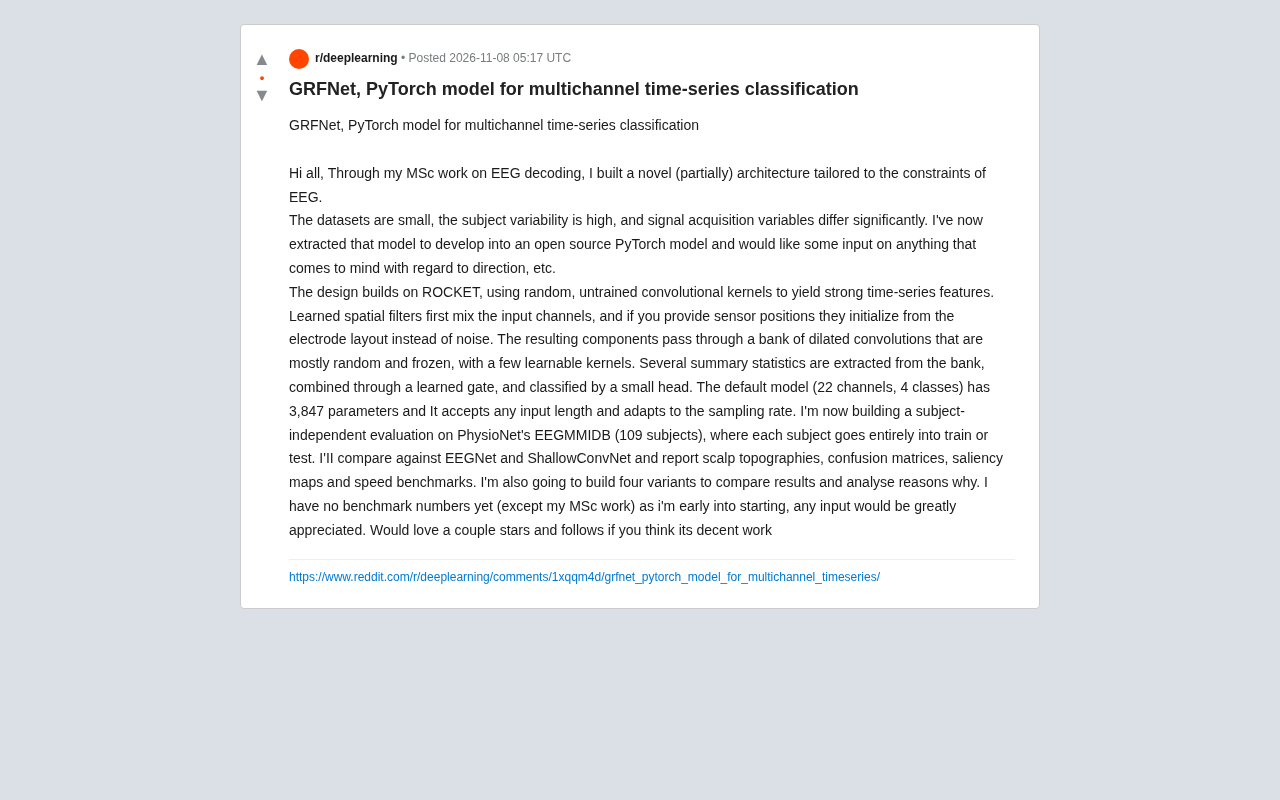
GRFNet: A Lightweight PyTorch Model Designed for Multichannel Time-Series Classification
GRFNet is a lightweight PyTorch model for multichannel time-series classification, originating from EEG decoding research. With only 3,847 parameters, it is based on the ROCKET architecture, combining random convolution kernels with learnable spatial filters, supports arbitrary input lengths, and will soon be evaluated on the PhysioNet dataset.
 Tech Frontiers
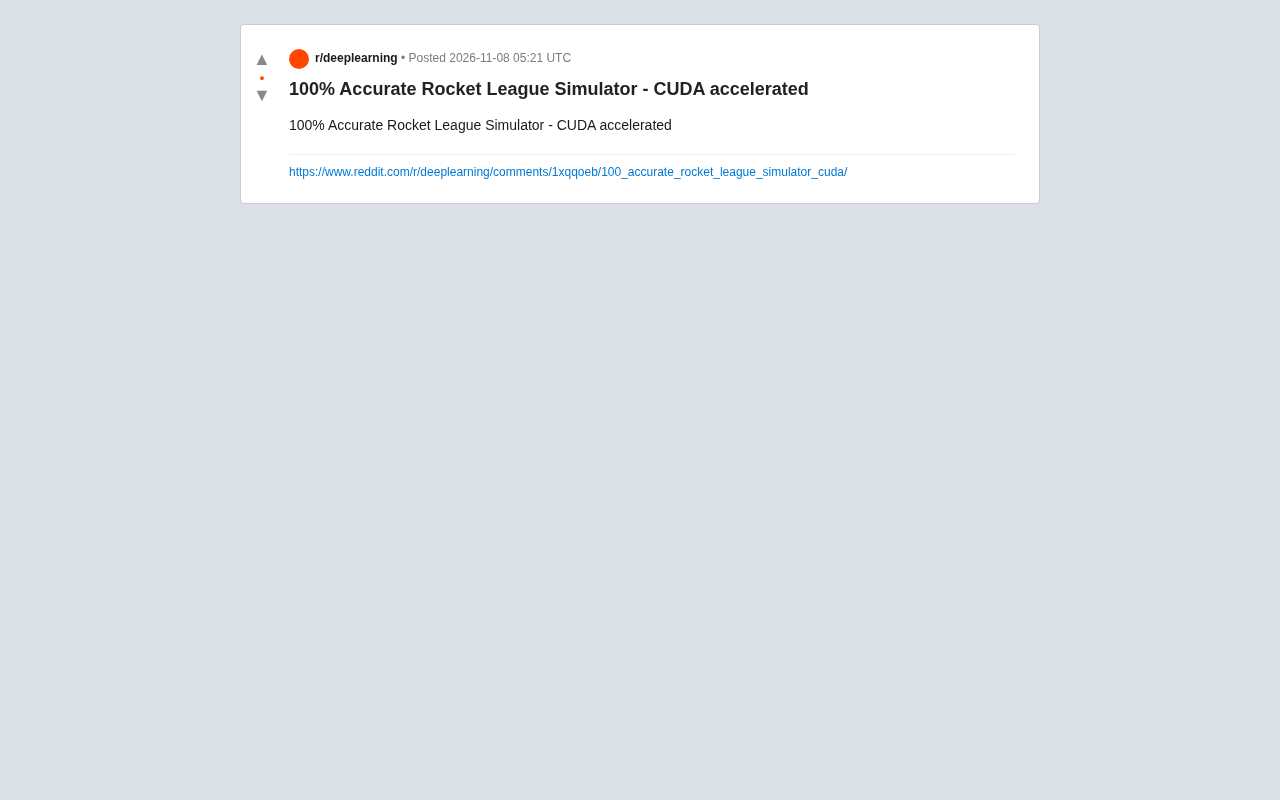
CUDA-Accelerated Rocket League Simulator: A Player-Made Hardcore Experiment
A Reddit post shows a "100% Accurate" Rocket League simulator accelerated with CUDA. We analyze its technical context, CUDA's value in game physics simulation, and the significance and limitations of such community projects.