Qwen4's 1M Context Window Leaked: 27B and Max Versions Coming Soon
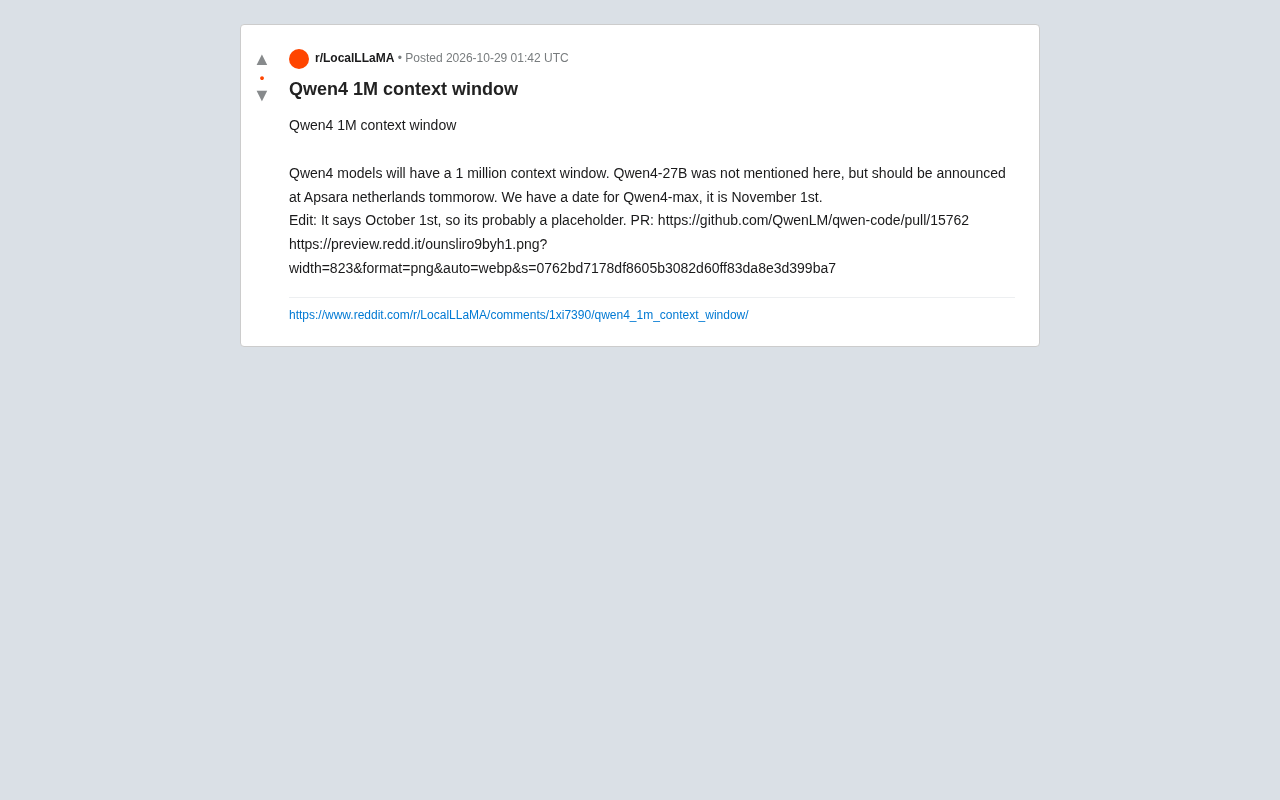
Leak: Qwen4 to support 1M context across all versions, with 27B and Max launching soon.
Based on a Reddit community leak, Alibaba's next-gen Qwen4 models will all support a 1M token context window, sourced from a GitHub PR in the qwen-code repo and a leaked screenshot. The leak suggests Qwen4-27B may be announced at the Apsara conference in the Netherlands, while Qwen4-max's date first showed November 1st then October 1st, which the leaker considers a placeholder. The article analyzes the industry significance of million-token context: long context is moving from showmanship to practicality and could reshape RAG chunking strategies, but brings unknowns around inference cost, latency, and long-context performance degradation. The 27B size is friendly for single-GPU deployment and the open-source community. All information is unconfirmed officially and awaits formal announcement.
Qwen4's 1M Context Window Leaked: 27B and Max Versions Coming Soon
According to leaks from the Reddit community, the next-generation model from Alibaba's Tongyi Qianwen team, Qwen4, will feature a 1M (one million) token context window. The information comes from a GitHub PR (QwenLM/qwen-code#15762) containing relevant configuration details, along with a leaked screenshot as supporting evidence.
Qwen4 Core Details: 1M Context and Version Roadmap
According to the post, the entire Qwen4 series will support a 1M context window. This means the model can process ultra-long documents, large codebases, or lengthy conversation histories in a single pass — a major step forward for long-text understanding and generation tasks.
The post also revealed the specific release cadence for each version:
- Qwen4-27B: Although not directly mentioned in the PR, the leaker claims this version will be announced at the Apsara conference in the Netherlands (pointing to "tomorrow").
- Qwen4-max: Date information is explicit, initially showing November 1st, but an edit update noted it actually reads October 1st, so the date is likely a placeholder and the final release date remains TBD.
Original excerpt: Qwen4 models will have a 1 million context window. Qwen4-27B was not mentioned here, but should be announced at Apsara netherlands tommorow. We have a date for Qwen4-max, it is November 1st. Edit: It says October 1st, so its probably a placeholder.
Industry Significance of a Million-Token Context
A 1M context window is not unprecedented — other models have demonstrated similar capabilities before — but Qwen4 making it standard across the entire lineup signals that long context is moving from "showmanship" to "practicality." For developers, this directly impacts the design philosophy behind RAG (Retrieval-Augmented Generation): when a model can reliably handle millions of tokens, many scenarios no longer require complex retrieval chunking — you can simply stuff an entire book or a whole project repository into the prompt.
However, expanding the context window also brings challenges around inference cost and latency. The attention computation for 1M tokens is enormous, and real-world usability depends on the level of inference optimization. The leak does not mention performance degradation under long contexts, which will be a key point to watch.
Context Windows and Attention Computation
The context window refers to the maximum number of tokens a model can accept in a single inference pass — it determines "how much content the model can see at once." Mainstream Transformers use self-attention, where each token computes relevance against every other token in the sequence, and standard implementations scale computation and memory usage quadratically with sequence length. So going from 32K to 1M could theoretically increase computation by roughly a thousand times. The industry typically mitigates this with techniques like FlashAttention, sparse attention, sliding windows, chunked processing, and KV Cache compression, but these optimizations often introduce trade-offs in precision or recall on ultra-long sequences. This is why "supports 1M" and "maintains usable quality at 1M" are two different questions.
RAG and Long Context
RAG (Retrieval-Augmented Generation) works by splitting documents into small chunks, building a vector index, and at inference time retrieving only the most relevant segments to assemble into the prompt — thereby sidestepping context length limits and reducing token costs. Long-context models don't necessarily replace RAG: when the corpus far exceeds 1M tokens, retrieval is still needed; but for medium-scale scenarios that emphasize holistic relationships (e.g., reading through a contract, understanding an entire codebase), putting the full text into context avoids the semantic fragmentation and retrieval gaps caused by chunking. In practice, the more common pattern is a combination of both — use retrieval to narrow the scope first, then let a long-context model do deep integration. On cost: long context is billed by input tokens, so flooding the prompt with massive amounts of irrelevant content actually costs more — another factor to weigh in design.
Interpreting Version Naming and Release Cadence
The Qwen4-max date shifting from November 1st to October 1st, with the leaker themselves judging it a "placeholder," suggests the official date has not been finalized. Meanwhile, Qwen4-27B choosing to debut at the Apsara conference in the Netherlands aligns with Alibaba Cloud's tradition of releasing major models at tech conferences. The 27B size sits between small-to-medium and large, suitable for single-GPU or few-GPU deployment, and friendly to the open-source community.
Interestingly, the GitHub PR itself is a change to the qwen-code repository, possibly involving context configuration for a code model, but the community has interpreted it as a clue about Qwen4's overall specs. This phenomenon of "reverse-engineering products from PRs" is not uncommon in open-source communities, and the accuracy of the information needs official confirmation.
Positioning of the 27B Parameter Scale
27B is a medium-to-large dense model size, sitting between the lightweight 7B–14B range and large models of 70B and above. At FP16 precision, 27B weights require roughly 54GB of VRAM; quantized to 4-bit, about 14–16GB, which can run on a single high-VRAM consumer GPU or a few professional cards — making it relatively friendly for local deployment and the open-source community. This size is typically used to strike a balance between capability and deployment cost: capable of handling complex tasks like code completion and document Q&A, without depending on multi-GPU clusters like very large models. If this version is released with open weights, it will become an attractive baseline choice for local inference and fine-tuning.
Impact and Expectations for Developers
If the entire Qwen4 lineup supports 1M context, the most direct beneficiaries will be code assistants, long-document Q&A, and Agent applications. Tasks like repository-level understanding, cross-file refactoring, and long legal contract analysis will gain better foundational capabilities. Meanwhile, if the 27B version is open-sourced, it will bring new options for local deployment.
All current information comes from community leaks. We recommend following official channels (Alibaba Cloud, the Qwen GitHub repository) for formal announcements to get accurate release plans and model card information.
This article is based on leaks from the Reddit community; actual specifications are subject to official release.
Related articles
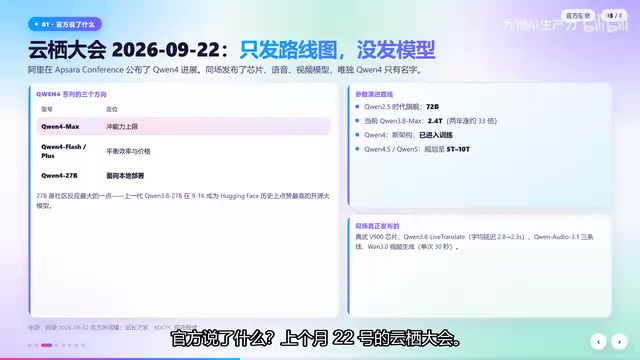
Qwen4 Architecture Preview Open-Sourced: 125B Parameters, 512 Experts, Designed for VRAM-Constrained Hardware
Qwen4 isn't released yet, but its architecture is previewed via open-source Qwen3.8 Flash Next: 125B params, 6B activated per token, 512 experts, 262K context, built for VRAM-limited hardware. This article covers official confirmations, key config.json metrics, and local deployment tests on 24G memory.
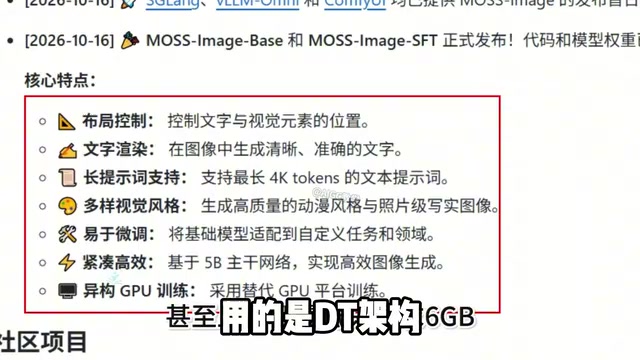
Run 8K Images on 6GB VRAM! Hands-On Test of Fudan's Open-Source MOSS-Image Model
Fudan OpenMouse team and Shanghai MOSS Intelligence open-source MOSS-Image, a 500M-parameter DT architecture text-to-image model that runs locally on 6GB VRAM with precise text rendering, structured layout control, and 4K Token prompt support—ideal for e-commerce posters and local deployment by individual creators.
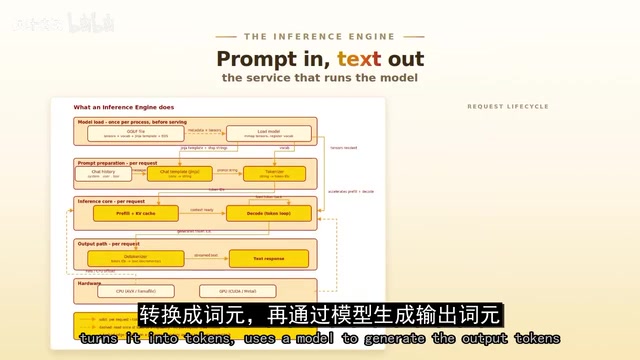
Overseas Blogger Tests Local Deployment of 100B-Parameter MoE Model: Key Lessons on Quantization and Tool Calling
Overseas blogger tests local deployment of Alibaba's Qwen 3.8 Flash Next 100B MoE model on a Strix Halo mini PC and CUDA workstation, revealing how quantization precision affects tool-calling success and the real-world performance of the Strata and GUFO inference engines.