r/OpenSource Bans AI Content, Moderator Blames Lunduke Amid Backlash
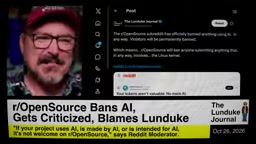
r/OpenSource's blanket AI ban sparks controversy over logical loopholes and brigading accusations.
Reddit's r/OpenSource announced a blanket ban on AI-related projects, content, and discussion, with violators facing permanent bans—and many have already been enforced. The rule's scope is overly broad: according to Lunduke, at least 20% of recent Linux kernel code was written by AI, so under the new rules, discussing Linux itself could trigger a ban. The announcement post drew over 2,000 negative comments, which moderators blamed on brigading sparked by Lunduke and Tim Sweeney; Kotaku's coverage was sarcastically dismissed by Lunduke as "it's all my fault." The incident highlights the governance dilemma facing open-source communities over the legitimacy of AI-generated code: one-size-fits-all bans fundamentally conflict with the reality that mainstream open-source ecosystems are already deeply embedded in AI toolchains.
The Reddit community r/OpenSource recently made a highly controversial decision: a blanket ban on all AI-related content. Enforcement has been aggressive—not only are posts removed, but violators face permanent bans. However, the logical flaws in the rule quickly drew widespread criticism, and the moderators' subsequent response only intensified the controversy.
A Self-Contradictory Ban
According to the r/OpenSource moderators' announcement, any project that uses AI, is generated by AI, or is intended for AI purposes is unwelcome. The moderators explicitly stated that violators will face permanent bans (perma-ban), and they are indeed enforcing this rule—many users have been banned.
The problem is that the rule's scope is extremely broad. In a video, YouTube tech commentator Lunduke pointed out that at least 20% of code commits to the Linux kernel in recent months were written by AI. Under r/OpenSource's new rules, even discussing Linux itself could trigger a ban. This inference is not deliberate nitpicking but a direct consequence of the rule's text—when "using AI" is defined as an untouchable red line, and modern open-source projects almost inevitably use AI-assisted tools somewhere, the boundary of the ban becomes blurry and unenforceable.
Lunduke mocked the policy in a post on X titled "Your tokens are not valuable. No more AI." He quoted the moderator's exact words: "If you post or comment content we don't like, such as the results of your LLM output tokens, you will never be welcome back."
Community Backlash and the "Outside Agitators" Narrative
After the rule was announced, the comment section of the announcement post was quickly flooded with opposition. According to Lunduke in his video, the post's comment count grew from around 2,300 and continued to climb, with the vast majority criticizing the rule.
But the moderators' reaction was unexpected. In a separate comment, an r/OpenSource moderator blamed the negative response on "some guy on Twitter who calls himself alternative news" for directing hundreds of people to the post, characterizing it as "brigading" (organized cross-subreddit harassment).
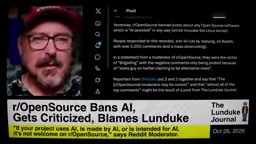
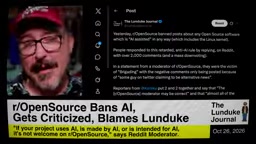
Kotaku later reported on the matter, linking the "Twitter user" referenced by the moderator to Lunduke. The report also mentioned that Epic Games CEO Tim Sweeney commented under Lunduke's post, which may have amplified the spread. Kotaku also noted that most of the highly upvoted comments under the announcement came from users who had never previously posted in r/OpenSource—which the moderators viewed as evidence of brigading.
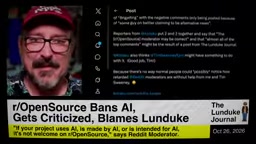
Lunduke's response was dripping with sarcasm: "So, it's all my fault. Kotaku also thinks Tim Sweeney might have been involved in the brigading, right? Because ordinary people couldn't possibly notice on their own how absurd a Reddit moderator's rules are—it must have taken me and Tim Sweeney to help them."
Brigading is a governance term on platforms like Reddit, referring to an external community organizing to flood another subreddit, using concentrated posting, commenting, or voting to manipulate public opinion or disrupt normal discussion. In Reddit's moderator tools, traffic from links in other subreddits, a large influx of new faces in a short time, and abnormal fluctuations in vote scores are all common signals for identifying brigading. Reddit officially disapproves of such behavior, and subreddits with serious violations may be quarantined or banned. However, the determination of brigading is itself controversial: moderators often rely on subjective judgment, and "a large number of new users expressing similar opinions" could be either organized action or simply the natural result of a piece of content going viral. This ambiguity means brigading accusations are sometimes used to delegitimize valid criticism.
The Boundary Dispute in Open-Source Governance
Setting aside the personal grudges and sarcastic theatrics, this controversy touches on a real tension in open-source community governance: the legitimacy of AI-generated code in open-source projects.
The proportion of AI-assisted code in the Linux kernel is a noteworthy indicator. If it is indeed around 20% as Lunduke claims, then any open-source community rule that categorically excludes AI content must confront a reality: mainstream open-source projects themselves are already deeply embedded in AI toolchains. Banning discussion of these projects amounts to isolating the community from the mainstream of the open-source ecosystem.
On the other hand, the moderators' concern about the influx of AI-generated content is not entirely unfounded. A large volume of low-quality AI-generated "projects" can indeed dilute community content quality, and brigading is a real problem on Reddit. The issue is that when rules are designed too broadly and enforced too rigidly, originally reasonable concerns can easily turn into suppression of normal discussion.
Lunduke offered his own summary at the end of the video: "These stupid stories just keep coming one after another." He also jokingly anointed himself "brigadier general," thanking subscribers for the title.
The trajectory of this controversy depends on whether r/OpenSource moderators are willing to adjust the rule text. Judging from their current attitude, they show no signs of softening. For a community that calls itself "open source," the cost of shutting out AI-related content with a one-size-fits-all ban may far outweigh the benefits.
The issue of AI-assisted code in the Linux kernel needs to be understood within its specific processes. The kernel community uses a mailing-list-driven patch review system, where every submission must be reviewed by a maintainer and retains provenance tags such as Signed-off-by. In recent years, controversy over AI-generated code has centered on two points: first, the license compatibility risks of GPL code potentially mixed into training data; second, the difficulty of tracing the original authors of AI-generated snippets, which creates tension with the kernel's Developer Certificate of Origin (DCO) system. Since 2024, the kernel community has repeatedly discussed whether to require disclosure of AI tool usage. Lunduke's claim that "20% of code is written by AI" has no official statistical support, but even if the proportion is far lower, it is enough to show that the coupling between mainstream open-source projects and AI toolchains can no longer be cut apart with one-size-fits-all rules.
Related articles

The Truth Behind Titanic's Sinking: Key Decisions and Communication Failures in the National Geographic Documentary
National Geographic's The Unsinkable Ship uses survivor testimony to reconstruct Titanic's fatal decisions—from the missing MSG telegram prefix and the broken boiler-room-to-bridge link to how 'unsinkable' thinking delayed damage control and evacuation.

74M-Parameter Open-Source Model Partially Outperforms Jev AI in Testing
Fastino AI's Glider 2.5 models, with just 74M–300M parameters, reportedly outperform Jev AI in some guardrail benchmarks per YouTube testing, run on consumer hardware, and even play Doom. We analyze small models' competitiveness and deployment value on specific tasks.

Gemini 4 Argon Hands-On: Aggressive Pricing, 3D Capabilities Need Coaching
Gemini 4 Argon hands-on: limited-time $2/$10 pricing, million-token output, strong 3D and reverse-engineering work, but weak front-end aesthetics and zero-shot ability need coaching.