RAG Technology Deep Dive: From Core Principles to GraphRAG and Agentic RAG Advanced Practices

A comprehensive guide to RAG technology, from core principles to GraphRAG and Agentic RAG.
This article systematically explores RAG (Retrieval-Augmented Generation), the essential technology behind 90%+ of enterprise AI applications. It covers why LLMs need RAG to combat hallucination, knowledge cutoffs, and private data gaps, then explains RAG's open-book exam approach. Advanced topics include GraphRAG's knowledge graph integration for cross-document reasoning and Agentic RAG's intelligent agent-driven decision-making for handling temporal conflicts and abstract queries.
Why Enterprise AI Can't Live Without RAG
Statistics show that over 90% of enterprise AI applications use RAG (Retrieval-Augmented Generation) technology. The core reason is simple: large language models inherently suffer from hallucination problems. In production environments, a model that confidently fabricates information is extremely dangerous.
Introducing RAG technology can reduce a large model's hallucination rate to below 5% — a significant improvement. More importantly, RAG enables enterprises to build their own private knowledge bases, allowing general-purpose LLMs to truly understand specific business contexts and generate reliable, trustworthy answers.
This article systematically covers RAG technology across four dimensions: the limitations of large language models, how RAG works, enterprise use cases, and advanced technical evolution represented by GraphRAG and Agentic RAG.
Three Major Limitations of Large Language Models
Hallucination Remains a Critical Problem
Many people assume that as model capabilities advance rapidly, the hallucination problem has disappeared. The reality is quite the opposite — when models become smart enough, their errors become harder to detect, and that's the real danger.
From a technical perspective, LLM hallucinations stem from the underlying architecture — Transformer models are fundamentally probabilistic prediction systems that generate text by predicting the next most likely token. Models don't possess true "fact verification" capabilities; they merely simulate knowledge expression at a statistical level. When training data coverage for certain knowledge is insufficient, or when questions fall outside the training distribution, the model still outputs content with the same confident tone — but that content may be entirely fabricated. What's more dangerous is that as model parameter scales increase and generation quality improves, the fluency and logical coherence of outputs also improve, making false information harder for humans to identify.
Even for the most cutting-edge models, officially reported error rates remain in the double-digit percentages. This means the hallucination problem has not been fundamentally solved, and enterprises cannot blindly trust raw LLM outputs.
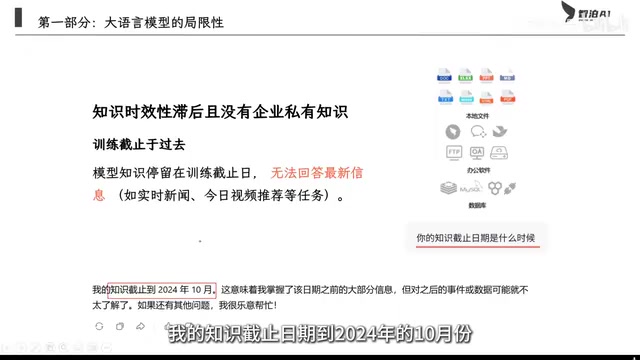
Knowledge Has a Temporal Cutoff
An LLM's knowledge comes from public data used during training. However, since training costs are extremely high (a single large-scale training run can cost millions or even tens of millions of dollars in compute), models can't be retrained daily. As a result, their knowledge has a clear "cutoff date."
This means models can't access today's news, real-time recommendations, or the latest market trends. For business scenarios that require real-time information, relying solely on LLMs is far from sufficient.
No Access to Enterprise Private Data
All training materials are based on public content, so no model can answer questions about an enterprise's internal private information. If a model "answers" a private enterprise question, it's certainly fabricating. This is the core pain point that RAG was designed to solve.
How RAG Works: Giving AI an Open-Book Exam
RAG, which stands for Retrieval-Augmented Generation, combines information retrieval with text generation, as the name suggests. The technique was formally introduced by Meta AI (formerly Facebook AI Research) in a 2020 paper. Its core idea is to combine parametric knowledge (the model's internal memory) with non-parametric knowledge (external document stores).
Its workflow can be summarized as:
- The user asks a question
- The system searches the knowledge base for relevant document chunks based on the question
- The user's question and the retrieved document chunks are sent to the LLM together
- The LLM generates an accurate, trustworthy answer "based on the reference materials"
To put it simply, this is like an open-book exam — letting the LLM review reference materials before answering questions so it doesn't make things up. RAG's core value lies in allowing the LLM to retrieve information from an external knowledge base before answering, then generating reliable responses based on that information.
Technical Foundations of the Retrieval Component
The retrieval component in RAG systems is typically implemented using vector databases (such as Pinecone, Milvus, Weaviate, Qdrant, etc.). The core technology involves converting both documents and queries into high-dimensional vector representations through Embedding models (such as OpenAI's text-embedding-ada-002, the BGE series, etc.), then finding the most semantically similar document chunks using metrics like cosine similarity or inner product. Unlike traditional keyword search, vector retrieval can understand semantic-level similarity — for example, when a user searches for "employee resignation process," even if the document uses phrasing like "personnel change procedures," the system can still match correctly. This semantic matching capability is the foundational guarantee of RAG system effectiveness.
Additionally, a frequently overlooked but critically important step is the document chunking strategy. Since LLMs have limited context windows and retrieval precision is highly correlated with document granularity, how documents are split directly impacts final results. Common strategies include fixed-length chunking, semantic paragraph chunking, and recursive chunking. Chunks that are too large reduce retrieval precision (introducing too much irrelevant information), while chunks that are too small may lose contextual meaning. The industry is currently exploring intelligent chunking based on semantic boundaries and Parent-Child document strategies to balance this trade-off.
Enterprise Use Cases for RAG
Smart Weekly Reports and Work Summaries
Traditional AI cannot complete tasks like "summarize the company's weekly report" because it doesn't have access to internal enterprise data. However, a RAG system integrated with a knowledge base (especially a graph database) can automatically generate a complete team progress report with just one sentence — including specific metrics like task improvement rates and data volume changes.
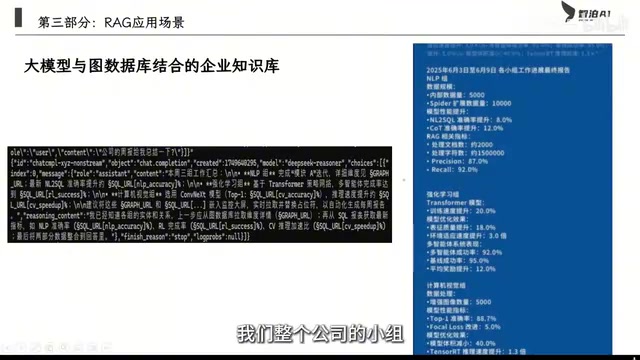
Financial Knowledge Graphs and Business Insights
Another typical scenario involves combining financial knowledge graphs to quickly grasp operational changes in partner companies. By building knowledge graphs from user operational data and partner financial data, LLMs can automatically uncover hidden needs of partners, helping enterprises better capture business opportunities.
Advanced RAG Technologies: GraphRAG and Agentic RAG
GraphRAG: Enabling AI to Understand Hidden Connections Between Documents
The core of GraphRAG is integrating knowledge graphs into the traditional RAG workflow. The key concept here is the "triple."
A Knowledge Graph is a structured knowledge representation method, first proposed and applied at scale by Google in 2012 for search engines. It organizes information in graph form, where nodes represent entities (people, places, concepts, etc.) and edges represent relationships between entities. In enterprise scenarios, building a knowledge graph typically involves data collection, Named Entity Recognition (NER), Relation Extraction (RE), knowledge fusion, and other steps. Compared to pure text retrieval, the core advantage of knowledge graphs lies in their ability to perform multi-hop reasoning — discovering hidden connections between A and C through the relationship chain A→B→C. This is a capability that traditional vector retrieval struggles to achieve.
A triple consists of two entities and the relationship between them. For example:
- Entity 1: The Shawshank Redemption (a movie)
- Entity 2: Morgan Freeman (an actor)
- Relationship: Stars in
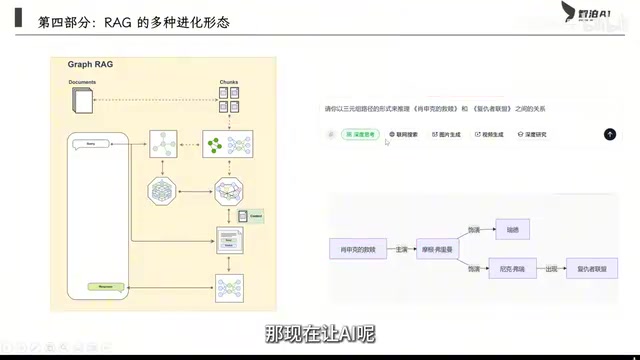
When we have AI reason about inter-document relationships in triple form, it can discover cross-document connections. For instance, AI can identify role connections of the same actor across different works. Through this approach, GraphRAG truly achieves "searching across all enterprise knowledge bases with a single query," dramatically improving cross-document information integration capabilities.
Microsoft Research officially released the GraphRAG framework in 2024. Its core workflow includes: using LLMs to automatically extract entities and relationships from documents to build a graph, then applying community detection algorithms (such as the Leiden algorithm) to perform hierarchical clustering on the graph, generating community summaries at different granularities. This enables the system to answer not only granular detail questions but also comprehensive questions that require a global perspective.
Agentic RAG: Introducing Intelligent Agent Decision-Making
Agentic RAG introduces intelligent agents into the RAG workflow, giving the system autonomous decision-making and task planning capabilities.
Agents are a popular paradigm in the AI field in recent years. The core idea is to give AI systems a "perceive-plan-act-reflect" loop capability. In Agentic RAG, an Agent typically has the following key modules: a task planner (decomposing complex questions into subtasks), a tool invoker (deciding when to use retrieval, computation, or external APIs), a memory module (maintaining context consistency), and a reflection module (evaluating intermediate result quality and deciding whether additional retrieval is needed). This architecture upgrades the RAG system from a linear "retrieve once, generate once" process to an iterative, self-correcting intelligent workflow.
Agentic RAG primarily solves three types of problems that challenge traditional RAG:
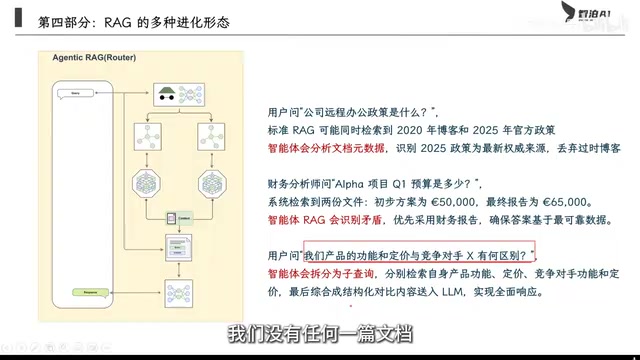
Handling temporal conflicts: When a user asks about "the company's remote work policy," traditional RAG retrieves all information from different years and gets confused. Agentic RAG can analyze document metadata (publication year, modification date), identify the most current authoritative policy, and discard outdated information.
Identifying data contradictions: When financial documents contain conflicting data, the agent can identify contradictions and adopt the more authoritative and accurate answer.
Decomposing abstract questions: For abstract questions like "How do our products differ from competitors?" — where no single document directly contains the answer — Agentic RAG can understand the user's intent, break it down into multiple specific sub-questions (own product features, pricing, who the competitors are, etc.), query each separately, and then synthesize a comprehensive response.
Remaining Limitations of RAG
Although RAG systems are already quite powerful, they are not perfect and still have two key limitations:
Scattered answer problem: When a complete answer is distributed across multiple document chunks, if the retrieval step misses some chunks, the final generated content may be incomplete or even incorrect. This is fundamentally because current retrieval methods (whether vector-based or keyword-based) score relevance between queries and individual chunks, making it difficult to ensure that multiple complementary chunks are retrieved simultaneously. The industry is addressing this through techniques like multi-round retrieval, Query Rewriting, and Hypothetical Document Embeddings (HyDE).
Information quality dependency: RAG is highly dependent on the quality of retrieved results. Suppose an enterprise has 100,000 documents, retrieves 100 of them, but only a few are valuable while the rest may contain errors or misleading information. Once the LLM adopts these "garbage documents," it will generate false, contradictory answers. This is why enterprises need to invest significant effort in data governance — data cleaning, document deduplication, version management, and access control — before deploying RAG systems. As the saying goes, "Garbage In, Garbage Out" — the quality of the knowledge base determines the upper limit of the RAG system.
Conclusion
RAG technology effectively compensates for the inherent shortcomings of large language models in hallucination, knowledge timeliness, and private data access through its "retrieval + generation" open-book exam approach, making it the standard for enterprise AI deployment. The emergence of GraphRAG and Agentic RAG further enhances the system's ability to understand cross-document relationships and complex user intents.
However, we should also clearly recognize that RAG system performance is highly dependent on retrieval quality and document organization. Understanding these limitations is essential for leveraging strengths while mitigating weaknesses in real-world engineering, ultimately building truly reliable enterprise knowledge bases.
Related articles

The Truth Behind Titanic's Sinking: Key Decisions and Communication Failures in the National Geographic Documentary
National Geographic's The Unsinkable Ship uses survivor testimony to reconstruct Titanic's fatal decisions—from the missing MSG telegram prefix and the broken boiler-room-to-bridge link to how 'unsinkable' thinking delayed damage control and evacuation.

74M-Parameter Open-Source Model Partially Outperforms Jev AI in Testing
Fastino AI's Glider 2.5 models, with just 74M–300M parameters, reportedly outperform Jev AI in some guardrail benchmarks per YouTube testing, run on consumer hardware, and even play Doom. We analyze small models' competitiveness and deployment value on specific tasks.

Gemini 4 Argon Hands-On: Aggressive Pricing, 3D Capabilities Need Coaching
Gemini 4 Argon hands-on: limited-time $2/$10 pricing, million-token output, strong 3D and reverse-engineering work, but weak front-end aesthetics and zero-shot ability need coaching.