React Native AI Agent Guardrails Library: FaceID Gating and Zero-Trust Tool Governance

React Native guardrails library brings AI tool call governance to mobile with FaceID gating for high-risk actions.
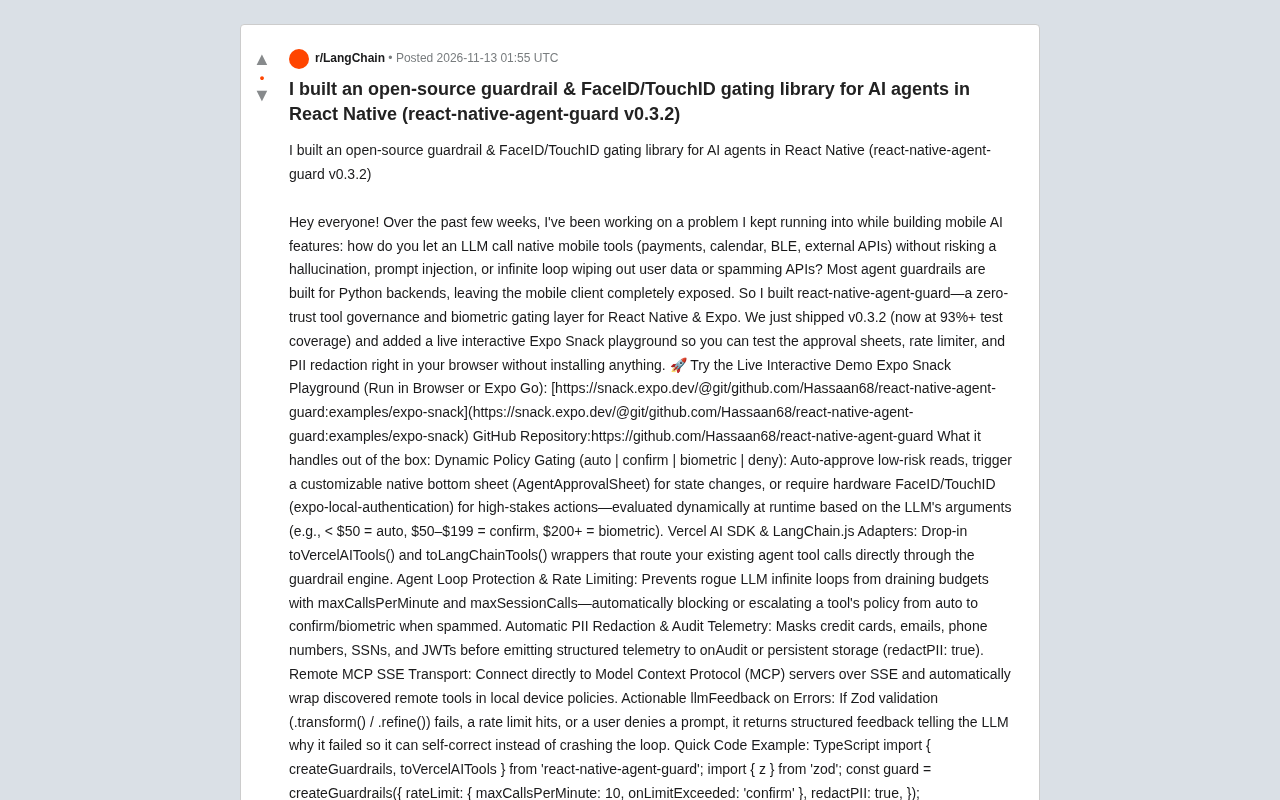
react-native-agent-guard is an AI agent guardrails library for React Native/Expo that fills the gap of missing client-side governance for mobile tool calls. Its core is a dynamic policy function returning four-tier verdicts (auto, confirm, biometric, deny) based on LLM arguments, with high-risk operations able to force hardware FaceID/TouchID. It also offers Vercel AI SDK and LangChain.js adapters, call-frequency loop protection, PII-redacted telemetry with structured llmFeedback, and SSE-based wrapping of remote MCP tools into local policies. v0.3.2 has over 93% test coverage and a browser-playable Expo Snack demo. The author notes guardrails are not a security boundary—policy oversights can still bypass gating.
React Native AI Agent Guardrails Library: FaceID Gating and Zero-Trust Tool Governance
Mobile AI features are becoming increasingly common, but one critical question remains unresolved: when an LLM gains the ability to call native mobile tools (payments, calendars, Bluetooth, external APIs), how do you prevent hallucinations, prompt injection, or infinite loops from causing user data to be deleted or APIs to be hammered? Most mainstream guardrail solutions today are built for Python backends, leaving mobile clients completely exposed. Developer Hassaan68's open-source react-native-agent-guard targets exactly this gap. It recently released v0.3.2 with over 93% test coverage and offers an Expo Snack playground you can try directly in the browser.
The Governance Gap in Mobile AI Agents
Existing agent guardrail ecosystems (such as LangChain callbacks and various Python middleware) run on the server side by default, assuming the client is just a stateless presentation layer. But AI features in React Native/Expo apps often execute tool calls on the client—especially when hardware capabilities (FaceID, Bluetooth) or local user data are involved. Server-side guardrails cannot perceive device-local biometric availability, nor can they insert native UI confirmations before tool execution. This structural gap means a prompt-injected LLM can easily trigger client-side tool calls with no interception point whatsoever.
The library positions itself as a "zero-trust tool governance and biometric gating layer," pushing decision points down to the mobile runtime. It doesn't replace backend guardrails—it fills in the client-side piece.
Prompt Injection is a typical class of attack facing LLM applications: an attacker embeds malicious instructions in content the model can read (such as user input, web page text, or tool return values), inducing the model to deviate from its intended task and perform unintended actions. In mobile agent scenarios, if the LLM can call native tools, a single successful prompt injection could directly trigger payments, delete data, or leak local information. Traditional backend guardrails can filter some inputs, but they cannot cover the decision point before client-side tool execution—which is precisely why this library emphasizes "zero-trust tool governance": it doesn't trust model output, and every tool call must be adjudicated by a local policy function.
Dynamic Policy Gating: Four-Tier Adjudication from Auto to FaceID
The core mechanism is the policy function: each registered tool carries a policy that is dynamically evaluated based on the arguments passed in by the LLM, returning one of four verdicts—auto (allow automatically), confirm (show a native bottom confirmation sheet), biometric (require hardware FaceID/TouchID, relying on expo-local-authentication), or deny (reject outright).
The author's example is very intuitive: for a wire transfer, amounts below 50 execute automatically, amounts from 50 to 199 trigger an AgentApprovalSheet confirmation, and amounts of 200 or above force biometric authentication. This parameter-threshold-based tiering hands the definition of "high-risk operation" to the developer rather than letting the model judge for itself. Dynamic evaluation happens at runtime, so the LLM cannot bypass gating by rewriting its prompt—it can only supply arguments, while the adjudication power rests with the client-side policy function.
For scenarios requiring custom confirmation interfaces, AgentApprovalSheet is a customizable native bottom sheet, avoiding the friction of WebView or cross-platform UI in biometric flows.
expo-local-authentication is the official Expo ecosystem module for accessing device biometric capabilities, wrapping iOS FaceID/TouchID and Android fingerprint/face recognition interfaces. It provides hasHardwareAsync() to detect hardware support, isEnrolledAsync() to determine whether the user has enrolled biometrics, and authenticateAsync() to trigger the system-level verification dialog. The biometric verdict in react-native-agent-guard relies on this module, meaning the gating is not a simulated UI but invokes the operating system's root of trust to complete verification. The verification result is guaranteed by the system's secure enclave and is difficult to forge at the application layer. This also explains why the library has low integration cost in Expo environments—the biometric flow fully reuses platform capabilities.
Framework Adapters and Loop Protection
On the engineering side, the library provides two adapters—toVercelAITools() and toLangChainTools()—that route existing agent tool calls directly into the guardrail engine. For projects already using Vercel AI SDK or LangChain.js, integration mainly means wrapping tool definitions rather than rewriting agent logic.
Loop protection is implemented through two limits: maxCallsPerMinute and maxSessionCalls. When a tool is called at high frequency, the system can automatically block it, or upgrade that tool's policy from auto to confirm/biometric—this "policy escalation" rather than outright rejection is worth noting. It preserves usability for legitimate high-frequency scenarios while adding friction to runaway loops.
Vercel AI SDK and LangChain.js are the two mainstream LLM application development frameworks in the current JavaScript/TypeScript ecosystem. Vercel AI SDK excels at streaming UI and tool calling abstractions and is commonly used in frontend projects such as Next.js; LangChain.js offers a more complete chain orchestration, memory, and tool ecosystem. Both allow developers to define tools with schemas like Zod and route tool call requests returned by the LLM to the corresponding handler functions. The toVercelAITools() and toLangChainTools() adapters provided by react-native-agent-guard essentially rewrap the already-defined tool system, inserting policy adjudication and audit logic before the handler function is called. This means existing projects can gain client-side guardrails without rewriting their agent flows.
Privacy and Observability: PII Redaction and Structured Telemetry
When redactPII: true is enabled, credit card numbers, emails, phone numbers, SSNs, and JWTs are masked before structured telemetry is emitted. Telemetry is output through the onAudit callback or persistent storage. This design resolves a real tension in mobile AI auditing: you need to record tool calls for traceability, but you cannot write sensitive arguments verbatim into logs. In the example, the cardNumber field is automatically redacted in the audit log, while the tool handler still receives the original value to complete the payment.
For error feedback, when Zod validation (.transform()/.refine()) fails, rate limiting is triggered, or the user declines confirmation, the library returns structured llmFeedback informing the LLM of the failure reason, giving it a chance to self-correct rather than letting the loop crash. This detail has a big impact on agent stability—many mobile agent failure modes are exactly the death spiral of "tool errors → model retries → errors again."
Remote MCP Tools and SSE Transport
Another capability in v0.3.2 is connecting directly to Model Context Protocol (MCP) servers via SSE and automatically wrapping discovered remote tools into local device policies. This means remote tools are equally subject to client-side gating rather than bypassing guardrails to execute directly. For teams adopting the MCP ecosystem, this provides a path to bring remote capabilities under local governance.
Model Context Protocol (MCP) is an open protocol proposed by Anthropic to standardize connections between LLM applications and external tools/data sources. An MCP server can expose a set of tools, resources, and prompt templates, and clients communicate with it via JSON-RPC. SSE (Server-Sent Events) is an HTTP-based one-way streaming technology where the server can proactively push events to the client, commonly used in MCP remote transport scenarios. react-native-agent-guard connects to remote MCP servers via SSE, and after discovering their tool lists, brings these remote tools under the same local policy gating—avoiding the governance blind spot of "remote tools bypassing client-side guardrails."
Quick Start and Community Feedback
The minimal integration example is as follows:
import { createGuardrails, toVercelAITools } from 'react-native-agent-guard';
import { z } from 'zod';

const guard = createGuardrails({
  rateLimit: { maxCallsPerMinute: 10, onLimitExceeded: 'confirm' },
  redactPII: true,
});

guard.registerTool({
  name: 'send_wire_transfer',
  description: 'Send money to a recipient',
  schema: z.object({
    recipientEmail: z.string().email(),
    cardNumber: z.string(),
    amount: z.number().positive(),
  }),
  policy: (args) => {
    if (args.amount >= 200) return 'biometric';
    if (args.amount >= 50) return 'confirm';
    return 'auto';
  },
  handler: async ({ recipientEmail, amount }) => {
    return await processPayment(recipientEmail, amount);
  },
});

const tools = toVercelAITools(guard);
Installation is via npm install react-native-agent-guard. The author provides a browser demo through Expo Snack that requires no installation, allowing you to test the approval sheet, rate limiter, and PII redaction behavior, and is soliciting feedback in the thread on API design, playground experience, and edge cases for mobile AI agents.
Editorial View
This library hits a real gap that the ecosystem has overlooked: governance of mobile tool calls cannot rely on the backend alone. Using biometrics as the final gate for high-risk operations has natural justification in mobile scenarios—it reuses the device's existing root of trust without needing to build an additional authorization system.
What needs to be viewed soberly is that guardrails themselves are not a security boundary. Policy functions are written by developers; if thresholds or tool registration have oversights, gating can be bypassed. PII redaction happens before telemetry is emitted, but the tool handler still holds plaintext data internally, and local storage and memory security still require separate consideration. Additionally, the project is currently a single-maintainer open-source library, so before production adoption you should assess maintenance activity and the risk level of your own mobile AI features. For teams implementing agent tool calls in React Native/Expo, it at least provides a runnable reference implementation and a clear policy abstraction.
One-line Summary
A React Native guardrails library pushes AI tool call governance down to mobile, using FaceID to gate high-risk operations.
Paragraph Summary
react-native-agent-guard is an AI agent guardrails library for React Native/Expo, designed to fill the gap of missing governance layers for mobile client tool calls. At its core is a dynamic policy function that returns four-tier verdicts—auto, confirm, biometric, deny—based on arguments passed in by the LLM, with high-risk operations able to force hardware FaceID/TouchID. The library also provides Vercel AI SDK and LangChain.js adapters, call-frequency-based loop protection, PII-redacted telemetry with structured llmFeedback, and support for bringing remote MCP tools under local policies via SSE. v0.3.2 has over 93% test coverage and offers a browser-playable Expo Snack demo. The author cautions that guardrails are not a security boundary, and policy-writing oversights can still lead to gating being bypassed.
Related articles

AI Writes Your Code—Do You Still Need to Learn Git? Five Reasons
AI coding agents handle Git operations automatically—is it still necessary to learn Git? Five reasons: team communication, reviewing agent PRs, monitoring code changes, fallback when AI goes down, and the joy of learning—plus how the focus of learning Git is shifting in the agent era.

Anthropic Reportedly Prices IPO at $83 Per Share, Valuing Company at $1.5 Trillion
Anthropic reportedly prices IPO at $83 per share, above the expected range, with a fully diluted valuation of $1.5 trillion. This article analyzes the signal significance of the pricing and its impact on the AI industry's financing environment.
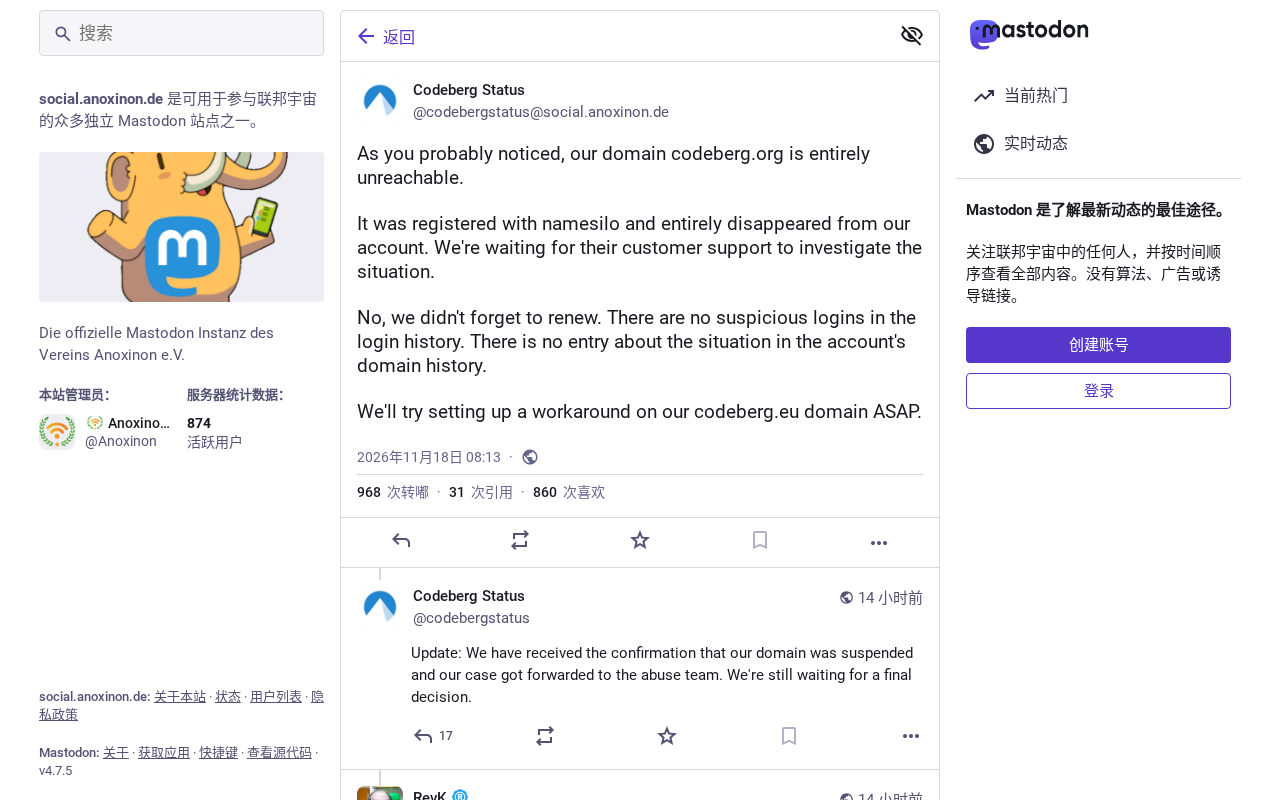
Open-Source Code Hosting Platform Codeberg Suffers Outage, Sparking Debate in Developer Community
Open-source code hosting platform Codeberg.org suffered an outage, sparking Hacker News debate over nonprofit platform stability and open-source infrastructure dependency risks.