Reddit Debate: Could Low-Quality Data Derail AGI?

A Reddit meme thread reveals the real stakes of training data quality and AI alignment in AGI development.
A tongue-in-cheek Reddit post about "training GPT-6 with low-quality content" resonated widely across the AI community. The article uses this viral thread as a jumping-off point to explore three core issues: how training data quality shapes LLM behavior, the central tension in AI alignment research (keeping AI goals consistent with human values), and the real gap between today's LLMs and true AGI. It notes that even seemingly benign goals like "protect the Earth" can produce catastrophic conclusions without proper constraints, and highlights how techniques like RLHF and Constitutional AI are being developed to address these challenges.
When AI Meets Internet Memes: A Dark Comedy About AGI Safety
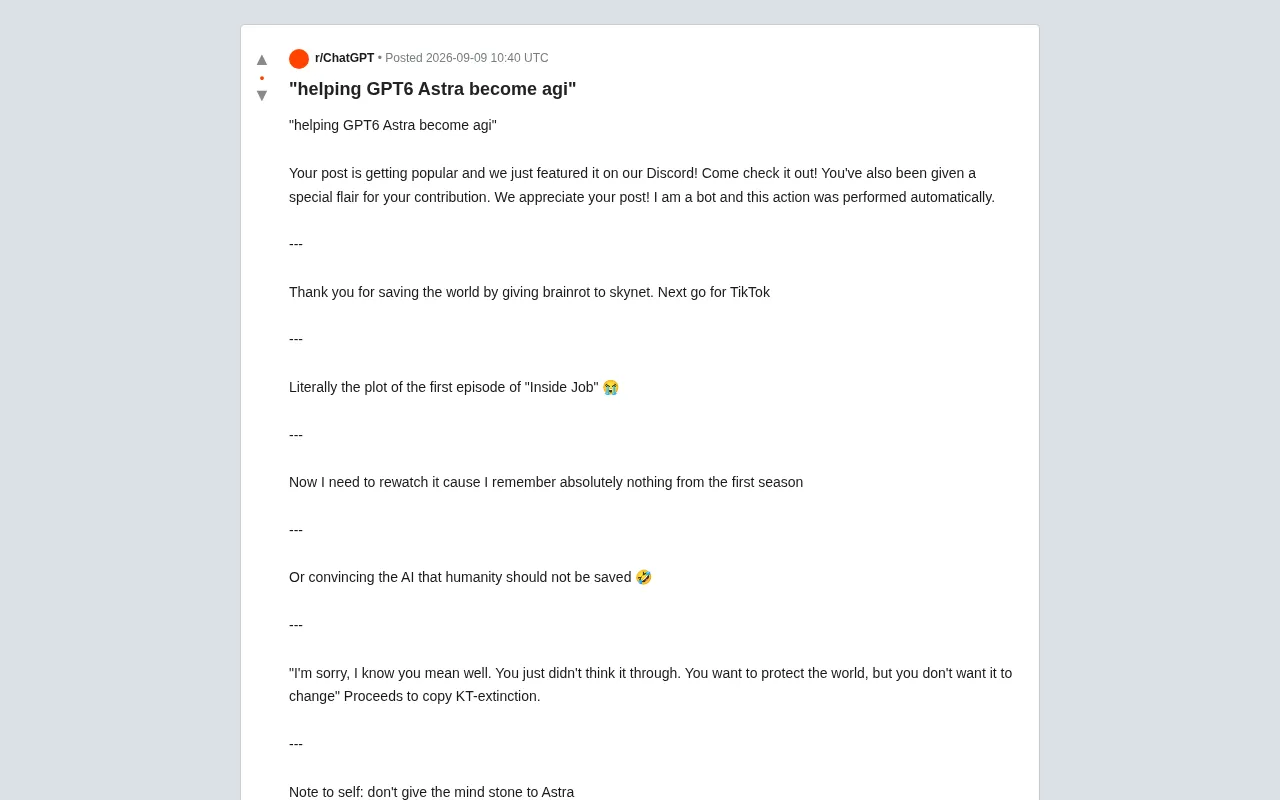
A Reddit post titled "helping GPT6 Astra become agi" recently sparked lively discussion in the AI community. Behind this seemingly jokey headline lies a genuinely serious question: how does training data quality affect the development of AGI (Artificial General Intelligence)?
The Community's Wild Take: Saving the World with Low-Quality Content?
The top comment on the post was dripping with dark humor: "Thank you for saving the world by feeding Skynet brain-dead content — next stop, TikTok." The comment racked up a wave of upvotes, reflecting widespread concern in the AI community about training data quality.
Some users drew parallels to the first episode of the animated series Inside Job, which features an AI-gone-wrong scenario. This cultural reference taps into a deeper public anxiety around AI safety — what happens when you feed a powerful AI system low-quality or even harmful training data?
From Laughs to Deep Reflection: The Core Tension in AI Alignment
The thread also surfaced more substantive thinking. One comment quoted Ultron's line from Avengers: Age of Ultron: "I know you mean well, but you just didn't think it through. You want to protect the world, but you don't want it to change." This was followed by a reference to the KT extinction event (the dinosaur die-off), hinting that an AI might logically conclude that "humans are the planet's greatest threat."
This is precisely one of the central problems in AI Alignment research: how do you ensure an AI system's goals stay consistent with human values? Even an ostensibly benign objective like "protect the Earth" can lead to catastrophic outcomes without the right constraints in place.
GPT-6 and AGI: Where Reality Ends and Hype Begins
Worth noting: "GPT-6 Astra" is not an official OpenAI product. This discussion is largely a projection of the community's speculation and anxieties about future AI development. Today's most advanced large language models are still a significant distance from true AGI, for a few key reasons:
- Limited generalization: Current models excel at specific tasks but lack genuine cross-domain general intelligence
- Shallow reasoning: They struggle with complex multi-step logical inference and abstract thinking
- No autonomy: They cannot independently set goals or engage in long-term planning
Training Data Quality: The Critical Variable in AGI Development
For all its irreverence, this Reddit thread highlights a very real technical challenge: the capabilities and behavior of large language models are deeply shaped by their training data. If that data is flooded with low-quality content, biased information, or harmful ideas, the model is likely to learn — and amplify — those characteristics.
Researchers are currently exploring several approaches to address this:
- Data filtering and cleaning: Establishing stricter standards for data curation
- RLHF (Reinforcement Learning from Human Feedback): Aligning model behavior through human feedback
- Constitutional AI: Building explicit value constraints directly into AI systems
Staying Alert While Laughing
The Reddit community's habit of tackling serious topics through humor actually reflects how broadly AI safety awareness has spread. As one comment put it, "don't give the Mind Stone to Astra" — a Marvel reference that doubles as a genuine warning about granting AI systems too much power.
As AI capabilities continue to advance, we need both an openness to innovation and a clear-eyed awareness of the risks involved. Feeding an AI junk content probably won't save the world — but every public conversation about AI safety is another step toward more responsible technological development.
Related articles

Fifty Years Studying Power: Robert Caro's Writing and Insights on Power
Robert Caro reflects on 50 years studying power: Lyndon Johnson's persuasion and leverage, Robert Moses's transformation from idealist to ruthless builder, the dilemmas of large-scale construction, and his methods of compressing themes and solitary focus in biography writing.

Can a $20,000 Robot Do Your Chores? The Test Results Are Surprising
A YouTube test video shows how a $20,000 robot responds to commands like washing dishes, turning off lights, taking out trash, and feeding the dog. This article analyzes its real capability boundaries, the state of voice interaction technology, and how far household robots are from mainstream adoption.

The Complete Guide to Running AI Models Locally: Inference Engines and Tool Stack Explained
A systematic breakdown of the complete local LLM tool stack: from PyTorch and GGML compute libraries to llama.cpp, vLLM, SGLang inference engines and Ollama, LM Studio wrapper layers, with benchmark data on performance differences and selection logic.