Reddit Hot Topic: What's That Prompt You Keep Coming Back To?
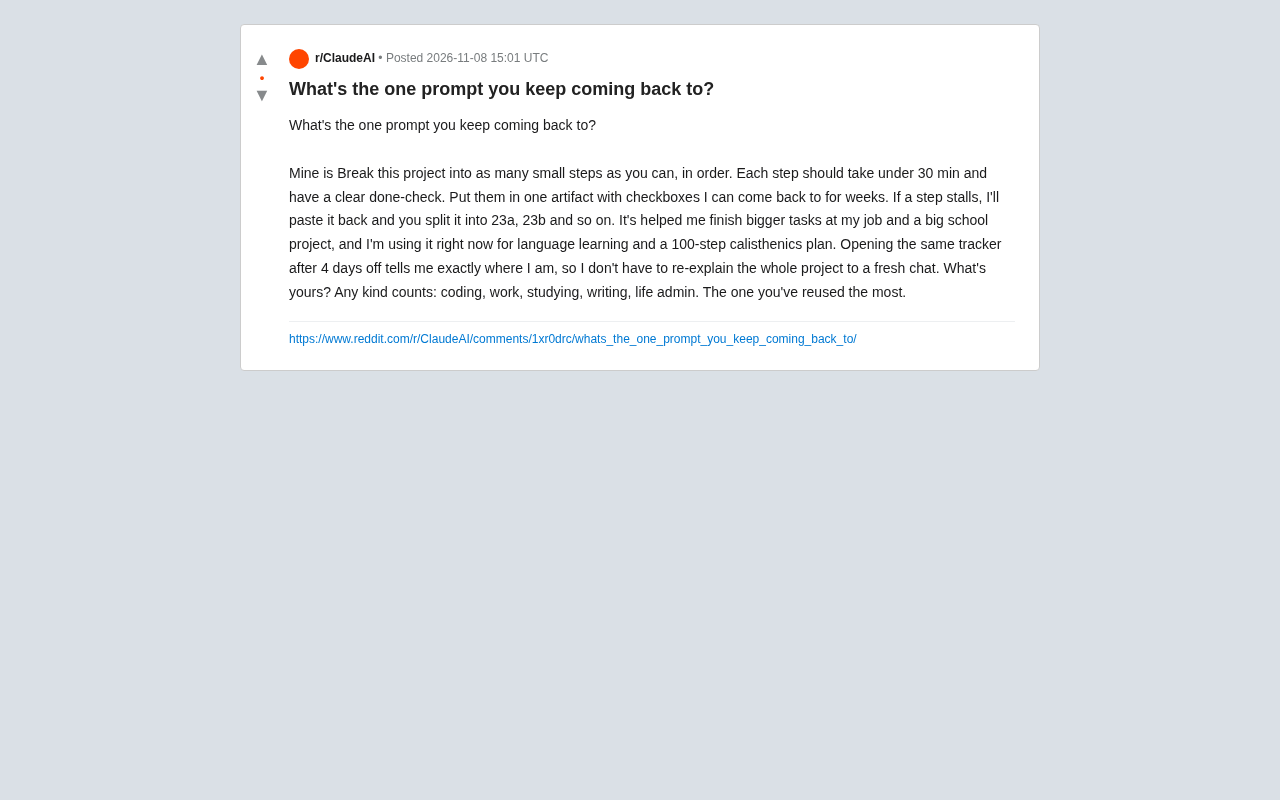
An evergreen prompt that breaks big tasks into small steps under 30 minutes and generates a trackable artifact.
The article introduces a widely discussed "evergreen prompt" on Reddit: asking AI to break projects into as many small steps as possible, each under 30 minutes with clear completion checkpoints, and output as an artifact with checkboxes for continuous tracking. The author analyzes why it works: structured output reduces cognitive load, small steps bring "small wins"-style accomplishment, progress visualization prevents getting lost in conversation flow; meanwhile, stuck steps can be recursively split into substeps, giving the plan elasticity. The framework applies to work, study, fitness, and other scenarios, demonstrating the universality of task decomposition. The article concludes with four principles for designing evergreen prompts: specify output format, set constraints, include fault tolerance, and focus on reusable scenarios.
One Prompt to Solve Procrastination on Big Tasks
On Reddit, a user posted: "What's the one prompt you keep coming back to?" and shared their answer: break projects down into as many small steps as possible, each taking no more than 30 minutes, with clear completion checkpoints. This prompt helped them complete big work tasks, school projects, and is even being used for language learning and a 100-step fitness plan.
This simple request works because it directly addresses the psychological pressure of big tasks. By forcing decomposition, AI transforms a vague "big project" into a series of executable micro-actions, lowering the barrier to starting. More importantly, it generates an artifact with checkboxes that can track progress over weeks. Even after a few days of interruption, reopening the same tracker immediately shows where you are—no need to re-explain the entire project to a new chat.
Why Is This Prompt an "Evergreen"?
Structured Output Reduces Cognitive Load
Ordinary task breakdowns often stay at the list level, but this prompt requires each step to have a clear "done-check" and limits step duration to 30 minutes. This aligns with the psychological principle of "small wins"—each completed small step brings a sense of accomplishment that drives continued action. Meanwhile, outputting to an artifact makes progress visual and prevents getting lost in the conversation flow.
Cognitive Load, proposed by educational psychologist John Sweller, refers to the mental burden on working memory when processing information. Human working memory capacity is limited, typically handling only 4-7 information chunks at once. Facing a large, vague project, the brain must simultaneously consider goals, steps, dependencies, scheduling, and many other elements—easily overloaded, leading to procrastination and anxiety. Breaking tasks into small steps under 30 minutes with clear completion checkpoints essentially reduces "extraneous cognitive load"—outsourcing complex planning to AI so the user only needs to focus on the current small step. The immediate feedback from completing each step activates the brain's reward circuit, creating a positive loop.
Flexible Mechanism for Handling Stalls
The prompt also includes a mechanism for dealing with stalls: if a step gets stuck, the user can paste it back to the AI and ask it to split into substeps like 23a, 23b. This recursive decomposition capability gives the plan elasticity, preventing total collapse due to one difficult point.
Recursive Decomposition draws on the "divide and conquer" idea from computer science: when a problem is hard to solve directly, break it into smaller subproblems of the same type until each is simple enough to handle directly. In this prompt, if step 23 gets stuck, the user doesn't have to overturn the entire plan—instead, ask the AI to split step 23 into substeps like 23a, 23b. The key is that it maintains the original numbering system and contextual continuity, allowing users to resume from the stall point at any time without replanning globally. It gives the plan software-iteration-like elasticity, turning "stuck" from a failure signal into a signal for further refinement.
Cross-Domain Versatility
From work projects to study plans to fitness training, this prompt shows strong adaptability. Its core logic—breaking complex goals into manageable small tasks—is universal. This explains why it's used repeatedly: no matter what new challenge in any domain, this framework can be applied.
The Feynman Technique, named after Nobel Prize in Physics laureate Richard Feynman, is a learning method aimed at "teaching others." Its core steps: choose a concept, explain it in the simplest language to a layperson; where explanation stalls or is vague, return to source material to relearn; then simplify and use analogies until fluent. In the prompt context, "explain this concept using the Feynman Technique" became an evergreen prompt because it forces the model to expose gaps in understanding rather than recite terminology. This shares the same underlying logic as the task decomposition prompt: transforming vague "I understand" into testable, concrete output.
Community Response and More Prompt Sharing
Although the comment section of the original post isn't fully presented in the material, it's reasonable to infer that such shares often prompt many users to contribute their own "evergreen prompts." Common types might include: "explain this code and find potential bugs" for debugging, "help me generate an article outline and expand it step by step" for writing, "explain this concept using the Feynman Technique" for learning, etc.
Each prompt reflects a specific pain point and a repeatable solution. For AI application developers and content creators, these prompts from real users are valuable insights, revealing how people integrate large language models into daily work and learning workflows.
How to Design Your Own "Evergreen Prompt"?
Based on this case, several design principles can be summarized:
- Specify output format: Require AI to output in a specific format (like an artifact with checkboxes) for easy tracking.
- Set constraints: Such as time limits per step, ensuring tasks are small enough.
- Include fault tolerance: Allow secondary decomposition of stuck steps.
- Focus on reusable scenarios: Choose task types you frequently face (like project planning, study plans) for optimization.
This Reddit post reminds us that the best prompts aren't necessarily complex—they precisely solve a recurring problem. If you don't yet have your own "evergreen prompt," why not start with task decomposition?
Related articles

Microsoft WebIQ: Verifiable Real-Time Web Grounding for AI Agents
Microsoft WebIQ gives AI Agents real-time, citable web grounding across web, news, images, videos, and Places—164ms P95 latency, 50% fewer tokens, Scopes source control, and MCP integration.
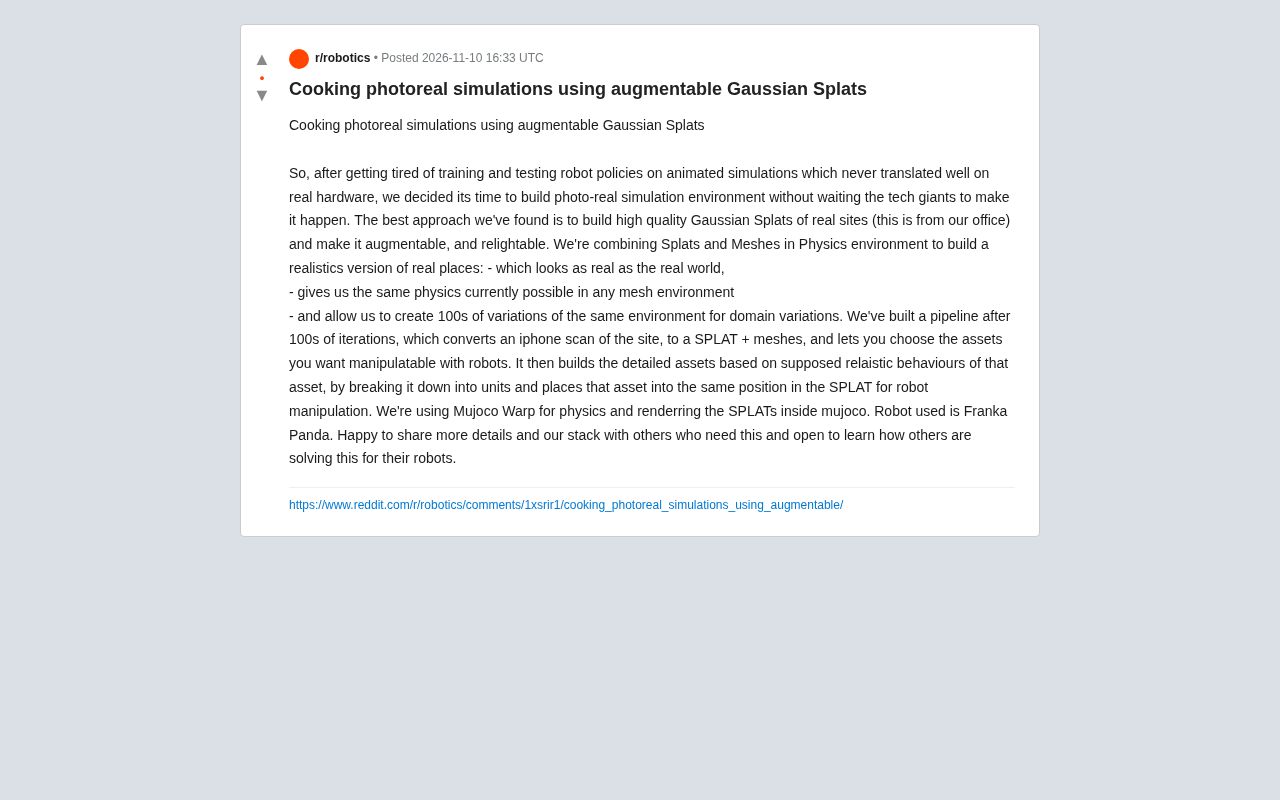
Augmentable Gaussian Splatting: Building Photorealistic Simulation Environments for Robot Training
Team combines Gaussian Splatting with meshes to build photorealistic robot simulation environments, integrating MuJoCo Warp physics and Franka Panda for augmentable, relightable real-site simulation.

Gemini 4 Carbon Released: The Leap from Gemini 3 to Gemini 4 in Under a Year
Google releases Gemini 4 Carbon, less than a year after Gemini 3. In the official demo, Carbon reverse-engineered the Theme Park binary, added a new DeepMind-themed ride, and ported it to the web in one shot.