Reddit User Reviews Bonus Advice with Hindsight: Checking Every Citation

A Reddit retrospective post shows the author revising bonus advice with hindsight and checking every citation.
The article discusses a Reddit post whose title says the author changed bonus advice during a retrospective and checked each citation one by one. With only the title and screenshot available, the article does not reconstruct the specific bonus scheme, citation count, or verification conclusions, but focuses on the methodological significance of the action. It notes that bonus advice involves incentive structures and expected behavior; once the conclusion is overturned after the fact, what matters more is what was originally cited and whether those citations were correctly understood. Checking citations one by one is costly but can distinguish "the conclusion was wrong" from "the evidence was wrong" and partly offset hindsight bias. The article ends with a transferable checklist: when advice changes, disclose citation verification results alongside it and focus the retrospective on a verifiable evidence chain.
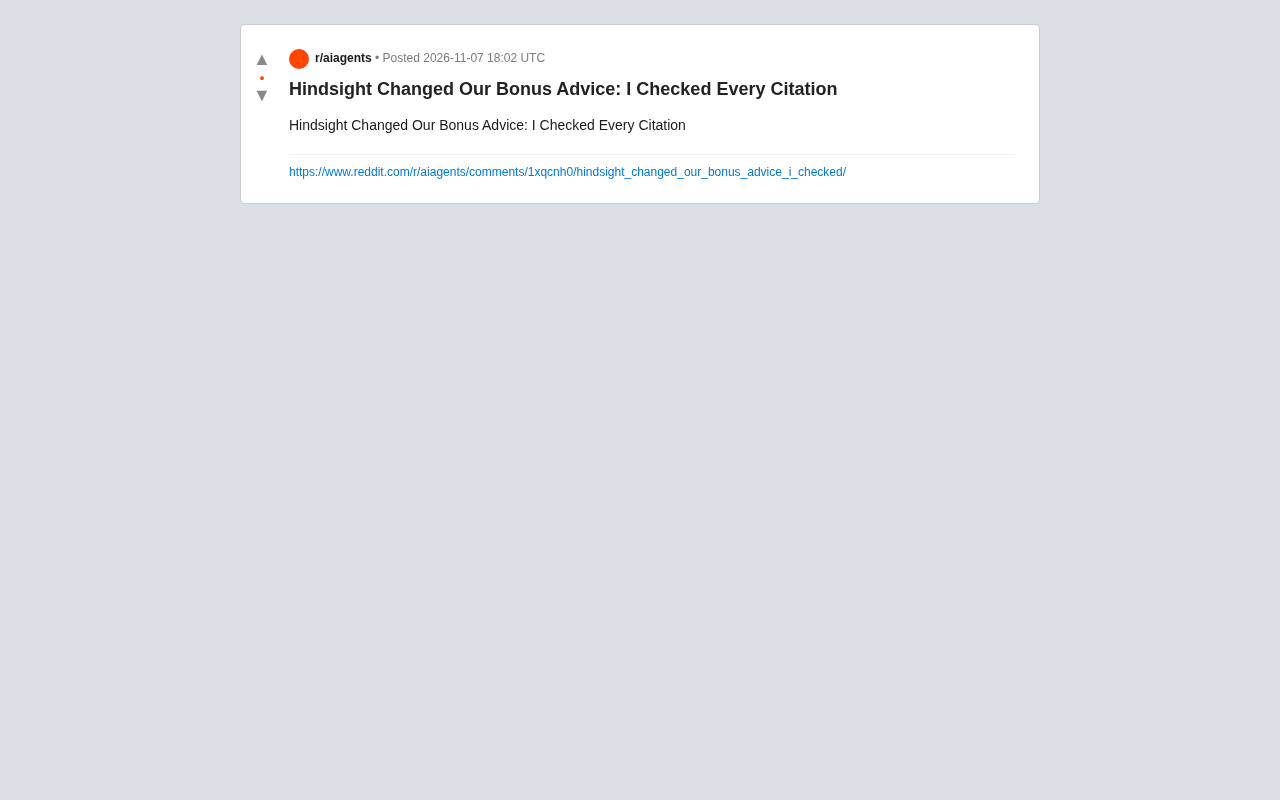
A Reddit post titled "Hindsight changed our bonus advice: I checked every citation" documents a retrospective audit of existing advice. The post itself does not elaborate on the specific industry, bonus scheme, or citation list, but the action revealed by the title is worth unpacking: when the outcome is already known, can people still be accountable for each piece of evidence when looking back at their original advice?
What the Post Says and Doesn't Say
Based on the available material, this is a retrospective post. The author claims to have revised "bonus advice" with hindsight and to have checked the citations supporting that advice one by one. The screenshot only presents information at the title level; the body details, number of citations, and verification conclusions are not provided in the source material.
This means it is impossible to determine whether this is an internal decision review, a content correction, or a public challenge to a certain type of incentive scheme advice. What can be confirmed are only two actions: the advice was changed by hindsight, and the citations were checked one by one.
Why "Checking Every Citation" Deserves Separate Mention
The quality of advice-based content largely depends on whether its evidence can withstand retrospective scrutiny. Bonus advice typically involves incentive structures, distribution logic, and expected behavior. Once the conclusion is overturned after the fact, what should be questioned most is not the conclusion itself, but what was originally cited and whether those citations were correctly understood.
Checking citations one by one is a costly approach. It requires the author to return to the original sources rather than stopping at secondhand paraphrases or summaries. The post puts this process in the title, indicating that the author considers the verification action itself to be the core of this retrospective, not merely the change in conclusion.
Citation checking / reference verification is a routine practice in academic publishing and fact-checking. Its basic process includes: confirming that the source actually exists, verifying the author and publication information, comparing the cited content with the original wording to see if they are consistent, and checking whether data or conclusions have been taken out of context. In academic publishing, this work is often called "citation accuracy review"; in journalism and fact-checking, it is part of "source tracing."
This practice matters because the distortion rate of secondhand paraphrase is not low. Researchers and fact-checking organizations have repeatedly found that many cited conclusions undergo semantic drift after layers of paraphrase: qualifiers are removed, correlation is presented as causation, and individual cases are treated as general rules. For content such as bonus advice that involves incentive design and behavioral expectations, a single misread citation can support an entire distribution logic.
The cost of checking citations one by one mainly comes from returning to the original sources rather than stopping at abstracts, reviews, or paraphrase articles. It breaks advice down into individually verifiable supports, making "which piece of evidence was wrong" and "whether the conclusion still holds" questions that can be discussed separately.
The Double-Edged Sword of Hindsight
Using outcomes to test advice can easily fall into hindsight bias: after knowing the ending, people overestimate how easy the original prediction was and are more likely to attribute accidental factors to necessity. The author uses "hindsight changed" to describe the change in advice, precisely highlighting this tension.
Checking citations can offset this bias to some extent. Citations are a relatively objective part of advice and can be independently verified: whether the source exists, whether the wording was distorted, and whether the data was taken out of context. Checking the citations at least allows "the conclusion was wrong" and "the evidence was wrong" to be distinguished.
Hindsight bias is a classic concept in social psychology concerning judgment and decision-making, first systematically described by Baruch Fischhoff in experimental research around 1975. Its core finding is that after people learn the outcome of an event, they systematically overestimate the likelihood that the outcome was predicted beforehand and tend to remember originally uncertain judgments as "I should have known then." This phenomenon is also colloquially called the "I knew it all along" effect.
Hindsight bias is usually accompanied by two mechanisms: first, cognitive reconstruction, in which people integrate new outcomes into existing memory, making old judgments appear closer to the outcome than they actually were; second, increased explainability of outcomes, in which once the ending is known, people easily construct a coherent causal story for it, thereby underestimating contingency. It has direct implications for new drug trials, financial forecasting, judicial responsibility determination, and business retrospectives, and is one of the root causes of improper "retrospective accountability."
In the context of advice auditing, this concept explains why judging the original bonus advice solely by its outcome is insufficient: the outcome itself contaminates the evaluator's memory and reasoning. Checking citations separately is equivalent to bypassing judgment contaminated by the outcome and returning to the level of evidence that was verifiable beforehand, and is therefore regarded as a local corrective measure against hindsight bias.
Implications for Content Creators and Advice Producers
Although the post provides limited information, it offers a transferable checklist: when advice changes, publicly disclose the citation verification results at the same time; distinguish which evidence has become invalid and which evidence was misread; and focus the retrospective on a verifiable evidence chain rather than merely explaining the new conclusion.
For creators and analysts who frequently produce advice-based content, checking citations one by one is also a form of self-discipline. It exposes every support of the advice to a testable position and makes later corrections traceable, rather than dismissing them with a single phrase like "circumstances changed."
The source material does not provide the specific bonus scheme, citation sources, or verification findings, so the argumentative details of the post cannot be further reconstructed.
One-line Summary
A Reddit retrospective post shows the author revising bonus advice after the fact and checking each cited source one by one.
Paragraph Summary
The article centers on a Reddit post whose title states that the author changed bonus advice during a retrospective and checked every citation one by one. Because the source material includes only the title and a screenshot, the article does not reconstruct the specific bonus scheme, number of citations, or verification conclusions, but instead focuses on the methodological significance of this action. The article notes that bonus advice involves incentive structures and expected behavior; once the conclusion is overturned after the fact, what is more worth questioning is what was originally cited and whether the citations were correctly understood. Checking citations one by one is costly, but it can distinguish "the conclusion was wrong" from "the evidence was wrong" and, to some extent, offset hindsight bias. The article concludes by distilling a transferable checklist: when advice changes, publicly disclose citation verification results at the same time, and focus the retrospective on a verifiable evidence chain.
Related articles
 Tech Frontiers
MuJoCo: An Analysis of DeepMind's Open-Source General-Purpose Physics Simulator
An in-depth analysis of Google DeepMind's open-source physics simulator MuJoCo: high-performance C++ kernel, MJCF modeling format, contact solving principles, MJX GPU acceleration, and robot reinforcement learning use cases.
 Tech Frontiers
Claude API Quick Start: The Official Quickstarts Project Collection
Anthropic's official claude-quickstarts project collection helps developers quickly build deployable apps with the Claude API. Nearly 20k stars, Python-based, great for beginners and prototyping.
 Tech Frontiers
AI Agents Connecting Directly to APIs: Which Calls Can Be Safely Allowed?
AI agents can call any API, but the real challenge is deciding which calls can be safely allowed. This article analyzes allowance decisions from three dimensions—intent matching, least privilege, and controllable impact—and argues that the control layer should sit outside the agent, combined with audit traceability to build a trustworthy API call governance mechanism.