Reddit User Seeks to Join RL Project Team, Reigniting Debate on AI Collaboration Barriers
A Reddit user seeking an RL project team reflects the participation barriers and collaboration realities for newcomers in the open-source AI community.
Starting from a Reddit team-up request, this article discusses the real-world dilemma newcomers face when participating in RL projects in the open-source AI ecosystem. The post was brief and did not provide technical background or project experience, and this kind of vague expression is not uncommon in technical communities. The article points out that collaboration barriers for RL projects are relatively high, involving environment setup, reward design, and training stability tuning, and that mature teams value concrete output such as code repositories and paper reproductions rather than mere interest. For newcomers hoping to join, the community suggests starting with reproducing classic algorithms, participating in open-source issue fixes, or providing valuable technical discussion, using action to build trust. The article also mentions community practices such as project-based learning and good first issue that lower the barrier, and suggests that the poster add their tech stack and specific direction to improve the chances of collaboration.
A Reddit user posted asking whether they could join someone else's reinforcement learning (RL) project team, sparking discussion about barriers to AI collaboration and ways to participate in the community. Behind this brief help-wanted post lies the real-world dilemma facing newcomers trying to participate in today's open-source AI ecosystem.
A Brief Team-Up Request
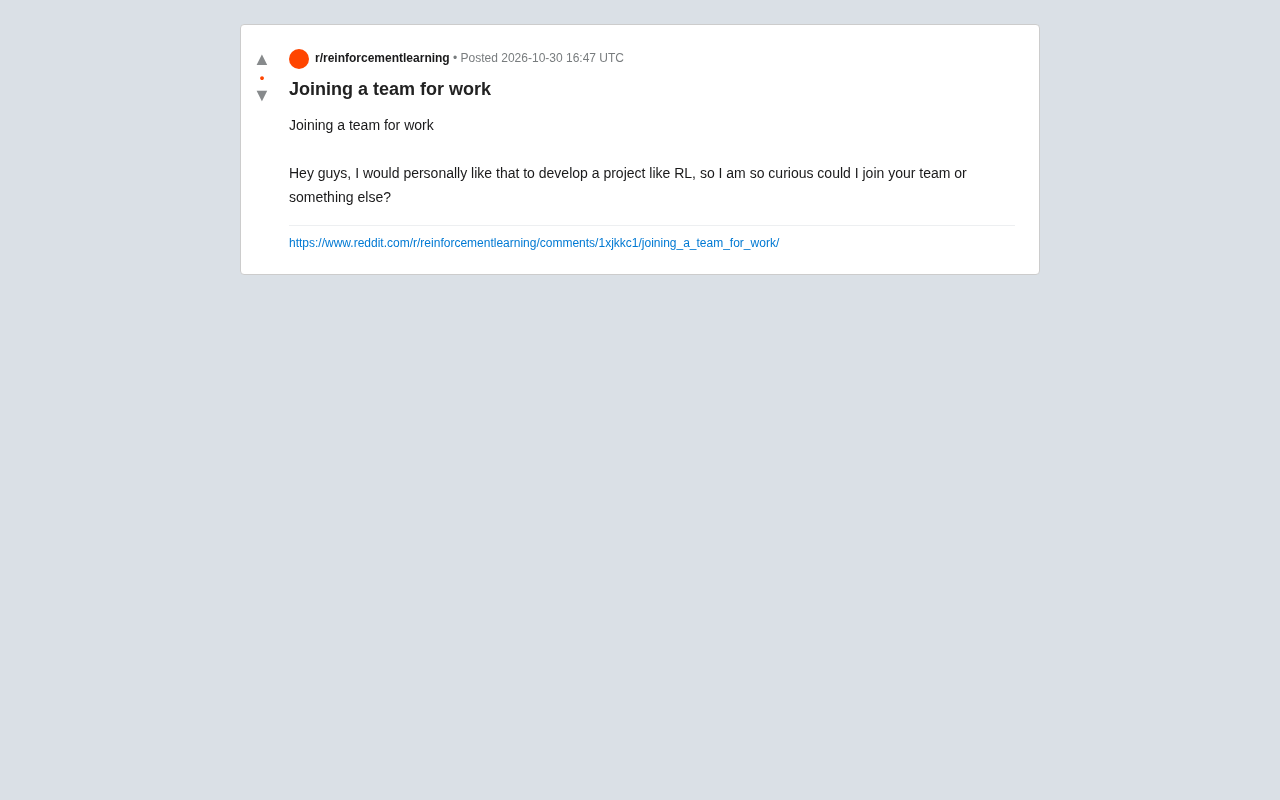
According to a post in the Reddit community, a user expressed strong interest in developing projects similar to reinforcement learning (RL) and directly asked whether they could join someone else's team or participate in other forms of collaboration.
The post was very short and did not mention any specific technical background, project experience, or the direction they hoped to work in. This kind of vague expression is not uncommon in technical communities—many beginners who are passionate about AI often lack a clear path when taking their first step toward collaboration.
Why Putting Together an RL Project Team Is Not Simple
The barrier to collaboration on reinforcement learning projects is relatively high, which is related to the characteristics of RL itself. Compared with supervised learning, RL involves multiple stages such as environment setup, reward design, and tuning training stability, and places certain demands on participants' engineering ability and theoretical understanding.
Based on common situations reflected in community feedback, mature RL project teams usually place more value on whether candidates have demonstrable code repositories, papers they have reproduced, or open-source contributions they have participated in when recruiting collaborators. Simply expressing interest without concrete output often makes it hard to get a response. This is not because the community is cold, but rather a practical consideration of collaboration efficiency.
Core Differences Between Reinforcement Learning and Supervised Learning
The most essential difference between reinforcement learning (RL) and supervised learning lies in the source of the learning signal. Supervised learning relies on paired input-label data, and the model learns a mapping relationship by minimizing prediction error; in RL, however, an agent must adjust its policy based on sparse or delayed reward signals while interacting with the environment. This means RL has no "standard answer" that can be directly fitted, and the training process involves the trade-off between exploration and exploitation, the high-variance problem of policy gradient estimation, and the risk of reward hacking caused by improperly designed reward functions. For this reason, RL projects require participants not only to call libraries and run models, but also to understand theoretical frameworks such as Markov decision processes, value function approximation, and policy optimization, and to diagnose engineering problems such as non-convergent training and exploding variance, which directly raises the threshold for team collaboration.
Why Reward Design and Training Stability Become Collaboration Pain Points
In RL engineering practice, reward design often determines project success more than model architecture. A seemingly reasonable reward function may induce the agent to learn degenerate behavior, for example repeatedly triggering a small reward in a game environment while giving up on completing the main task. Such problems usually require repeated experiments and team discussion to identify, and are difficult to predict just by reading documentation. Training stability is also a frequent pain point in collaboration: performance variance under different random seeds can be extremely large, hyperparameters have a much stronger impact on results than in supervised learning, and debugging cycles are long with high compute consumption. These characteristics make it difficult for RL projects to split tasks as clearly as traditional software projects, and if new members lack the ability to interpret training curves and habits of experiment management, it is hard for them to quickly make effective contributions to the team.
Feasible Paths for Newcomers to Participate in AI Projects
For developers hoping to join RL projects, common community advice includes: start by reproducing classic algorithms to build up code artifacts, participate in issue fixes in small open-source projects on GitHub, or provide valuable discussion on specific technical questions in relevant forums. These actions build trust more effectively than directly asking to join a team.
Another trend worth noting is that more and more AI learning communities organize collaboration through "project-based learning," where newcomers can gradually accumulate experience in structured tasks and then transition to more open team collaboration.
A Mirror of Community Collaboration Culture
Although this post contains limited information, it reflects a persistent topic in the AI community: how to lower the barrier for newcomers while maintaining collaboration quality. Some communities respond to this need by setting up "good first issue" labels and holding newbie-friendly hackathons.
For the poster, a more effective approach might be to add their tech stack, learning progress, and the specific RL direction they want to pursue in the post, so that potential teammates can judge the possibility of collaboration.
One-line Summary
A Reddit user seeking an RL project team reflects the participation barriers and collaboration realities for newcomers in the open-source AI community.
Paragraph Summary
Starting from a Reddit team-up request, this article discusses the real-world dilemma newcomers face when participating in RL projects in the open-source AI ecosystem. The post was brief and did not provide technical background or project experience, and this kind of vague expression is not uncommon in technical communities. The article points out that collaboration barriers for RL projects are relatively high, involving environment setup, reward design, and training stability tuning, and that mature teams value concrete output such as code repositories and paper reproductions rather than mere interest. For newcomers hoping to join, the community suggests starting with reproducing classic algorithms, participating in open-source issue fixes, or providing valuable technical discussion, using action to build trust. The article also mentions community practices such as project-based learning and good first issue that lower the barrier, and suggests that the poster add their tech stack and specific direction to improve the chances of collaboration.
Related articles

The Touchscreen MacBook and Apple's Delightful Mess: A Deliberate Gamble
The Vergecast unpacks the touchscreen MacBook Pro's launch logic, the ProLed naming controversy, the iPad squeezed between iPhone and Mac, and how Apple stays competitive with premium hardware in the AI era.

Fifty Years Studying Power: Robert Caro's Writing and Insights on Power
Robert Caro reflects on 50 years studying power: Lyndon Johnson's persuasion and leverage, Robert Moses's transformation from idealist to ruthless builder, the dilemmas of large-scale construction, and his methods of compressing themes and solitary focus in biography writing.

Can a $20,000 Robot Do Your Chores? The Test Results Are Surprising
A YouTube test video shows how a $20,000 robot responds to commands like washing dishes, turning off lights, taking out trash, and feeding the dog. This article analyzes its real capability boundaries, the state of voice interaction technology, and how far household robots are from mainstream adoption.