Reflections Sparked by a Tweet: The Value and Limits of Tech Conversations

A low-information thank-you tweet prompts reflection on the value of fragmented social media information and the bottom line of tech content creation.
The article takes a tweet that merely expresses gratitude as its object of analysis, pointing out that this material lacks a theme, viewpoints, and data, and cannot support in-depth reporting. The author thereby discusses the immediacy and emotional expression characteristics of fragmented social media information, emphasizing its lack of depth and verifiability, and reminds readers to distinguish emotional expression from factual information. The article further proposes that professional creators facing low-information material should not force-fabricate content but should instead turn to discussing broader topics or seek multi-source materials such as official announcements, technical papers, and expert commentary for cross-verification. The ultimate conclusion: honestly acknowledging the inadequacy of material is more meaningful than forcibly filling in the gaps, and critical thinking is a fundamental skill of tech writing.
When a Tweet Becomes Source Material
In the era of information overload on social media, even a short tweet can sometimes serve as a window into the dynamics of the tech world. Recently, a tweet from Twitter read: "Thanks for having me on Alex - great conversation!" This tweet provided no specific content—it merely expressed gratitude for a conversation. For content creators, such material is both a challenge and an opportunity for reflection.
The tweet itself carries very little information, but it reflects a common mode of interaction in the tech community: polite acknowledgments after podcasts, interviews, or online conversations. Such tweets are often quickly scrolled past, yet they hint at potentially valuable discussions behind the scenes. Unfortunately, due to the lack of context, we cannot know the specific topic of the conversation, the guest's viewpoints, or any substantive content.
A podcast is a digital audio or video program that users can automatically receive as a series through subscription, often centered on interviews, news commentary, or thematic discussions. Tech podcasts have grown rapidly over the past decade, becoming an important channel for practitioners to share opinions, announce product information, and build personal brands. Guests often post thank-you messages on social media after participating in a podcast—both as a courtesy to the host and as an act of content distribution, leveraging social networks to spread episode clips or links to a wider audience. Understanding this context helps assess the actual position of a brief thank-you tweet in the information ecosystem: it is typically the末端 link in a show's marketing chain, rather than an independent information source.
The Value and Limits of Fragmented Information on Social Media
Fragmented information on social media, like this tweet, typically features immediacy and emotional expression but lacks depth and verifiability. For audiences of tech news and analysis, what they expect more is content supported by data and featuring clashing viewpoints. This tweet mentions no technical details, product names, or industry trends, and therefore cannot serve as core material for an in-depth report.
However, from another perspective, such tweets also reflect the interpersonal networks and knowledge-sharing culture of the tech community. A simple thank-you may signify a cross-disciplinary conversation, perhaps touching on topics like AI, entrepreneurship, or product design. But as content creators, we must honestly point out: without specific information, any extended interpretation is merely speculation.
Social capital is a sociological concept referring to the resources individuals or groups obtain through social networks, including information, trust, reciprocity, and influence. In the tech community, public acknowledgments, retweets, and interactions are common ways to accumulate and display social capital. A thank-you tweet表面上 is just a polite expression, but in fact it sends a signal to followers that "I have had a conversation with someone in the industry," helping to enhance the poster's visibility and credibility in the network. However, social capital is not equivalent to verifiable factual information; it reflects relational structures rather than content quality. Therefore, when analyzing such tweets, they should be treated as evidence of social behavior rather than a source of technical or industry information.
How to Extract Value from Low-Information Material
When faced with such material, the professional approach is not to force-fabricate content but to use it as an opportunity to discuss broader topics. For example, we could explore the role of tech podcasts and interviews in information dissemination, or analyze the social capital behind "thank-you posts" on social media. Even so, the article must still be fact-based and avoid excessive speculation.
In this task, the original material consists of only one tweet and one screenshot (the screenshot information is empty), with no multi-source fusion analysis. This means we cannot perform cross-verification or provide any specific data or viewpoints. Therefore, the focus of this article is to explain the limitations of the material and remind readers: when consuming information, pay attention to distinguishing emotional expression from factual information.
Multi-source fusion analysis refers to cross-comparing and integrating information from different channels in research or reporting to enhance the reliability of conclusions. Common sources include official announcements, technical papers, patent documents, expert interviews, and industry reports. The limitation of a single social media post is that it cannot self-verify and is prone to bias from being taken out of context. The core operations of multi-source verification include: confirming the original source, seeking independent corroborating sources, and checking consistency of time and context. For material consisting of only one tweet and a blank screenshot, no multi-source fusion can be carried out, which explains at the methodological level why such material is insufficient to support in-depth analysis.
Implications for Tech Content Creators
For creators in the AI and tech fields, the richness of source material directly determines the depth of content. A tweet can serve as an introduction but is insufficient to support an insightful article. Ideally, creators should seek multiple sources, including official announcements, technical papers, expert commentary, etc., to ensure the accuracy and comprehensiveness of the content.
Moreover, this tweet also reminds us that interactions on social media often carry an element of social etiquette. When citing such content, one should avoid over-interpretation and certainly not treat pleasantries as factual statements. Maintaining critical thinking is a fundamental skill of tech writing.
Conclusion
Although this tweet itself cannot constitute an in-depth article, it prompts us to reflect on the value and limitations of social media information. In an era flooded with fragmented information, professional content creators should uphold high standards, base their work on facts, and use analysis as a tool to provide readers with truly valuable content. For this article, honestly acknowledging the inadequacy of the material is perhaps more meaningful than forcibly filling in the gaps.
Related articles
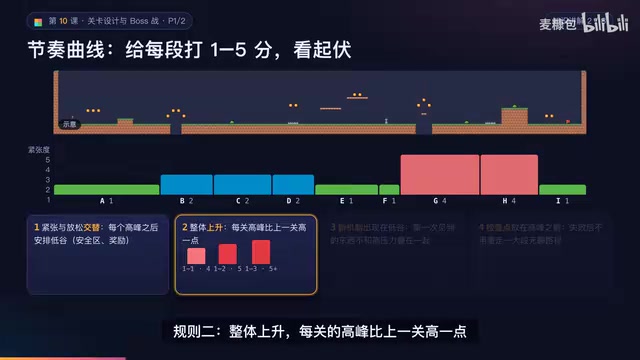
AI Game Development in Practice: Designing Levels with the Four-Step Method and Pacing Curves
AI game development lesson 10: design levels with the four-step method (teach, practice, combine, test) and a 1-5 pacing curve, plus sightline guidance and safety zones—implement Animatable Body 2D moving platforms and generate ASCII sketches for 1-2 Underground Cavern and 1-3 Guard Hall.

AI Game Development in Practice: Two-Phase Boss State Machines and Death Heatmap Tuning
AI game development lesson 10: implement a two-phase Boss with a state machine, guarantee fairness with color signals and a 0.4-second warning floor, locate difficulty cliffs with a death heatmap, and apply lightest-to-heaviest fixes one at a time, with an acceptance checklist and common pitfalls.
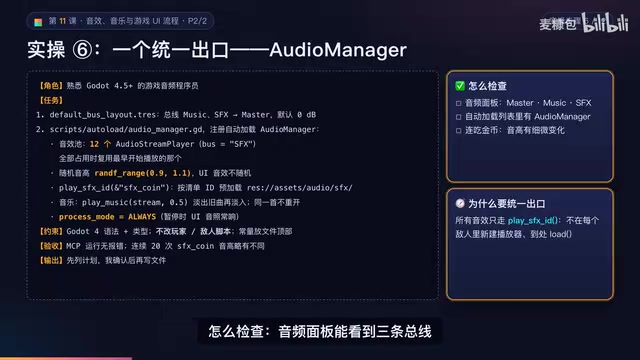
AI Game Development in Practice: Audio Buses and Building the Full UI Flow
AI game dev lesson 11 part 2: Godot's audio trio, audio buses and dB conversion, AudioManager's player pool and random pitch, autoload boundaries, the full UI flow from title to clear, fault-tolerant JSON saves, and pixel font anti-aliasing and integer-size rules.