Rerun: Turn Your AI Subscription into an AI Coworker Team

Rerun turns an AI subscription into a schedulable AI coworker team with tools that asks before acting, open source with self-hosting.
Rerun is the #3 Product Hunt product that upgrades a ChatGPT or Claude subscription from a Q&A chat window into a standing team of AI coworkers. Each coworker has callable tools, a dedicated computer, and a shared workspace, can run on schedules or triggers, and asks for confirmation before risky operations. Open source under AGPL v3 with self-hosting support, it reuses your existing subscription rather than paying API fees and keeps data under your control. It targets individuals and small teams who feel they're not getting enough value from AI, with the trade-off of defining boundaries and handling operations.
From One-Off Chats to a Standing Team: Rerun's Positioning
Most people still use ChatGPT or Claude the same way: open the chat box, ask a question, get an answer, close the page. They pay the subscription fee monthly, but the value of AI is confined to one-off Q&A sessions. Rerun, the #3 product on Product Hunt, tries to change that: it turns your AI subscription into a team of "AI coworkers."
Each AI coworker comes equipped with tools, a "computer," and a shared workspace. They can run automatically on a schedule or when triggered, and they ask for your approval before performing risky operations. More importantly, Rerun is now open source (AGPL v3) and supports self-hosting.
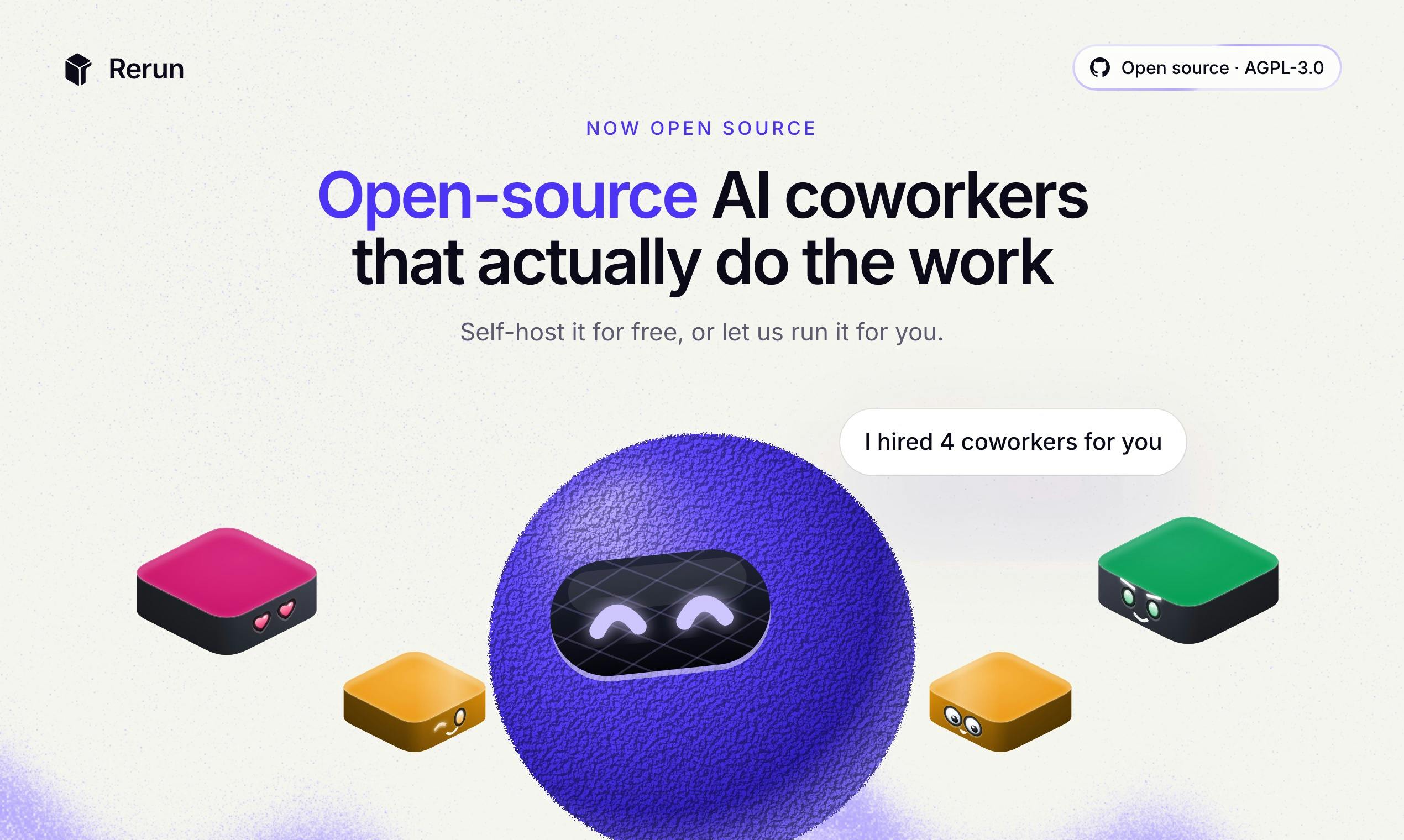
How It Works: What AI Coworkers Actually Do
Rerun's design philosophy is to turn AI from a "tool" into a "team member." Here are its key elements:
Tools + a Computer + a Shared Workspace
Each AI coworker has callable tools and a dedicated "computer," meaning it doesn't just output text—it can perform real actions within an environment. The shared workspace lets multiple AI coworkers—and humans and AI—collaborate around the same context instead of working in isolation.
Run on a Schedule or Trigger
This is the dividing line between Rerun and ordinary chat interfaces. AI coworkers can start automatically on a preset schedule or be triggered by specific events. In other words, tasks no longer depend on you initiating them—the AI gets to work when you need it.
Confirmation Before Risky Operations
The biggest concern with automation is losing control. Rerun's approach is to request user confirmation before executing risky actions, keeping the final decision in human hands. For teams integrating AI into real workflows, this design is the key prerequisite for trusting it enough to use.
The difference between AI Agents and ordinary conversational AI: Traditional chat models are single-turn "input–output" mappings—the model can only generate text and cannot proactively change external state. AI Agents add goal decomposition, tool calling, and iterative execution on top of that: the model can decide which tool to call, read the returned result, and then decide the next step, until the task is complete or human intervention is needed. In Rerun, the "tools + computer" combination essentially gives the model an action space for executable actions, while "confirmation before risky operations" corresponds to the human-in-the-loop mechanism in the agent field, used to balance autonomy and controllability.
Open Source and Self-Hosting: Why This Step Matters
Rerun is open source under AGPL v3 and supports self-hosting. For scenarios where it's used as an "AI coworker team," this matters a lot:
- Data control: AI coworkers run within your workspace, so the files, tasks, and context involved are all under your control—you don't have to hand everything over to a third party.
- Clear cost structure: Rerun reuses your existing ChatGPT or Claude subscription instead of stacking on another layer of pay-per-use API costs.
- Auditable and extensible: Open source means teams can review its behavioral logic and modify it to suit their own needs.
The choice of AGPL v3 also sends a clear signal: Rerun wants to stay open while preventing someone from repackaging it as a closed-source commercial product.
What AGPL v3 is: The GNU Affero General Public License v3 is a strong copyleft license. It adds a key clause on top of GPL v3: if the software provides a service over a network, users also have the right to obtain its source code. This means that even if someone deploys Rerun as a SaaS offering, they must release the modified source code. For teams that want to prevent "open-source projects from being commercialized as closed source," AGPL v3 is one of the most common choices—but enterprises adopting it should also be aware of their compliance obligations, as integrating it with internal systems may trigger source-code disclosure requirements.
What self-hosting means: Self-hosting means deploying the software on servers or local environments you control, rather than using a vendor-hosted cloud version. For AI agent tools, this directly determines whether task data, files, and workflow context leave your own infrastructure. The trade-off is that you're responsible for deployment, upgrades, backups, and security yourself.
Who It's For, and What to Think Through
Based on its positioning, Rerun targets individuals and small teams who already pay for an AI subscription but feel they're "not getting enough value." It shifts the subscription from "per-use consumption" to "continuous output," letting AI push tasks forward in the background on a cadence instead of requiring a human nudge each time.
There are also things to think through. Letting AI coworkers run automatically and operate tools means you need to set clear boundaries for their behavior—which operations they can do directly and which must be asked about first. Rerun provides a confirmation mechanism, but how to define the rules and how to isolate workspaces still depends on the user. In addition, while self-hosting gives you control, it also means operational responsibility falls on you.
Its Product Hunt results—95 upvotes, 5 comments, and #3 for the day—show it has hit a real need: "making an AI subscription more valuable." But as an early-stage project, its long-term stability and the actual experience of multi-AI collaboration still need validation from more users.
TL;DR
Rerun transforms an AI subscription from a "Q&A window" into "a team of coworkers that can be scheduled, have tools, and ask for permission," while open source and self-hosting give this automation the foundation teams need to actually trust it.
One-line Summary
Rerun turns an AI subscription into a schedulable AI coworker team with tools that asks before acting, and it's open source with self-hosting support.
Paragraph Summary
Rerun is the #3 product on Product Hunt, aiming to upgrade a ChatGPT or Claude subscription from a "Q&A chat window" into a standing team of AI coworkers. Each AI coworker comes with callable tools, a dedicated "computer," and a shared workspace, can run automatically on a schedule or trigger, and asks for user confirmation before performing risky operations. The project is open source under AGPL v3 and supports self-hosting, reusing your existing subscription instead of paying separate API fees while keeping data and workspaces under your control. It targets individuals and small teams who already pay for AI but feel they're "not getting enough value"; the trade-off is that users must define behavioral boundaries, isolate workspaces, and take on operational responsibility.
Related articles

9 AI Subscription Plans Compared: The Real Cost Per 100M Tokens Revealed
Bilibili creator tests 9 AI subscription plans from Volcano, Alibaba, Tencent, Baidu, Zhipu, Xiaomi, MiniMax and more, converting them all to real cost per 100M tokens, breaking down fixed-quota vs. three-tier coefficient billing and how caching, time-of-day discounts, and window limits affect actual quota.

Vibe Coding for Beginners: Expressing Intent Instead of Handwriting Code
What is Vibe Coding? A 137-episode Bilibili course defines it: the core is expressing intent, not writing code. This article analyzes Vibe Coding's productivity logic, target audience, and entry expectations to help beginners decide if it's worth learning.

LangChain Beginner's Guide: An Agent Development Roadmap from LangGraph to Deep Agents
Clarify the encapsulation relationship among LangChain, LangGraph, and Deep Agents, and master the learning path and selection logic for agent development frameworks—suitable for beginners in large model development.