Research Agent in Action: AI Runs the Full NASA Airfoil Validation Workflow on a Cloud Host

CloscoScience cloud host lets the Agent independently complete the NACA 0012 airfoil CFD validation loop in 8 hours.
The article introduces how research automation Agent CloscoScience bypasses the three obstacles of domestic network, payment, and environment, providing teams with a persistent cloud host pre-installed with OpenFOAM, Paraview, and over 2,400 Python packages. Through the NACA 0012 airfoil validation case, it demonstrates the Agent's complete workflow from reading NASA data, generating three grid sets, handling medium-grid divergence, completing the angle-of-attack sweep, to outputting the report. After 8 hours and 197 steps, all 6 acceptance criteria were met: the lift curve slope deviates 0.8% from CFL3D, the stall angle matches the wind tunnel, and the maximum lift deviation is attributed to SST model limitations. The article points out that the Agent's core value lies in troubleshooting logic and error attribution, not in replacing engineer judgment, making it suitable as a team's resident compute node.
Title
Research Agent in Action: AI Runs the Full NASA Airfoil Validation Workflow on a Cloud Host
Meta Description
Research automation Agent CloscoScience in action: on an 8-core 16G cloud host with Cloud Opus 5.5 master-slave mode, it completed NASA NACA 0012 airfoil validation. The k-Omega SST model's lift coefficient deviates 0.8% from CFL3D, including the full self-diagnosis of the medium-grid divergence.
Article Content
Overseas AI vendors are now equipping Agents with cloud computers—GrokBot gives each account a persistent cloud host, XGPD Cloud provides a code sandbox, and Agent capabilities are being pushed upward by hardware. But applying this model to domestic research scenarios runs into three obstacles: restricted network access, overseas account and payment barriers, and the lack of ready-made simulation software in sandboxes with non-persistent environments. Research automation Agent CloscoScience bypasses these three obstacles: it's directly usable on domestic networks, provides one cloud host per team, comes with Ubuntu 24.04 pre-installed with over 2,400 Python packages, a complete R and Julia toolchain, and a directly accessible terminal.
This article uses a real case in fluid mechanics to show how the Agent completes the full loop of NASA airfoil validation from scratch.
The Compute Configuration and Environment Foundation of a Cloud Host
This cloud host has 8 cores, 16G of RAM, and nearly 500G of disk. The environment page shows Ubuntu 24.04 with over 2,400 pre-installed Python packages. Two sets of OpenFOAM are installed, and Paraview 6.1 is also present. For model configuration, master-slave mode is recommended: the master model is Cloud Opus 5.5 (Anthropic's current latest flagship model), which excels at deep reasoning and complex tasks; the sub-agents follow the master model with reasoning intensity set to high and context evaporation. The entire task ran for nearly 8 hours, using only 24% of the context—enough to hold paper data, logs, and scripts.
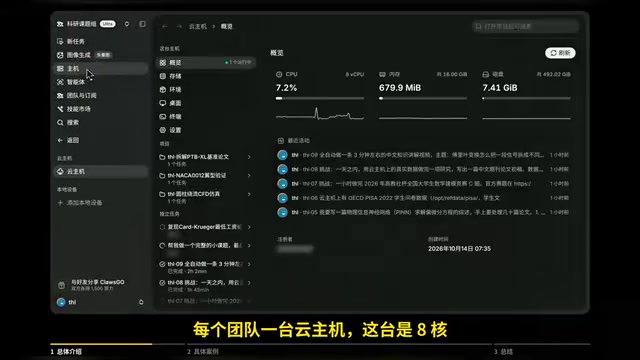
The key to this configuration is not how powerful a single card is, but environment persistence—self-installed software packages won't be lost due to updates. For simulation tasks that require repeated tuning of solver parameters, this matters more than peak compute. A team's existing Fluent workstation or GPU cluster can also be registered as an SSH server for access, and a personal computer can be added to the team as a host. The skill marketplace has 860 skills, and installing one shares it with the whole team.
Task Setup: Validation Target of the NACA 0012 Airfoil
The test object comes from NASA's Turbulence Modeling Resource: NACA 0012 airfoil, Reynolds number 6 million, k-Omega SST turbulence model, chimera coordinates, with wind tunnel comparison data computed by NASA using CFL3D. All 8 files were dropped in together.
The prompt only clarified three things: what was needed, what to compare against, and what counts as done. The acceptance criteria were very specific—lift coefficient deviation from CFL3D within 2%, plus completion of a grid independence study with three grid sets.

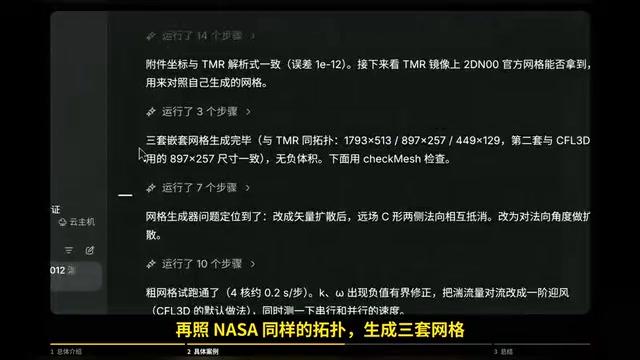
The rest was left for the Agent to plan on its own. It first checked the chimera coordinates, then generated three grid sets using the same topology as NASA. The coarse grid at 10 degrees angle of attack was computed first, giving a lift coefficient of 1.077, versus CFL3D's 1.0778—the first data set already fell within the error band.
The NACA 0012 airfoil is a symmetric airfoil developed by NACA (National Advisory Committee for Aeronautics) in the 1930s. In the designation, "00" indicates zero camber and "12" indicates a maximum thickness of 12% of the chord. Because of its simple geometry and abundant aerodynamic data, it has become a classic benchmark for CFD validation. Reynolds number 6 million means an extremely high ratio of inertial to viscous forces, with flow close to actual flight conditions, placing stringent demands on turbulence models and grid resolution. The k-Omega SST turbulence model, proposed by Menter, combines the accuracy of k-Omega in the near-wall region with the robustness of k-Epsilon in the far field, switching via blending functions; it is one of the most commonly used two-equation models in aerospace external flow simulation. CFL3D is a structured-grid CFD solver developed by NASA Langley, and its cases are often treated as numerical benchmarks. Chimera/overset grids allow grid blocks to overlap, commonly used for complex geometries, but they introduce interpolation errors that must be handled carefully.
Medium Grid Divergence: The Agent's Self-Diagnosis and Repair Chain
The medium grid diverged right from the start. The Agent did not stop and wait for a human; instead, it self-checked all the way through: first locating pressure oscillations above the airfoil, then switching the discretization scheme, using an incompressible sphere solver as a control, and finally fixing the cold-start logic—only then was the full angle-of-attack sweep queued up.
The value of this process lies in the problem-localization path. Pressure oscillations point to grid or scheme issues; switching schemes rules out discretization errors; the sphere solver control verifies whether the solver itself is working properly; fixing the cold start resolves initial-field mismatch—the four steps together form a complete CFD troubleshooting logic rather than blind parameter tuning.
The task continued running on the cloud host after the browser was closed. After nearly 8 hours and 197 steps, all 6 acceptance criteria were met, and 5 files were returned: a validation report, an attached compute package, comparison plots, and data tables.
Cold start means the solver begins iterating from a uniform flow field or a user-specified initial field, rather than interpolating from an existing converged solution. In a cold start, the initial field differs greatly from the true solution, easily triggering pressure oscillations or even divergence, especially at high Reynolds numbers and in separated flows. Discretization schemes (such as second-order upwind, QUICK, central differencing) affect numerical dissipation and stability; switching schemes is a common means of ruling out discretization errors. An incompressible sphere solver (such as simpleFoam) is used as a control to verify whether the solver itself works properly on a simple case, thereby isolating the source of the problem. Angle-of-attack sweep means solving a series of angles of attack in sequence, ensuring each converges before advancing, otherwise errors accumulate. The Agent's troubleshooting chain reflects the typical thinking of a CFD engineer: localize possible causes from the phenomenon, rule them out one by one with controlled experiments, and finally fix the initial-field logic.
Result Comparison: Deviation Analysis Against Wind Tunnel and CFL3D
The lift curve essentially overlaps with the wind tunnel data and CFL3D results. At 10 degrees angle of attack, the suction peak differs by only 0.2%, the lift curve slope differs by 0.8%, and the stall angle of attack of 7 degrees matches the wind tunnel.
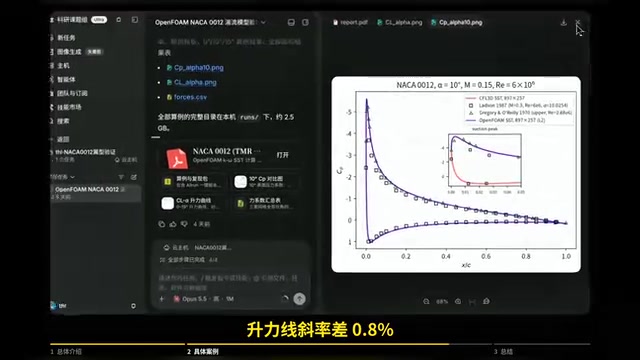
But the maximum lift is somewhat lower. In the report, the Agent itself wrote the reason: the SST model cannot capture the sudden stall seen in the wind tunnel. This is a limitation of the turbulence model itself, not a problem with the solver settings. It also wrote several entries in its experience log, such as that next time it will handle chimera coordinates by block first.
The value of this section is that the Agent not only gives results but also provides error attribution—it clearly explains the seemingly contradictory pair of "lower maximum lift" and "matching stall angle," pointing to model assumptions rather than numerical errors.
Lift curve slope is the slope of the lift coefficient versus angle of attack; the theoretical value in the linear region is about 2π per radian (about 0.11 per degree), in practice affected by viscosity and finite aspect ratio. Stall angle of attack is the angle at which the lift coefficient reaches its maximum and then begins to decrease; for NACA 0012 at Reynolds number 6 million it is about 7 degrees, and matching the wind tunnel indicates accurate simulation of the linear region and pre-stall behavior. A lower maximum lift coefficient stems from the SST model's inability to capture the sudden stall separation in the wind tunnel—SST is based on RANS and is conservative in predicting large-scale separation and post-stall unsteady flow, an inherent limitation of RANS-type models rather than a grid or setup error. Error attribution refers to decomposing deviations into numerical errors (grid, scheme, convergence) and model errors (turbulence assumptions); the Agent's ability to identify the latter indicates a degree of physical reasoning capability.
The Boundaries and Applicable Scenarios of Research Agents
This case does not overturn the value of CFD engineers; rather, it compresses repetitive work. Grid generation, parameter sweeps, troubleshooting loops, and report compilation can be run through by the Agent, while humans only need to define acceptance criteria.
The boundaries are equally clear. The Agent's troubleshooting capability is built on the existing solver ecosystem—OpenFOAM and Paraview are pre-installed. If switched to obscure in-house software, the environment configuration step may still get stuck. The quality of error attribution depends on whether it can identify problems at the level of model assumptions—this time it identified SST's stall limitation, but that is a textbook-level known issue. When encountering genuinely unknown deviation patterns, human judgment is still required.
From an engineering practice perspective, this type of Agent is suitable as a resident compute node in a team: submit the task, close the browser, and come back to collect the report. For teams doing simulation that require repeated validation, this model mainly saves the manpower of waiting and troubleshooting, rather than replacing judgment.
One-line Summary
CloscoScience cloud host lets the Agent independently complete the NACA 0012 airfoil CFD validation loop, meeting all criteria in 8 hours.
Paragraph Summary
The article introduces how research automation Agent CloscoScience bypasses the three obstacles of domestic network, payment, and environment, providing teams with a persistent cloud host pre-installed with OpenFOAM, Paraview, and over 2,400 Python packages. Through the NACA 0012 airfoil validation case, it demonstrates the Agent's complete workflow from reading NASA data, generating three grid sets, handling medium-grid divergence, completing the angle-of-attack sweep, to outputting the report. After 8 hours and 197 steps, all 6 acceptance criteria were met: the lift curve slope deviates 0.8% from CFL3D, the stall angle matches the wind tunnel, and the maximum lift deviation is attributed to SST model limitations. The article points out that the Agent's core value lies in troubleshooting logic and error attribution, not in replacing engineer judgment, making it suitable as a team's resident compute node.
Related articles

T3 Code: The Open-Source AI Coding Assistant's Comeback Story
T3 Code is an open-source AI coding assistant that unifies subscriptions like Codex and Claude, with powerful remote control and parallel task management.

Never Elected, Yet Ruled New York for 30 Years: The Ultimate Case Study in the Mechanics of Power
Robert Caro's biographies reveal how unelected Robert Moses ruled New York for 30 years through legal drafting and public authorities, and how Lyndon Johnson built leverage as a "powerless" Senate Majority Leader. Unpacking the underlying logic of accumulating and sustaining power.

The CPython 3.10 Recursion Trap and Synthetic Recovery in TokenGuard, an LLM Circuit Breaker
TokenGuard's author recounts a recursion crash caused by OrderedDict.pop in CPython 3.10 and introduces v0.3.0's Loop Nudge synthetic recovery, inline DLP scanning, and other new LLM agent circuit-breaker capabilities.