Researchers Warned for Years About North Korean Hacker Tactics, Yet Binance Still Hit by Record $6.3 Billion Theft

Binance suffered a $6.3 billion theft by North Korean hackers, exposing a structural gap between threat warnings and enterprise defense.
The article examines Binance's record $6.3 billion asset theft, allegedly carried out by long-active North Korean hacker groups. The author stresses that the real warning lies not in the attack itself but in the fact that researchers had repeatedly warned years earlier about these "persistent, patient" long-term infiltration tactics, yet Binance was still breached—revealing a massive gap between publicly available threat intelligence warnings and enterprises' actual defensive capabilities. The article analyzes two possible explanations for the failure of warnings: a structural disconnect between intelligence dissemination and security development, and the asymmetric contest between nation-state attack resources and a single enterprise's defense in depth. Finally, it recommends that the crypto industry incorporate threat intelligence into regular exercises, adopt defense models that assume compromise, and strengthen multi-factor verification in permissions and fund flows, while noting that North Korean hackers have become a systemic risk difficult to eliminate from the crypto ecosystem.
An Attack Warned About for Years
According to security media reports, Binance, the world's largest cryptocurrency exchange, suffered a record $6.3 billion asset theft, with the perpetrators allegedly tied to long-active North Korean hacker groups. What is unsettling is not the attack itself, but the fact that researchers had repeatedly warned years in advance about the persistence and patience characterizing these tactics—and Binance was still breached. The incident exposes a harsh reality: there is a massive gap between publicly available threat intelligence warnings and enterprises' actual defensive capabilities.
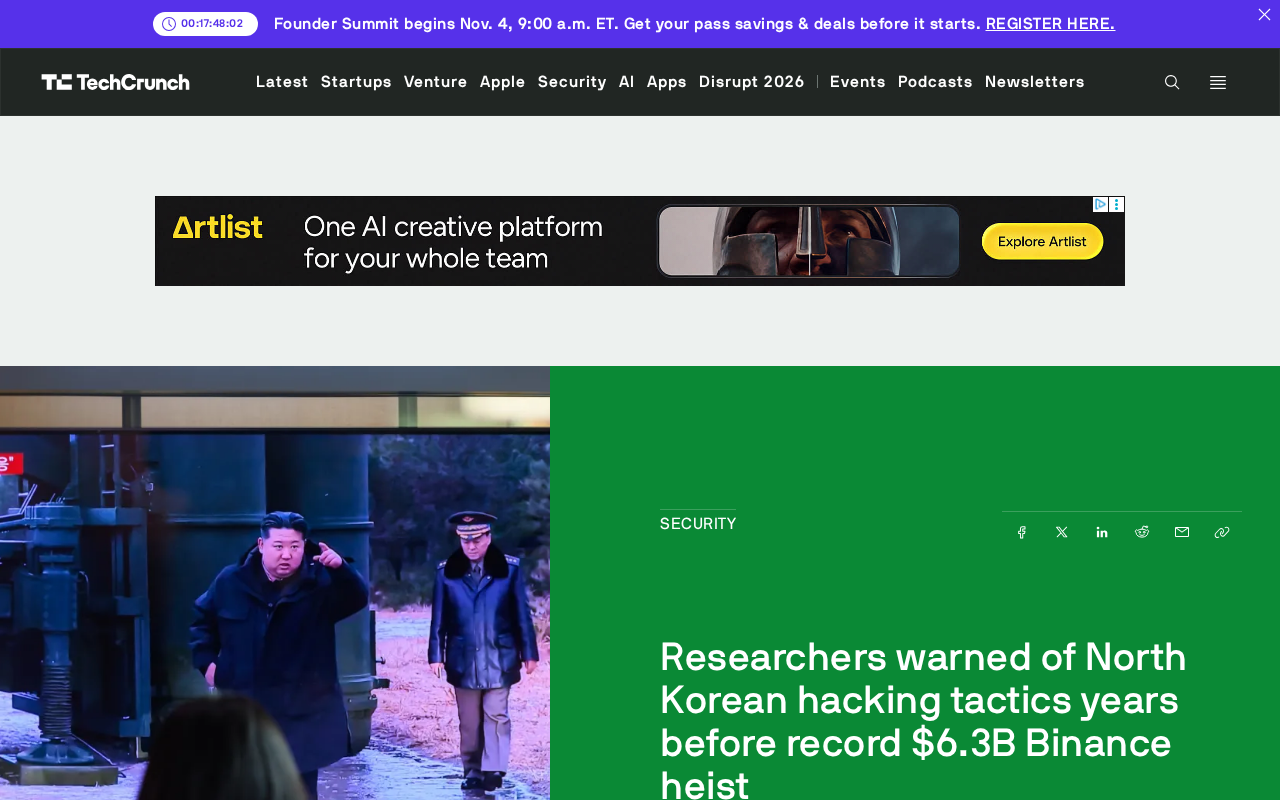
The "Patient Tactics" of North Korean Hackers
In security experts' descriptions of North Korean hacking methods, two words recur: persistent and patient. This is not a traditional intrusion aimed at a short-term breakthrough, but a mode of operation involving long-term infiltration, gradually building access, and waiting for the optimal moment.
The hallmarks of this tactic are: attackers do not retreat after a single failure but keep trying different entry points; they are willing to spend months or even longer lurking in the target network, observing defensive mechanisms and personnel behavior patterns; and ultimately they strike fatally when the target is at its weakest. For defenders, this means a single successful interception does not equal security—attackers may return through another path at any time.
Public reports over the years have continuously reminded the crypto industry of this threat pattern, but warnings have not translated into sufficient defensive action.
APT (Advanced Persistent Threat) is a key framework for understanding this type of attack. APT does not refer to a specific piece of malware, but describes a category of long-term cyber intrusion operations launched by states or state-supported organizations. Its core features are precisely "advanced" (use of custom tools and zero-day exploits) and "persistent" (long-term residence and repeated attempts). Multiple North Korean hacker groups (such as Lazarus Group and APT38) are widely classified as APT actors, and their operations often carry a clear goal of obtaining funds to evade international sanctions. Unlike traditional criminal gangs seeking a one-time score, APT attackers typically follow a multi-stage chain of "reconnaissance—initial intrusion—privilege escalation—lateral movement—persistence—objective achievement." Each stage can be intercepted by defenders, but attackers need succeed in only one link to continue advancing. This also explains why a single interception does not constitute a security guarantee.
Why Warnings Failed: The Disconnect Between Intelligence and Execution
The most important question to examine in this incident is not "how strong North Korean hackers are," but "why a known threat still caused record losses."
One possible explanation is a structural disconnect between the dissemination of threat intelligence and enterprises' security development. Tactical analyses published by researchers often remain within professional circles, and even if an exchange's security team reads the reports, it may not be able to translate them into concrete defense strategies and resource allocation. The security surface facing crypto exchanges is extremely complex—hot wallets, cold storage, employee endpoints, third-party services, internal permission management—and negligence in any one link can become a breach point.
Another explanation involves the trade-off between attack scale and defense cost. When attackers are willing to invest nation-state resources and endure long-term failure, whether a single enterprise's defense in depth is sufficient is itself an open question.
Threat Intelligence is divided into three levels: strategic, operational, and tactical. Strategic intelligence is aimed at decision-makers, explaining threat trends and resource priorities; tactical intelligence provides specific indicators of attack (IoC), such as malicious IPs, file hashes, and TTPs (tactics, techniques, and procedures). The problem is that public reports mostly remain at the level of strategic and tactical descriptions, while enterprises need to translate these descriptions into executable detection rules, defensive architecture adjustments, and exercise playbooks to truly benefit. The industry commonly uses the MITRE ATT&CK framework to bridge this gap—it breaks down attacker behavior into a mappable matrix of techniques and tactics, enabling defenders to check their own coverage blind spots item by item. If an exchange's security team lacks the ability to map intelligence to ATT&CK and implement it as control measures, warnings can only be "read" rather than "used."
The distinction between hot wallets and cold storage is fundamental to understanding an exchange's attack surface. Hot wallets refer to wallets connected to the internet and used for daily deposits, withdrawals, and liquidity scheduling; their private keys are online, making them convenient but exposed to remote attacks. Cold storage keeps private keys offline (such as hardware wallets, paper wallets, and multi-signature isolated environments), offering high security but inconvenient operation. Most major theft incidents do not directly crack cold storage; instead, they achieve their goals indirectly by compromising hot wallets, employee endpoints, or some online link in the signing process. In addition, multisignature (multisig) and MPC (multi-party computation) wallets reduce the risk of a single point of failure by distributing signing authority among multiple parties, but their security still depends on whether participants' endpoints and processes have been compromised—which is precisely the target of long-term positioning by "patient" attackers.
Lessons for the Crypto Industry
The figure of $6.3 billion set a record for crypto theft, but its significance goes far beyond the amount itself. It shows that even for high-risk threats that have been repeatedly named, the industry as a whole has still failed to establish an effective response mechanism.
For crypto trading platforms, this incident points to several directions: incorporate public threat intelligence into regular defense exercises rather than treating it as background reading; design defense models for "patient" attacks that assume compromise has already occurred; and set up more checkpoints requiring multi-factor verification in permission management and fund flow processes.
More broadly, the long-term activities of North Korean hackers have become a systemic risk in the crypto ecosystem that is difficult to eliminate. Researchers' warnings were accurate; the question is whether, after the warnings, the industry is willing to pay the corresponding price to truly respond.
Related articles

Axion 1.0: A Minimalist Training Recipe for a 35B Open-Source Agent Foundation Model
Axion 1.0 is ByteDance's fully open 35B agent foundation model trained with a minimalist two-stage SFT plus RL recipe—no mid-training, DPO, or OPD—with data construction, validation, and training code released, competing with commercial models on agent benchmarks.

Get SMS Alerts for Codex Quota Resets and Stop Wasting Usage | Reset Alerts
Reset Alerts is a free tool that sends SMS and Telegram reminders when OpenAI Codex usage resets, helping developers use up remaining requests before the reset. No app needed—just text START to subscribe.

Jelly Sheet: Why mrdoob's Physics Simulation Experiment Is Drawing Attention
Jelly Sheet is a browser-based soft body simulation experiment by Three.js founder mrdoob, earning 301 points and 77 comments on Hacker News. This article analyzes its technical challenges, interaction feel, and dissemination path in the creative coding community.