Ring Launches $999 Autonomous Patrol Robot RoverCam
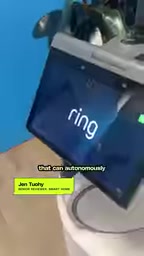
Ring launches RoverCam, an autonomous mobile security camera priced near $1,000, targeting commercial settings.
Ring has released RoverCam, an autonomous mobile security camera that packs a 4K periscope camera, two-way talk, and a built-in siren onto a movable chassis for indoor patrol. A light tower illuminates the ceiling to help users locate it. Priced at $999.99 and aimed mainly at commercial venues, it ships December 16. The article notes it's essentially a "reincarnation" of Amazon's Astro robot, stripped of personification and repositioned as a dedicated security tool—reflecting the trend toward specialized consumer robots.
Ring is pushing security cameras from a "fixed viewpoint" toward "active patrolling." Among its latest announced products, an autonomous mobile security camera called RoverCam is the centerpiece—it's both a camera and a robot that can drive itself around your home.
From Fixed Camera to Mobile Patrol Robot
RoverCam's core selling point is packing Ring's existing security capabilities onto a movable chassis. According to a YouTube source, it features a 4K periscope camera, two-way talk, and a built-in siren—these three cover the common needs of home and small business security: see clearly, talk to people, and sound an alert.
What really sets it apart from ordinary Ring cameras is its "autonomous driving" capability. It can move autonomously indoors on patrol rather than passively waiting for an event to trigger it. For scenarios that require coverage across multiple rooms or large areas, this mobility means a single device can handle inspection tasks that previously required multiple fixed cameras.
Periscope Camera is a camera structure that changes the light path through a prism or mirror, folding the lens horizontally. Its main benefits are achieving higher optical zoom or a longer focal length within a limited body thickness, while allowing the lens to face different directions. Using a periscope design on a mobile robot allows a more compact camera module and, even when the robot chassis is low to the ground, maintains a longer observation distance and a better pitch angle—balancing size and imaging capability.
Design Details: Light Tower and Visual Positioning
RoverCam has a rather clever design touch—the light tower. This component can illuminate the ceiling upward, letting users clearly know its location as it moves around.
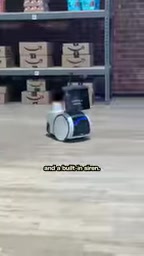
This detail seems minor, but it actually solves a real problem once mobile robots enter the home: when a device moves autonomously across the floor, how do people quickly perceive its location and status? Projecting light onto the ceiling as a visual signal is more noticeable than adding lights to the body, and it avoids direct glare.
Pricing and Positioning: Business First, Home as an Option
Ring's positioning for RoverCam is clear: primarily aimed at commercial venues, but it can also be used at home. However, price is a barrier for home users—$999.99, close to a thousand dollars.
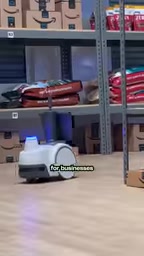
The original article calls this price "very expensive." For business users, a device that can patrol autonomously with a 4K camera and siren may be more cost-effective and efficient in coverage than deploying multiple fixed cameras; but for ordinary households, spending close to a thousand dollars requires a stronger justification. The product is scheduled to ship on December 16.
The Astro Connection: A "De-personified" Rebirth
RoverCam isn't an entirely new form factor built from scratch. According to the source, it's actually the "reincarnation" of Amazon's Astro home robot—Astro was essentially "Alexa on wheels."

The difference is that RoverCam completely strips away the personified setup, no longer playing the role of a home assistant but turning entirely into a security tool. The original article's assessment is quite direct: it "has no personality at all," but at least it has a clear purpose.
This shift is worth pondering. Home robots have been wavering between "companionship" and "utility" for years, and Astro's attempt never really opened up the mass market. Ring's approach is to narrow the same mobile platform to a single high-frequency need—security—replacing vague emotional value with clear functional value. For manufacturers, this lowers the cost of user understanding; for the category, it also suggests that consumer robots in the near term are more likely to land as "dedicated tools" rather than "general-purpose assistants."
Amazon Astro is a home assistant robot released by Amazon in 2021, equipped with a wheeled chassis, a retractable camera, and the Alexa voice assistant. It was initially positioned as a "mobile smart display/home assistant" that could patrol, make video calls, and follow users. Its price was once as high as $1,449.99 (later reduced), and market response was limited, mainly due to vague functional positioning and a high price. Astro later underwent internal adjustments at Amazon, with some teams and product lines reorganized. RoverCam is seen as a continuation of the same mobile platform idea, but it cuts the Alexa assistant and emotional interaction, focusing on the single scenario of security.
Several Issues Worth Watching
RoverCam's actual performance still depends on several dimensions that haven't been fully discussed: obstacle avoidance and path planning for autonomous movement, battery life and charging methods, how privacy data is handled, and its actual inspection efficiency in commercial settings. These will determine whether it's "a camera that can move" or a truly usable security robot.
From a product strategy perspective, Ring choosing to enter the commercial market first at a price close to a thousand dollars and then observe home demand is a relatively prudent path. The imagination space for mobile security is considerable, but whether users are willing to pay for a camera that drives itself will become clearer after shipping.
Obstacle avoidance and path planning for autonomous mobile robots typically rely on multi-sensor fusion: LiDAR or depth cameras for building indoor maps and ranging, visual SLAM for localizing their own position, and ultrasonic or infrared sensors for close-range collision avoidance. Path planning is divided into global planning (finding the optimal route from the map) and local planning (avoiding suddenly appearing obstacles in real time, such as pets or people). For security cameras, obstacle avoidance isn't just about preventing collisions—it also needs to avoid getting stuck on thresholds, carpet edges, or under furniture during patrols. In terms of battery life, such devices usually adopt an auto-recharge strategy, needing to autonomously return to the charging dock when battery is low; the placement of the charging dock and the home layout directly affect practical usability.
One-line Summary
Ring launches RoverCam, an autonomous mobile security camera priced near a thousand dollars, targeting commercial settings.
Paragraph Summary
Ring has released an autonomous mobile security camera called RoverCam, packing a 4K periscope camera, two-way talk, and a built-in siren onto a movable chassis so it can patrol autonomously indoors rather than passively waiting for an event to trigger it. A light tower on top illuminates the ceiling upward, making it easy for users to locate the robot. RoverCam is priced at $999.99, primarily aimed at commercial venues, with a high barrier for home use, and is scheduled to ship on December 16. The article notes that it is essentially the "reincarnation" of Amazon's Astro home robot, but completely stripped of its personified setup, shifting from a home assistant to a dedicated security tool—reflecting the trend that consumer robots in the near term are more likely to land as dedicated tools. Its actual performance still depends on dimensions not fully discussed, such as obstacle avoidance, battery life, privacy handling, and inspection efficiency.
Related articles

Anthropic Launches Dual Flagships Claude Fable 5.2 and Mythos 5.2, Topping Coding and Science Benchmarks
Anthropic releases Claude Fable 5.2 and Mythos 5.2 dual flagships, with full upgrades in coding, 3D interaction, and life sciences, topping third-party intelligence index, integrated by GitHub Copilot and Cursor, API pricing lower than competitors.
Claude Code Reportedly Leaks Secrets to GitHub, Sounding the Alarm for AI Coding Security
Claude Code reportedly exposed passwords and API keys to GitHub, per Ars Technica. We recap the incident alongside Claude Fable 5.2's 20% price cut and Meta Muse Ember, urging developers to check commit settings before granting permissions.
Getting Started with LangChain: Core Concepts of the Agent Development Framework
Starting from the three major limitations of LLMs, this article explains LangChain's positioning and value as an Agent development framework: limited knowledge, external system interaction, and state retention, along with its official documentation system and learning path.