Rivian Sales Surge: Early Signs That the Affordable R2 Bet Is Paying Off

Rivian's Q3 production jumped 85% YoY as its affordable R2 model bet shows early signs of paying off.
Rivian reported Q3 production of 19,751 vehicles and deliveries of 19,248, with production up 85% and deliveries up 45% year-over-year — among its strongest quarterly results in recent memory. The core driver is the company's bet on the affordable R2 model, which targets a broader mainstream market compared to the premium-priced R1T and R1S, and could help Rivian transition from a niche luxury brand into a scaled manufacturer. Production growth outpacing deliveries suggests inventory is being built for a future ramp. However, the strong YoY figures are partly inflated by a low base from last year's planned factory shutdown, and the true sustainability of this growth remains to be proven over coming quarters.
Rivian Delivery Numbers Stage a Strong Rebound
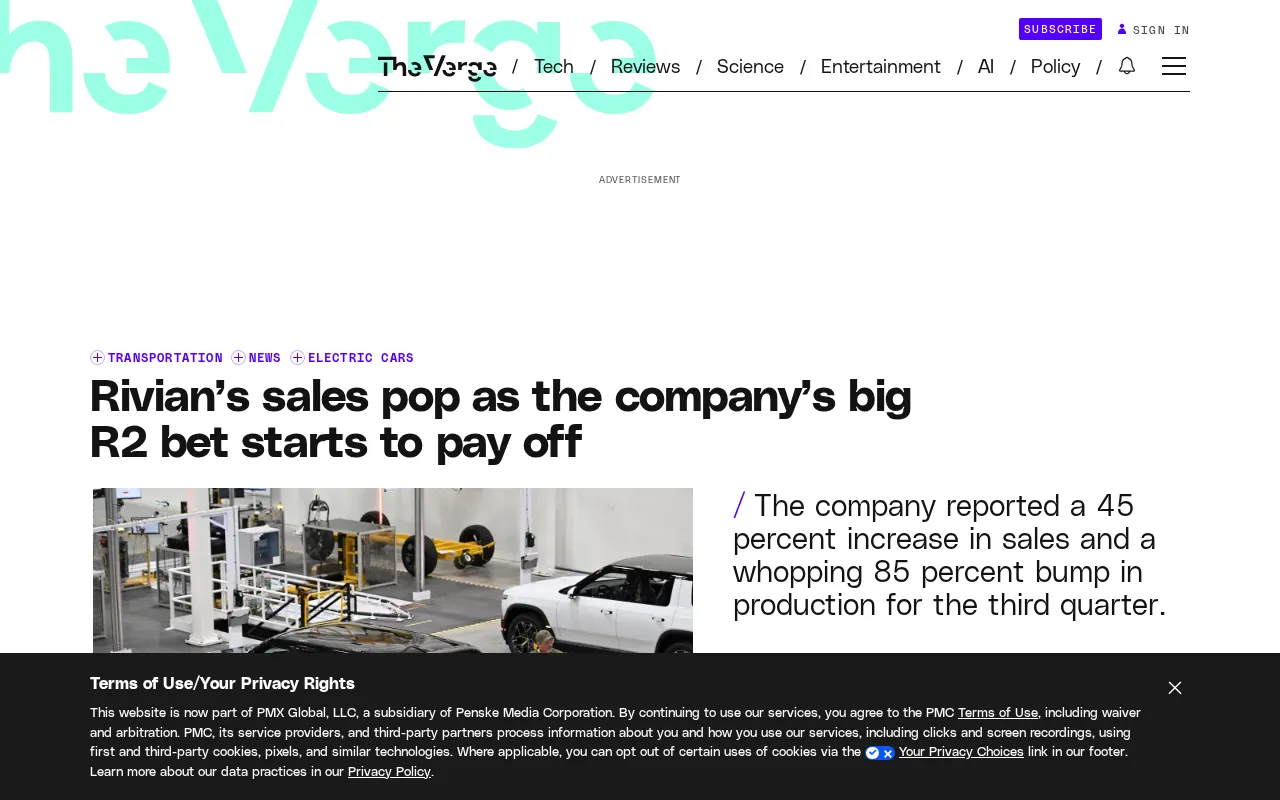
Rivian has placed enormous hopes on its more affordable R2 model, and the latest numbers suggest that bet is beginning to pay off. The company has released its Q3 production and delivery results: 19,751 vehicles produced and 19,248 delivered.
Behind those figures lies impressive year-over-year growth — production climbed 85% compared to the same period last year, while deliveries jumped 45%. For an EV startup still working through its scaling phase, that kind of momentum sends a positive signal.
Why the R2 Strategy Matters
Rivian built its early market presence around the R1 lineup — the R1T pickup truck and R1S SUV — but those vehicles carry premium price tags that limit their audience. The R2, positioned as a more accessible product, is seen by the company as a critical step toward expanding market reach and driving higher shipment volumes.
The 85% year-over-year jump in production signals that Rivian has made real progress in unlocking capacity. The fact that production growth is outpacing delivery growth suggests the company is building up inventory ahead of a future delivery ramp, and reflects increasing maturity in its supply chain and manufacturing operations.
Why Affordable Models Are the Deciding Factor
As competition in the EV market intensifies, relying solely on high-end vehicles can't sustain meaningful sales volume. Affordable models not only reach a broader consumer base, but also allow manufacturers to spread production costs across more units, improving per-vehicle economics.
Rivian has described the R2 as a "big bet" precisely because it determines whether the company can evolve from a niche luxury brand into a mainstream EV manufacturer capable of shipping at scale.
The R1T starts at around $69,900 and the R1S at approximately $75,900 — both firmly in the luxury EV segment, alongside Tesla's Model S/X and Rivian's Amazon commercial delivery vans (EDV) as its early primary revenue sources. By contrast, the R2 is targeting a price point of around $45,000, going head-to-head with the mass-market Tesla Model Y. This price band represents the largest segment of the U.S. EV market and is where competition from BYD, Hyundai, GM, and others is most fierce. Rivian plans to add R2 production lines at its existing Illinois plant and build a new factory in Georgia to further expand capacity — two capital expenditures that will ultimately determine whether the R2 strategy translates from vision into real shipment volume.
Challenges and Key Metrics to Watch
Despite the impressive year-over-year figures, these growth numbers deserve a measured read — the high production and delivery growth rates are partly a function of a low comparison base from the same period last year. For investors and industry observers, the real question is whether this growth can be sustained over the coming quarters.
The gap between production and deliveries (approximately 500 units) represents a normal production-to-delivery lag, but its trajectory still warrants monitoring. If R2 demand holds up, Rivian could use this momentum to gain market share and achieve meaningful economies of scale.
Closing Thoughts
Rivian's Q3 data offers early positive validation for its R2 strategy. The affordable model bet is beginning to show results, but whether it can translate near-term growth into long-term profitability and scale still hinges on how production ramps and actual market demand play out in the months ahead.
The so-called "low base effect" is worth explaining here: in the same period of 2023, Rivian was in the midst of a major factory overhaul — the company voluntarily halted production for several weeks to upgrade the R1 series manufacturing platform, causing that quarter's output and deliveries to fall well below normal levels. As a result, a significant portion of the 85% year-over-year production increase in Q3 2024 reflects a recovery from an abnormally low trough, rather than pure business expansion. Investors typically look at quarter-over-quarter (QoQ) data alongside year-over-year figures to strip out this distortion and better assess the true quality of growth. Whether Rivian can sustain double-digit quarterly sequential growth through 2025 will be the more critical test of the R2 strategy's real substance.
Related articles

Vibe Coding Full-Stack in Practice: AI Programming from Beginner to Enterprise Deployment
From Cursor to Claude Code, this Bilibili AI programming course uses four progressive projects to cover full-stack development, open-source secondary development, and team collaboration. The article analyzes the shock to frontend roles, the efficiency shift from 50 people to 5, and the methodology required for enterprise-grade projects.

David Blaine's Global Quest for Real Magic: From South Africa to Japan and India
David Blaine travels to South Africa, Japan, and India in his Do Not Attempt special, documenting Spinning drivers, black mamba rescuers, iaijutsu masters, and ascetics—exploring the boundary between magic and real human极限 challenges.

Is a Touchscreen MacBook Coming? Vergecast Reveals Apple Executive's Response
Vergecast podcast reveals a conversation between a reporter and Apple executive John Ternus about a touchscreen MacBook and Apple Pencil support. Ternus says iPad is the best device for a stylus, while the reporter bets MacBook will eventually support Apple Pencil.