Roku Developer Repositories Migrate to GitLab: Platform Strategy or Developer Experience Compromise?

Roku moves developer repos from GitHub to GitLab, sparking debate on motives and developer experience.
Roku announced migrating its developer code repositories from GitHub to GitLab. The official blog only provided the new address without explaining reasons, sparking heated discussion on Hacker News. Interpretations include cost and compliance, reducing GitHub lock-in risk, and concerns about higher open source collaboration barriers. Criticism centers on opaque communication—missing details like old link redirects and issue/PR history migration directly affect workflows. Supporters see hosting choice as an enterprise infrastructure decision, urging focus on API and documentation stability. The migration doesn't change Roku SDK capabilities but signals tighter control over the developer toolchain; long-term impact depends on community support and documentation efforts.
Roku Developer Repositories Migrate to GitLab: Platform Strategy or Developer Experience Compromise?
Roku recently announced the full migration of its developer code repositories from GitHub to GitLab, a change that sparked intense discussion on Hacker News, with the post garnering 204 points and 138 comments. For a company whose core business centers on streaming hardware and the Roku OS ecosystem, switching code hosting platforms may seem like an internal engineering decision, but it actually involves multiple considerations around developer toolchains, community collaboration methods, and long-term platform strategy.
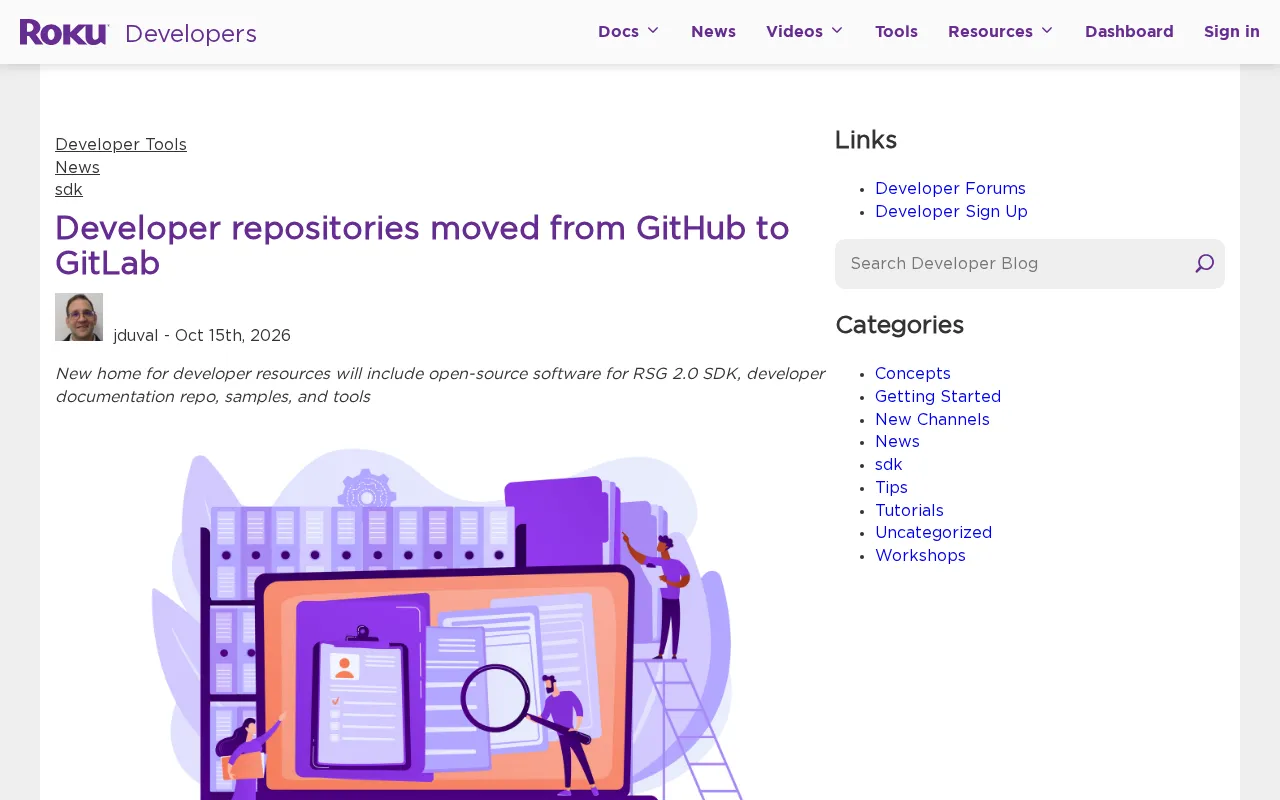
The Migration Itself: Official Understatement, Enthusiastic Community Reaction
According to a brief announcement on Roku's official developer blog, the migration involves Roku developer-related code repositories, with the official new address pointing to GitLab. The blog post did not elaborate on the reasons for the migration, only providing entry information for the new platform. This "results only, no explanation" communication approach is precisely the starting point for extensive questioning in the HN comment section.
The developer community's first reactions focused on two levels: first, what are the technical motivations for the migration, and second, what impact it has on existing developers who rely on GitHub workflows. Due to limited official information, discussion quickly shifted from facts to speculation, dividing into several typical positions.
Why GitLab: Several Mainstream Interpretations
Cost and Compliance Trade-offs
Many developers in HN comments believe that common drivers for enterprise code hosting migration from GitHub to GitLab include cost structure, self-hosting requirements, and data governance strategies. GitLab is known for providing a complete DevOps platform and self-hostable solutions, making it more attractive to companies that want unified control over code, CI/CD, and internal compliance processes. As a publicly traded company, Roku has high requirements for code asset security and auditing—this explanation gained considerable agreement in the discussion.
Continuation of the De-GitHubization Trend
Another viewpoint places this matter in a broader industry context: in recent years, some companies have remained vigilant about dependence on a single code hosting platform, and migration to GitLab or self-built solutions is seen as an action to reduce platform lock-in risk. Some in the discussion mentioned that after Microsoft acquired GitHub, some companies' concerns about platform neutrality increased. Although this claim lacks direct corroboration from Roku officials, it appeared repeatedly in HN comments.
Vendor Lock-in refers to the phenomenon where users or enterprises are bound to a single supplier's products or services due to high migration costs. In the code hosting domain, lock-in effects manifest at multiple levels: repository data formats, issue and PR history, CI/CD pipeline configurations, third-party integrations (such as Slack notifications and code scanning tools), and team members' collaboration habits. Although GitHub's API and ecosystem integrations are rich, after deeply using its proprietary features (such as Actions, Packages, Projects), migrating to other platforms often requires substantial refactoring work. Therefore, when evaluating code hosting platforms, enterprises consider not only features and price but also data portability and exit costs. GitLab, with its open-source core and self-hosting capabilities as selling points, is often viewed as an option to reduce platform lock-in risk, but it has its own lock-in issues—just in different dimensions.
Potential Impact on Open Source Collaboration
Some comments also pointed out that if Roku migrates sample code and SDK repositories intended for external developers to GitLab as well, it may increase operational friction for community contributors. GitHub's network effects in the open source ecosystem remain significant, with issue tracking, pull request habits, and search discovery all formed around GitHub. After migration, external developers need to additionally register GitLab accounts and adapt to new collaboration processes, which to some extent raises the participation threshold.
Network Effect refers to the phenomenon where the value of a product or service increases as the number of users increases. GitHub's dominant position in the open source ecosystem is a typical manifestation of network effects: developers tend to host and discover projects on the platform with the most users, and project owners also tend to choose the platform with the most active developers, creating a positive feedback loop. This effect makes it difficult for emerging or alternative platforms to attract equivalent community attention and contribution traffic in the short term, even with comparable features. After migrating to GitLab, Roku's public repositories may face reduced visibility and fewer external contributors, because many developers are accustomed to searching for and participating in projects on GitHub, and cross-platform participation requires additional cognitive and operational costs.
Controversial Focus Points of Developer Experience
In the HN discussion, the most concentrated criticism was not directed at GitLab's features themselves, but at the communication approach of the migration and the opacity of its scope. Multiple commenters stated that the official blog did not explain which repositories were affected, whether old links would retain redirects, or whether issue and PR histories would be fully migrated. For teams relying on Roku SDK for application development, these details directly relate to daily work efficiency.
Those supporting the migration believe that the choice of code hosting platform is essentially an enterprise infrastructure decision, and developers should focus on the stability of APIs and documentation rather than the hosting platform brand. As long as Roku maintains the accessibility of SDK documentation and sample code, the switching of hosting platforms should not be over-interpreted.
The divergence between these two positions essentially reflects the expectation gap between platform companies and external developers regarding "infrastructure decision transparency."
Redirect in the Web domain refers to the technical mechanism that automatically forwards access requests for one URL to another URL. In code repository migration scenarios, old link redirects are crucial: if GitHub repository addresses referenced in developer documentation, blog posts, and issue discussions are not redirected, users will encounter 404 errors when clicking, causing document failure and workflow interruption. Both GitHub and GitLab support automatic redirects during repository transfers, but cross-platform migration (GitHub to GitLab) usually requires the migrating party to configure redirect rules themselves or retain archived status of old repositories. Roku's official announcement did not mention whether it would retain read-only access to old GitHub repositories or set up redirects—this is precisely one of the details HN commenters are concerned about, as it directly affects the convenience for external developers to find historical resources and continue participating in projects.
What It Means for the Roku Developer Ecosystem
Roku's core competitiveness lies in Roku OS device coverage and channel application ecosystem. The migration of developer repositories itself will not change SDK capabilities or application distribution rules, but it sends a signal: Roku is tightening control over its developer toolchain, tending to incorporate code assets into more unified enterprise-level platform management.
For small and medium-sized developer teams, the short-term impact is mainly workflow adjustment costs; in the medium to long term, it remains to be seen whether Roku will establish more comprehensive public sample libraries and community support channels on GitLab. If external collaboration activity declines after migration, Roku may need to invest more resources in documentation and community operations to compensate.
Summary
Roku's migration of developer repositories to GitLab is a typical platform infrastructure decision, yet it stirred ripples in the developer community due to brief official communication. Cost, compliance, and platform neutrality may be the main drivers, while the gain or loss in developer experience depends on the details of migration execution—old link compatibility, historical data integrity, and smoothness of community collaboration. For developers relying on the Roku ecosystem, it is worth watching whether officials will subsequently supplement migration scope explanations and developer support plans.
One-line Summary
Roku migrates developer repositories from GitHub to GitLab, sparking community discussion about motivations and developer experience.
Paragraph Summary
Roku announced the migration of its developer code repositories from GitHub to GitLab. The official blog only provided the new address without explaining the reasons, sparking heated discussion on Hacker News. The discussion divided into several interpretations: cost and compliance considerations, reducing the risk of GitHub platform lock-in, and concerns about raising the threshold for open source collaboration. Criticism mainly focused on communication opacity—missing details such as old link redirects and issue/PR history migration directly affect developer workflows. Supporters believe that hosting platform choice is an enterprise infrastructure decision, and developers should focus on API and documentation stability. The migration itself does not change Roku SDK capabilities but sends a signal that Roku is tightening control over its developer toolchain; medium- to long-term impact depends on subsequent community support and documentation development.
Related articles

Vaani Developer Platform: Build Human-Like Voice AI Agents with Zero Code
Vaani Developer Platform tops Product Hunt with 175 upvotes, offering zero-code construction of human-like voice AI agents with flow design, tool and knowledge base connections, real phone deployment, and structured call data output.

Knocket AI: A Lightweight Tool That Lets Visitors Chat with Zero Friction
Knocket AI is a lightweight tool that lets visitors start real-time chats via a website or link without registering, targeting founders, creators, and small teams.

XWiki Launches Open-Source MCP Server: Let AI Read Your Wiki
XWiki's open-source MCP Server extension connects your Wiki knowledge base to AI agents like Claude Code and GitHub Copilot, supporting Q&A, page editing, and structured data—self-hosted to keep data control.