Russian University Mathematics Dataset: 1,740 Problems with Handwritten and Typed Solutions

Reddit releases 1,740 Russian-style university math problems with handwritten and printed solutions, targeting multimodal math understanding.
A dataset called "Russian University Mathematics Dataset" has appeared on Reddit, containing 1,740 Russian university math problems, each with solutions covering both handwritten and printed modalities. The article notes that recognition and semantic parsing of handwritten mathematical expressions remain difficult, and that mixed documents with handwritten derivations next to printed exercises are very common in real learning scenarios; the dataset provides supervision signals for handwritten symbol recognition, cross-modal solution consistency verification, and extraction from mixed-format documents. The rigorous proof style of Russian mathematical texts can supplement existing English datasets, but the scale of 1,740 problems is rather small and better suited for fine-tuning or evaluation; specific data formats and annotation granularity have not yet been disclosed, and Russian problem statements also pose a language barrier.
Mathematical AI training has long faced an awkward problem: general-purpose models can solve Olympiad problems, yet they may not be able to read the dense handwritten derivations mixed with printed formulas in Russian-style textbooks. Someone on Reddit has released a dataset called "Russian University Mathematics Dataset," containing 1,740 university-level math problems, with solutions provided in both handwritten and printed forms, attempting to fill this gap.
Core Composition of the Dataset
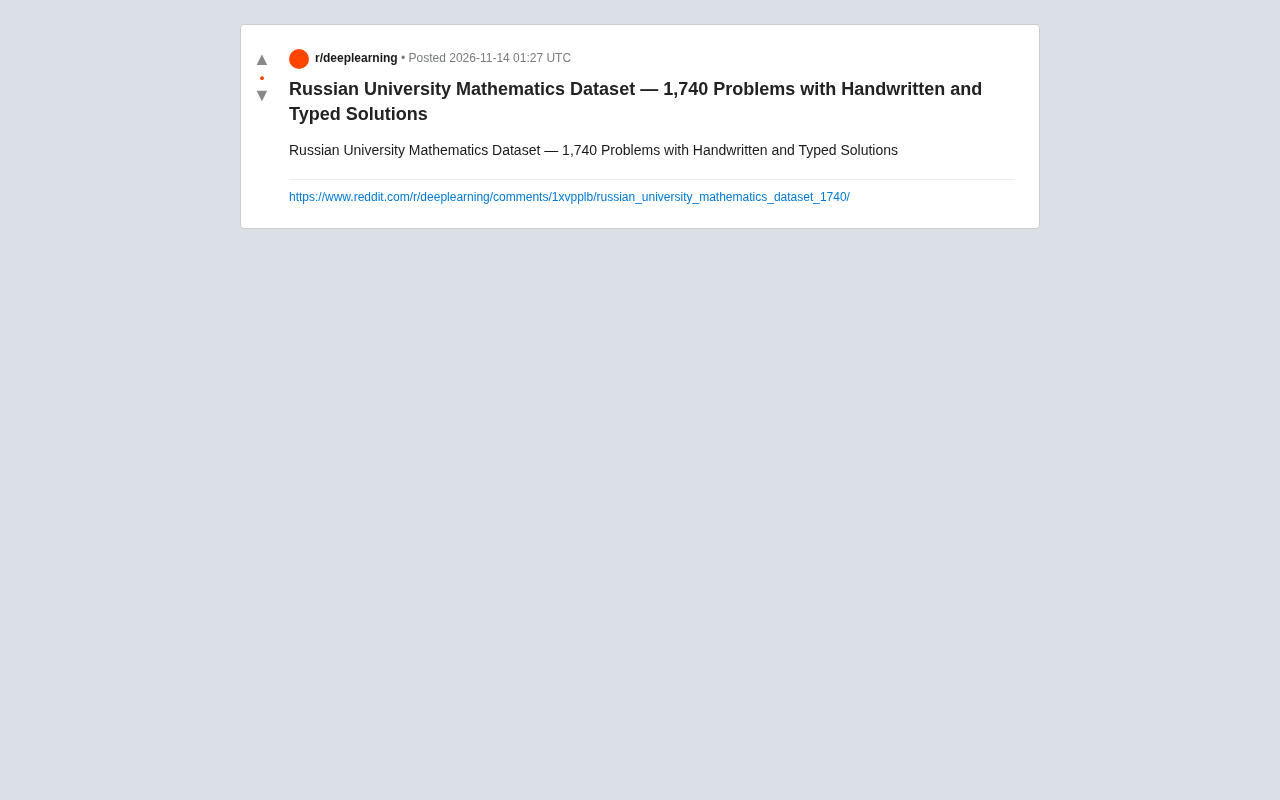
According to the original Reddit post, the dataset contains 1,740 problems, all with accompanying solutions, and the solutions cover both handwritten and printed modalities. This means researchers can use it for multimodal mathematical understanding tasks, such as recognizing solution steps from handwritten drafts, comparing the logical consistency of handwritten versus printed solutions, or training models to locate key formulas in mixed-format text.
You might not have noticed that the dataset is labeled with the source "Russian University," suggesting the problems lean toward the Russian university mathematics curriculum—typically characterized by rigorous proof derivations and symbolic manipulation, which differs from common English competition problem datasets.
Why the Mix of Handwritten and Printed Deserves Attention
In mathematical AI research, printed formula recognition (such as LaTeX OCR) already has relatively mature solutions, but the recognition and semantic parsing of handwritten mathematical expressions remain difficult. In real learning scenarios, students often write derivations by hand next to printed exercises, and such mixed documents are very common in applications like photo-based problem search and homework grading.
This dataset provides handwritten and printed solutions for the same problem or the same type of problem side by side, offering supervision signals for the following tasks:
- Handwritten mathematical symbol recognition and structured parsing
- Cross-modal solution consistency verification (whether the handwritten process logically matches the standard answer)
- Layout analysis and content extraction of mixed-format documents
LaTeX OCR refers to the technology that automatically converts images of mathematical formulas into LaTeX code, a subtask of document image analysis. Its mainstream approaches typically use an encoder-decoder architecture: the encoder (such as CNN or ViT) extracts image features, and the decoder (such as Transformer) autoregressively generates LaTeX token sequences; training data mostly comes from formula screenshots and corresponding source code in arXiv papers. Printed formulas, due to standardized fonts and neat layout, already achieve high recognition accuracy; but handwritten formulas involve connected strokes, symbol deformation, and writing slant, and lack large-scale high-quality annotations, so they remain an open challenge. In addition, LaTeX OCR only solves the "vision-to-symbol" conversion and does not understand the mathematical semantics of formulas, which is precisely the part that mathematical reasoning models need to handle further.
Potential Value for AI Mathematical Reasoning Training
Evaluations of general large models on mathematical reasoning mostly rely on standard problem sets, whereas solutions in real teaching scenarios often contain handwritten intermediate steps, correction marks, and abbreviated symbols. Although the scale of 1,740 problems is not large, the symbolic conventions and layout characteristics of Russian mathematical texts can serve as a useful supplement to existing English datasets.
From a broader perspective, the digitization and structuring of non-English mathematical educational resources is becoming part of multilingual AI capability building. The definition-theorem-proof structure commonly found in Russian university mathematics textbooks also provides material for training models to understand long-chain logical derivations.
Multilingual mathematical ability is a relatively weak dimension in current large model evaluation. Existing mathematical reasoning benchmarks (such as GSM8K and MATH) are dominated by English problems, and model performance on non-English mathematical texts often drops significantly, for reasons including the low proportion of non-English mathematical content in training corpora and the fact that the way mathematical symbols interweave with natural language varies by language. The Russian mathematical education tradition emphasizes the rigorous structure of definition—theorem—proof, and problem statements often contain numerous abbreviations, symbol conventions, and implicit premises, which pose additional challenges to models' cross-lingual symbol understanding and long-chain derivation abilities. Structuring such resources and incorporating them into training or evaluation helps assess whether models truly possess language-independent mathematical reasoning ability, rather than merely memorizing surface patterns of English problem types.
Limitations to Note Before Use
Currently, the only public information comes from the original Reddit post, and the dataset's specific format (whether LaTeX transcriptions are provided, the annotation granularity of handwritten images, the correspondence between problems and solutions) remains unclear. The scale of 1,740 problems is rather small for pretraining and is better suited for fine-tuning or evaluation sets. In addition, Russian problem statements pose a language barrier for non-Russian research teams, requiring additional translation or bilingual alignment work.
If the original post later releases download links and data format descriptions, the dataset's practical value for multimodal mathematical understanding is worth continued tracking.
One-line Summary
Reddit releases 1,740 Russian-style university math problems with both handwritten and printed solutions, targeting multimodal mathematical understanding.
Paragraph Summary
A dataset called "Russian University Mathematics Dataset" has appeared on Reddit, containing 1,740 Russian university math problems, each with solutions covering both handwritten and printed modalities. The article notes that recognition and semantic parsing of handwritten mathematical expressions remain difficult, and that mixed documents with handwritten derivations next to printed exercises are very common in real learning scenarios; the dataset provides supervision signals for handwritten symbol recognition, cross-modal solution consistency verification, and extraction from mixed-format documents. The rigorous proof style of Russian mathematical texts can supplement existing English datasets, but the scale of 1,740 problems is rather small and better suited for fine-tuning or evaluation; specific data formats and annotation granularity have not yet been disclosed, and Russian problem statements also pose a language barrier.
Related articles

AI Writes Your Code—Do You Still Need to Learn Git? Five Reasons
AI coding agents handle Git operations automatically—is it still necessary to learn Git? Five reasons: team communication, reviewing agent PRs, monitoring code changes, fallback when AI goes down, and the joy of learning—plus how the focus of learning Git is shifting in the agent era.

Anthropic Reportedly Prices IPO at $83 Per Share, Valuing Company at $1.5 Trillion
Anthropic reportedly prices IPO at $83 per share, above the expected range, with a fully diluted valuation of $1.5 trillion. This article analyzes the signal significance of the pricing and its impact on the AI industry's financing environment.
Open-Source Code Hosting Platform Codeberg Suffers Outage, Sparking Debate in Developer Community
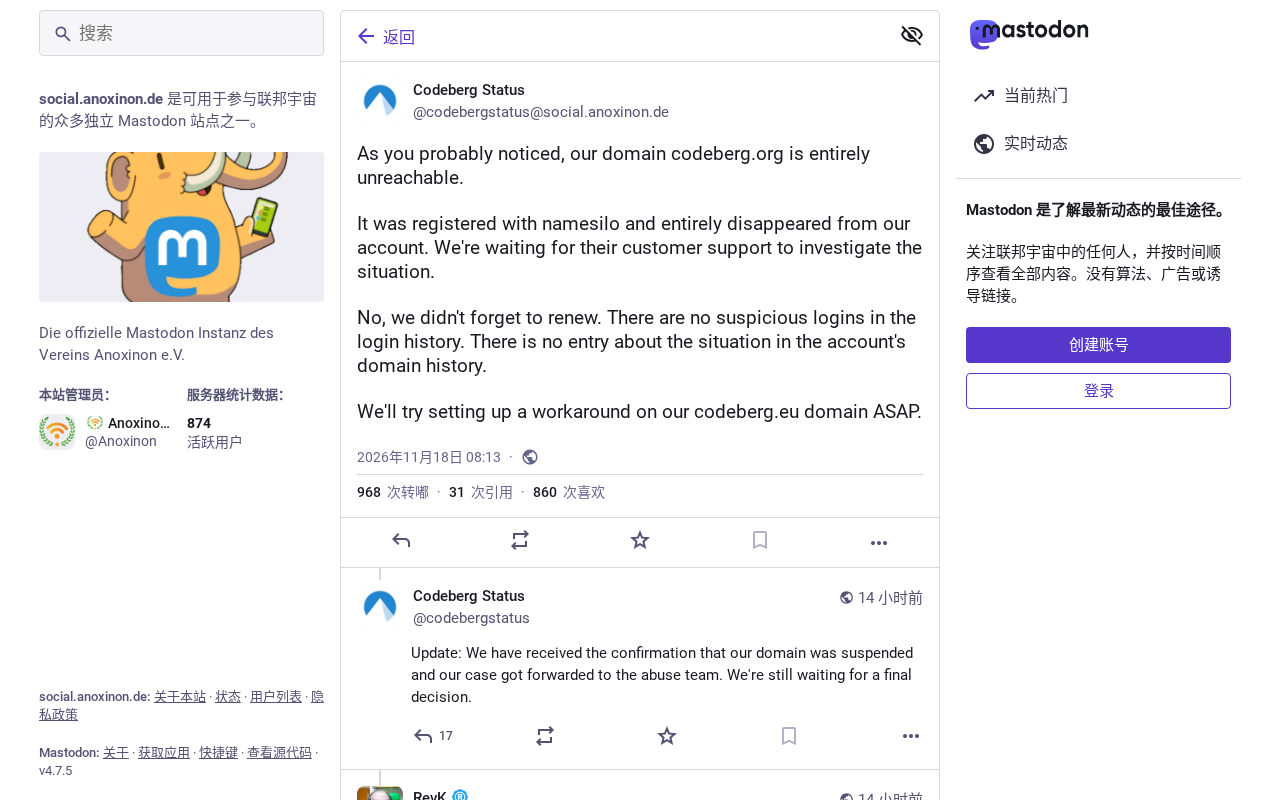
Open-source code hosting platform Codeberg.org suffered an outage, sparking Hacker News debate over nonprofit platform stability and open-source infrastructure dependency risks.