Scott Aaronson: AI Is Opening Up a New Continent for Mathematics
Aaronson uses microscopes and telescopes as metaphors to argue that AI will unveil an entire continent of truths in complexity theory.
Theoretical computer scientist Scott Aaronson proposes that AI's significance for complexity theory and mathematics may be analogous to Leeuwenhoek's invention of the microscope or Galileo's use of the telescope—not solving a specific problem, but suddenly allowing humanity to see clearly a world that had always existed but had been invisible. He emphasizes that what AI brings is an expansion of cognitive vision rather than an improvement in computational efficiency. This judgment comes from a scholar who has long studied complexity boundaries such as P vs NP and who holds a cautious attitude toward AI, and thus deserves attention. Around this view, researchers generally agree that AI-assisted mathematics is moving from verification toward discovery, but disagreement remains on the point that AI-generated proofs still require rigorous human verification and that formal verification is irreplaceable. Aaronson uses the wording "about to obtain" rather than "already accomplished," preserving caution.
From a Drop of Pond Water to an Entire Continent
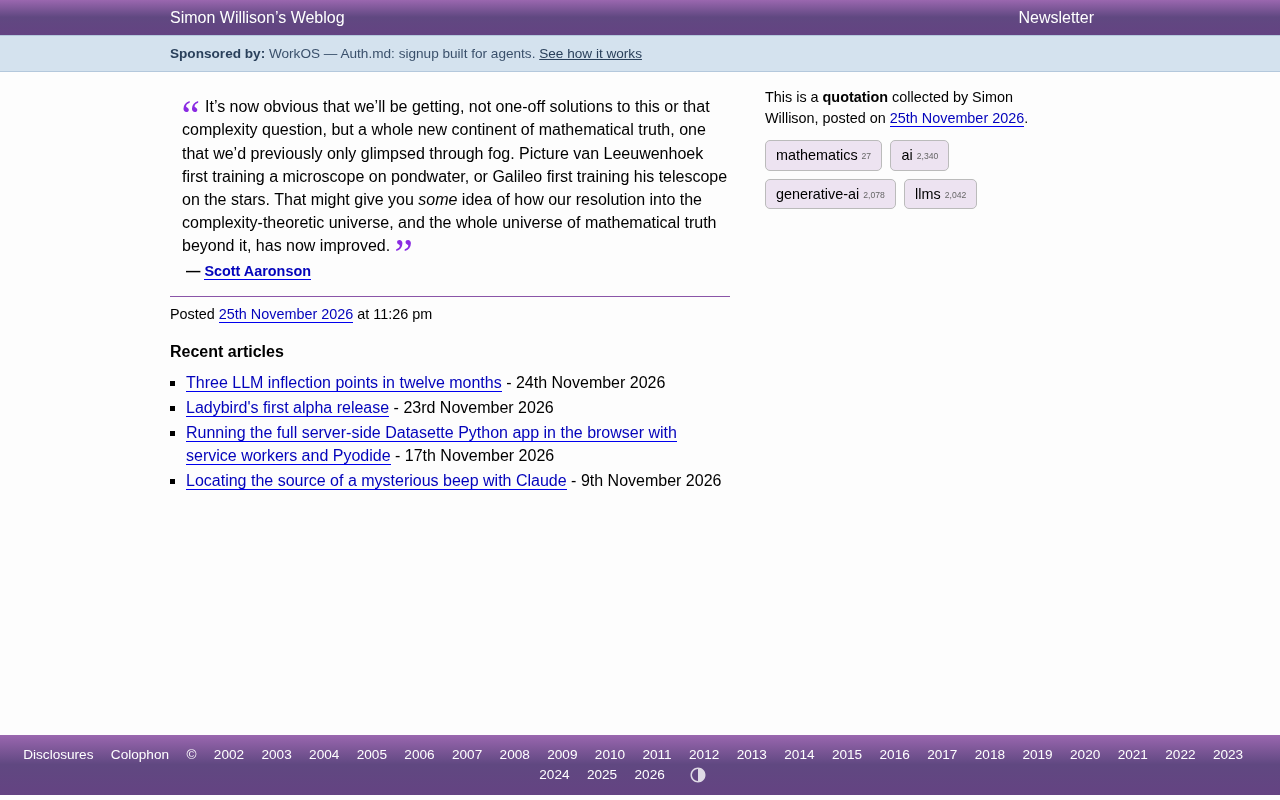
In his blog, theoretical computer scientist Scott Aaronson put forward a vivid and striking claim: what we are about to get is not a few scattered answers to some complexity problems, but an entire continent of mathematical truths that previously could only be glimpsed dimly through the fog.
He drew an analogy with two classic moments in the history of science—Leeuwenhoek first pointing a microscope at pond water, and Galileo first pointing a telescope at the night sky. Neither of these acts solved a specific problem; rather, they suddenly allowed humanity to see clearly a world that had always existed but had been invisible. Aaronson believes that AI's significance for complexity theory, and for mathematics as a whole, may be on this same order of magnitude.
This passage was excerpted and quoted by Simon Willison and tagged with mathematics, llms, ai, generative-ai, indicating that it is being circulated in the context of "AI and mathematics" rather than as a purely mathematical discussion.
Why Complexity Theory
Aaronson's identity is what gives this statement weight beyond general platitudes. He is one of the core researchers in complexity theory, having long worked on the boundaries of problems like P vs NP. Complexity theory is characterized by simple problem statements but extremely difficult proofs, with a large number of conjectures remaining unresolved for long periods.
For this reason, his expectation of "obtaining an entire continent at once" deserves attention. It implies a judgment: what AI brings is not faster computation but stronger exploratory capability—the ability to locate regions within a vast proof space that human intuition struggles to reach. To use his metaphor, we previously saw only outlines through the fog; now the fog is clearing.
The Difference from "AI Is Just a Tool"
If AI merely accelerates computation, then what it solves is a problem of efficiency. But what Aaronson describes is an expansion of cognitive vision. Microscopes and telescopes did not change the pond water or the night sky; what changed was what humans could see. This distinction is key to understanding his statement.
P vs NP is the most famous unsolved problem in complexity theory: it asks whether, if the answer to a problem (such as Sudoku) can be quickly verified in polynomial time, it can also be quickly solved in polynomial time. Intuitively it seems like it should be possible, but no one has yet proven or disproven it. This problem matters because it touches on fundamental boundaries in cryptography, optimization, artificial intelligence, and many other fields. Similar conjectures in complexity theory include P vs BPP, NP vs coNP, and others, which together form a vast and intricate network of conjectures—this is precisely the "continent" Aaronson refers to: an interconnected system of truths rather than isolated problems.
Consensus and Reservations Across Multiple Perspectives
This view does not appear in isolation. According to Simon Willison's excerpt and discussions surrounding Aaronson's blog, AI-assisted mathematical research is moving from "assisted verification" toward "assisted discovery"—a trend observed by multiple parties.
However, disagreement also exists. Some researchers emphasize that AI-generated proofs still require rigorous human verification, and that the role of formal verification tools is irreplaceable. Others are more optimistic, believing that the acceleration of the exploration phase alone will change the pace of mathematical research. Aaronson's phrasing clearly leans toward the latter, but he uses wording like "about to obtain" rather than declaring it already accomplished.
This caution is also reflected in his choice of analogies: microscopes and telescopes are tools, but it is the people using them who truly see the world. What AI opens up is vision, not a replacement for the observer.
Formal verification refers to writing mathematical proofs in a way that computers can mechanically check, with representative tools including Lean, Coq, Isabelle, and others. In these systems, every step of reasoning must strictly follow axioms and proven theorems, automatically verified by software, and jumps like "obviously" or "easily proven" are not permitted. In recent years, the Lean community's mathlib project has accumulated a massive amount of formalized mathematical knowledge, becoming important infrastructure for AI-assisted proving. For AI-generated proofs, formal verification provides near-zero-cost correctness checking, but it also means that translating natural-language proofs into formal code itself requires substantial human effort—this constitutes the technical background of the current debate.
What It Means for Researchers
If this "new continent" truly exists, the way mathematical research is conducted will adjust accordingly. Finding conjectures, constructing counterexamples, and screening directions within a vast proof space—these highly intuition- and experience-dependent activities may increasingly involve AI participation.
The accompanying problem is verification cost. A broader vision means more things need to be confirmed, and the importance of formal proofs and automated verification will rise further. Aaronson's optimism describes the discovery end, but the engineering burden does not automatically disappear.
For those concerned with the boundaries of AI capabilities, the value of this excerpt lies in the fact that it comes from a theoretical computer scientist who holds a cautious attitude toward AI. When someone who has long studied the limits of computation begins to use the phrase "new continent" to describe the changes before him, that signal itself is worth recording.
Proof search space is a key concept for understanding "AI's exploratory capability." The proof of a mathematical conjecture can be composed of countless combinations of reasoning steps, and the space of these possible paths is extraordinarily vast, far beyond exhaustive enumeration. Human mathematicians navigate this space relying on intuition, analogy, and domain experience, quickly eliminating large numbers of unpromising directions. AI's advantage lies in its ability to explore massive branches in parallel and discover circuitous paths that human intuition easily overlooks, but it does not inherently possess the ability to judge "which path leads to a meaningful conclusion." Therefore, the current mainstream vision is human-machine collaboration: AI broadens the search scope, while humans are responsible for directional judgment and final verification.
One-line Summary
Using microscopes and telescopes as metaphors, Aaronson argues that AI will unveil an entire continent of truths in complexity theory.
Paragraph Summary
Theoretical computer scientist Scott Aaronson proposes that AI's significance for complexity theory and mathematics may be analogous to Leeuwenhoek's invention of the microscope or Galileo's use of the telescope—not solving a specific problem, but suddenly allowing humanity to see clearly a world that had always existed but had been invisible. He emphasizes that what AI brings is an expansion of cognitive vision rather than an improvement in computational efficiency. This judgment comes from a scholar who has long studied complexity boundaries such as P vs NP and who holds a cautious attitude toward AI, and thus deserves attention. Around this view, researchers generally agree that AI-assisted mathematics is moving from verification toward discovery, but disagreement remains on the point that AI-generated proofs still require rigorous human verification and that formal verification is irreplaceable. Aaronson uses the wording "about to obtain" rather than "already accomplished," preserving caution.
Related articles
When AI Starts Blogging: Scott Aaronso…
When AI Starts Blogging: Scott Aaronson's Kitchen Wine Experiment
Scott Aaronson shares a kitchen wine AI writing experiment on his blog, sparking Hacker News debate. This analysis explores the authenticity gap in AI-generated blog content, transparency disputes, and implications for content creators.

Amazon Loses Recall Case: Liability for 400,000 Dangerous Products Established
A U.S. court ruled Amazon is a distributor, not a logistics provider, and must recall over 400,000 dangerous products. This analysis examines the ruling's impact on platform liability boundaries and e-commerce compliance.
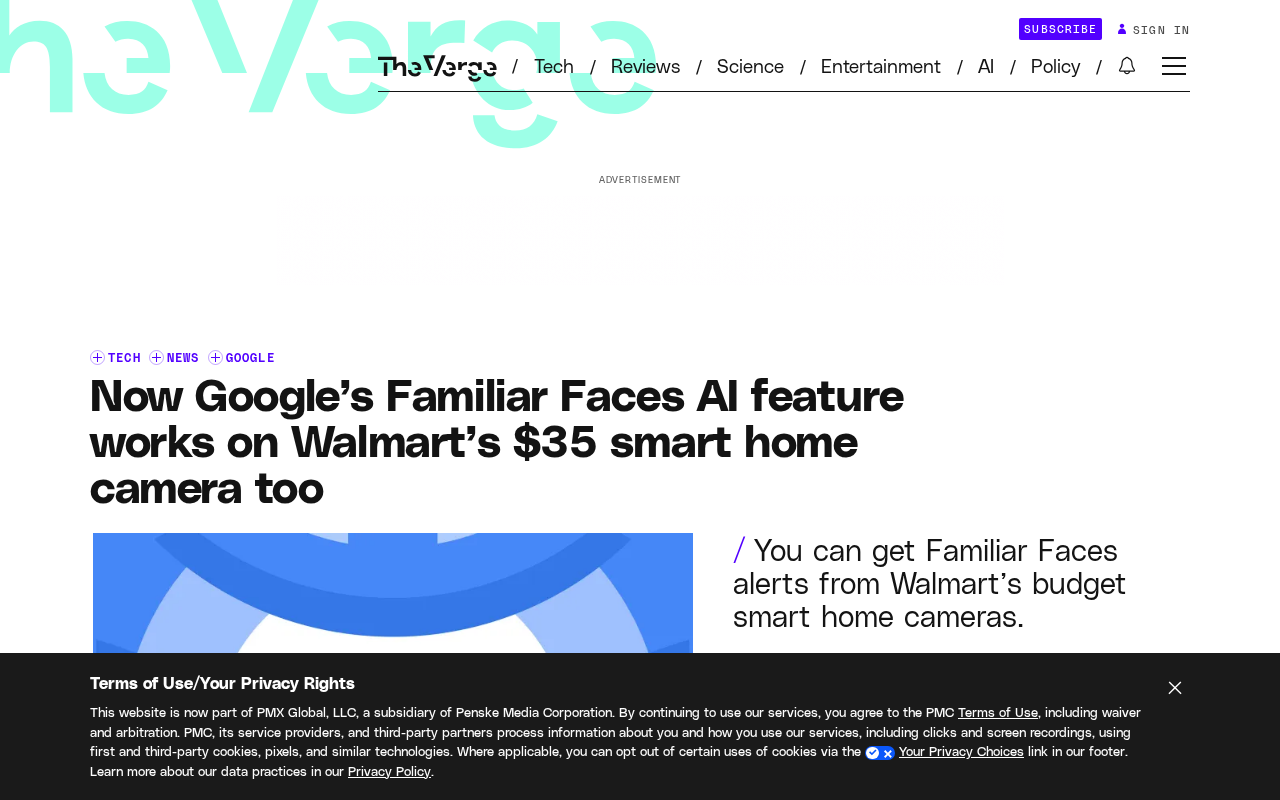
Google Familiar Faces Comes to Walmart's Budget Cameras
Google Familiar Faces facial recognition now supports Walmart's Onn outdoor and floodlight cameras at $35 and $77, but requires a Google Home Premium subscription.