Sherlock: An Open-Source Tool for Tracking Usernames Across Social Networks

Open-source tool Sherlock locates accounts across social platforms using a single username, with nearly 100K stars.
Sherlock is an open-source Python project on GitHub whose core capability is taking a username and traversing a built-in site list to determine whether that username has accounts on each social platform. It doesn't use official APIs but directly requests the profile page for the username, offering broad coverage and low barriers to use. The project has earned nearly 100,000 stars with over 1,700 new stars in a single day, showing it hits a real need for digital identity organization and security research. Open-source and community maintenance allow its site list to be continuously updated, but changes in page structures and anti-scraping strategies can also affect detection accuracy. The article also reminds that such batch-locating tools involve privacy and compliance boundaries and must be used within legal parameters.
Sherlock: An Open-Source Tool for Tracking Usernames Across Social Networks
In today's highly fragmented social media landscape, a single username can be scattered across dozens of platforms. The open-source project sherlock-project/sherlock on GitHub was created precisely to solve this pain point: it can quickly locate corresponding accounts across numerous social networks using just one username. Written in Python, the project has garnered nearly 100,000 stars, with over 1,700 new stars in a single day—a clear indication of the attention it receives.
Core Features and Design Approach
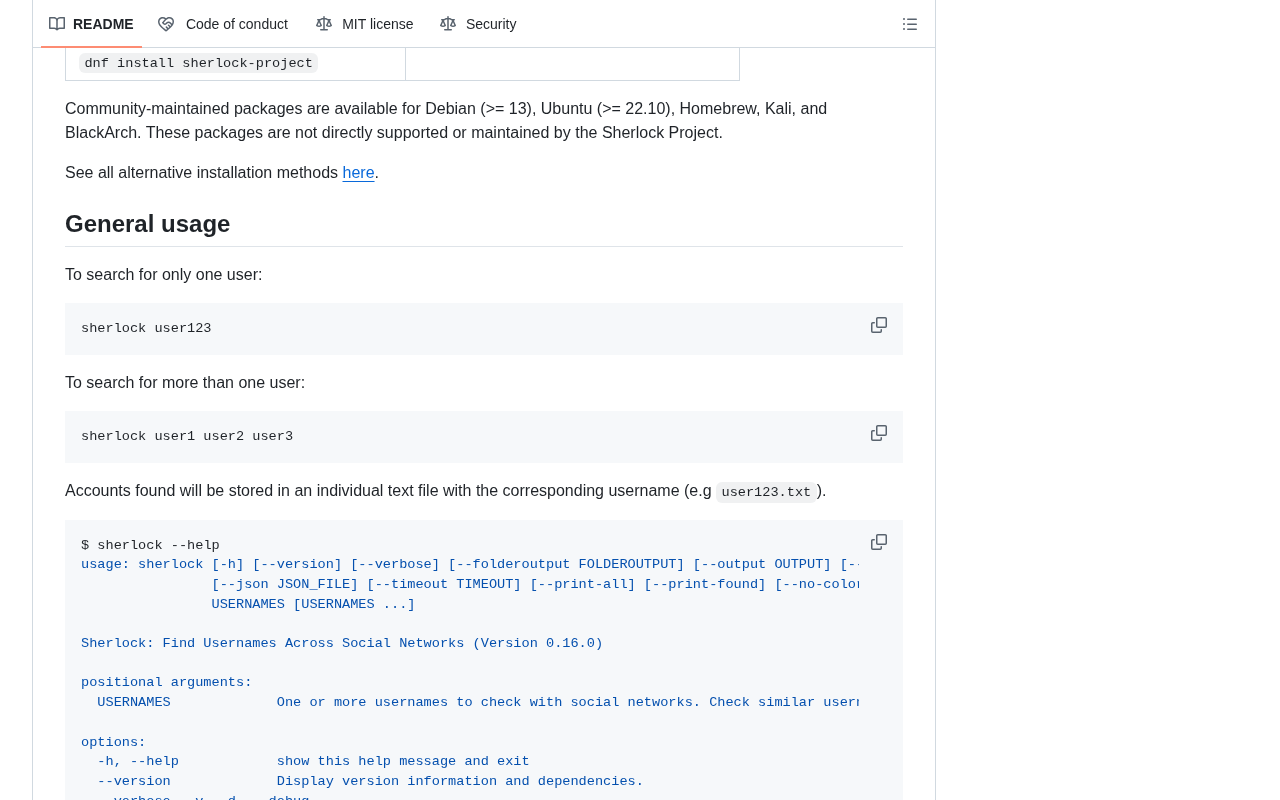
Sherlock's positioning is straightforward—searching for social accounts across platforms by username. Users simply provide a username, and the tool traverses its built-in site list, checking one by one whether that username exists on each corresponding platform. This "single input, multi-point probing" approach eliminates the tedium of manually trying each platform.
According to the project description, Sherlock does not rely on official APIs from each platform. Instead, it determines whether an account exists by requesting the page corresponding to that username on the site. This design allows it to cover a large number of platforms while also lowering the barrier to use. Implemented in Python, the project is easy for developers to run locally or integrate into their own workflows.
Technical background on "not relying on official APIs, directly requesting user pages": Most social platforms' public APIs often require applying for keys, have rate limits, and some platforms don't even offer user-existence query interfaces—making it difficult to cover a large number of sites using APIs alone. Sherlock takes a more general approach: it sends HTTP requests to personal profile URLs like https://site-domain/username, then determines whether an account exists based on the returned HTTP status code (e.g., 200 means the page exists, 404 means it doesn't) and page content characteristics. This method is essentially "HTTP fingerprint probing"—simple to implement and requiring no keys—but it can fail when platforms return uniform error pages for unauthenticated requests, redirect to verification pages, or trigger anti-scraping measures. This is precisely the root cause of the "accuracy fluctuating with platform policy changes" mentioned in this article.
Why Developers Love It
With nearly 100,000 stars and 1,761 new stars in a single day, Sherlock clearly hits a real need. For security researchers, it's a convenient entry point for investigating account correlations; for ordinary users, it can help confirm which platforms their username is already taken on, facilitating unified digital identity management.
Being open source is another major advantage of Sherlock. The site list and detection logic can be maintained and extended by the community, meaning the tool can keep pace as social platforms evolve. For developers looking to learn about network requests, batch probing, and similar practices, Sherlock's code structure also offers reference value.
On the meaning of GitHub Star counts: Stars are GitHub's mechanism for users to express interest and recognition for a repository—similar to "bookmark + like"—and are not equivalent to actual usage or a code quality rating. For a tool-type project, nearly 100,000 stars typically means it has entered the top tier of similar projects and is widely cited; short-term surges like "1,761 new stars in a single day" are often related to the project appearing on the GitHub Trending list or being widely shared in tech communities or social platforms, reflecting exposure rather than long-term activity. Understanding this helps form an objective view of the relationship between popularity metrics and actual usability.
Use Cases and Considerations
Typical scenarios for Sherlock include digital footprint mapping, username availability checks, and information correlation analysis in security research. It should be noted that any tool capable of batch-locating accounts involves privacy and compliance boundaries. Users should ensure they use it within legal and compliant parameters, avoiding harassment or privacy violations against others.
Furthermore, social platforms' page structures and anti-scraping strategies are constantly changing, so the tool's detection accuracy may fluctuate with platform adjustments. The community-maintained site list requires continuous updates, and users should understand that missed or false detections are inherent limitations of such tools.
On "digital footprints" and username correlation analysis: A digital footprint refers to traceable information left by users through online activities, and usernames are one of the most common cross-platform correlation identifiers—many people reuse the same nickname across multiple platforms, making it possible to link scattered accounts through a single username. In security research, this practice is called "username enumeration" or OSINT (Open-Source Intelligence) collection, commonly used for attack surface assessment, brand impersonation investigation, or account ownership verification. But precisely because it has the ability to "link anonymous identities to real individuals," if used for stalking, harassment, or doxxing, it may cross legal boundaries related to personal information protection. Therefore, in practice, probing should only be conducted on one's own accounts or authorized entities, and results should not be publicly disseminated.
Conclusion
Sherlock solves the problem of cross-platform username tracking with a simple approach. Thanks to its open-source nature, ease of use, and community-driven development, it has become a representative project in this field. For users who need to organize digital identities or conduct security research, it's a tool worth knowing about; and in the process of using it, compliance and privacy awareness are equally indispensable.
One-line Summary
Open-source tool Sherlock can locate accounts across multiple social platforms using a single username, with nearly 100,000 stars.
Paragraph Summary
Sherlock is an open-source Python project on GitHub whose core capability is taking a username, traversing a built-in site list, and determining whether that username has accounts on each social platform. It doesn't use official APIs but directly requests the personal profile page for the username and judges account existence based on returned results, offering broad coverage and low barriers to use. The project has earned nearly 100,000 stars with over 1,700 new stars in a single day, demonstrating that it hits a real need for digital identity organization and security research. Open-source and community maintenance allow its site list to be continuously updated, but changes in page structures and anti-scraping strategies can also affect detection accuracy. The article also reminds that such batch-locating tools involve privacy and compliance boundaries and must be used within legal parameters.
Related articles
 Tech Frontiers
GitHub Daily·Nov 07: Agent-Ready and Context Compression
GitHub Trending Nov 07: meta's agent-ready design system astryx, billion-context's 5x context compression, sherlock nearing 100k stars, plus local-first localthings and bare-metal GPU orchestration nvke.
 Tech Frontiers
Buoyant Open-Sources Kinference: An Inference Control Plane for vLLM on K8s
Buoyant open-sources Kinference, an inference control plane for vLLM on Kubernetes, with declarative routing, KV-cache-aware load balancing, and per-tenant metrics—claiming 95% lower median TTFT in official benchmarks.
 Tech Frontiers
The Truth Behind Anthropic's 2x R&D Speedup: A Deep Dive into the METR Report
METR's external evaluation shows Anthropic's AI testing progress over the past year roughly equals the prior two years, with R&D accelerating about 2x—and roughly 80% likely from AI assistance. The report also admits key evidence was redacted, the range spans 1.3x to 3x, and Anthropic says it hasn't doubled yet, diverging from METR's judgment.