Shipping Through Rain or Snow: The Hidden Engineering Culture Code of AI Teams

A "rain or snow, we keep shipping" tweet sparks reflection on how AI teams maintain delivery cadence amid uncertainty.
Starting from a short tweet, the article analyzes why it resonated in developer circles. The tweet uses a weather metaphor to express that "external conditions are not a reason to pause," with its reach coming from semantic tension rather than technical information. The article points out that the core of AI product delivery isn't a single launch, but getting a feedback loop from data to model to user behavior running end to end; engineering resilience is reflected in maintaining release cadence during incidents, with release decisions tied to model evaluation. Such low-information, high-attitude statements are essentially cultural signals that require a stable release process to avoid becoming ironic. Finally, it offers three actionable self-check questions: Is release frequency being slowed by evaluation costs, is the rollback path short enough, and is "waiting for perfection" being mistaken for rigor.
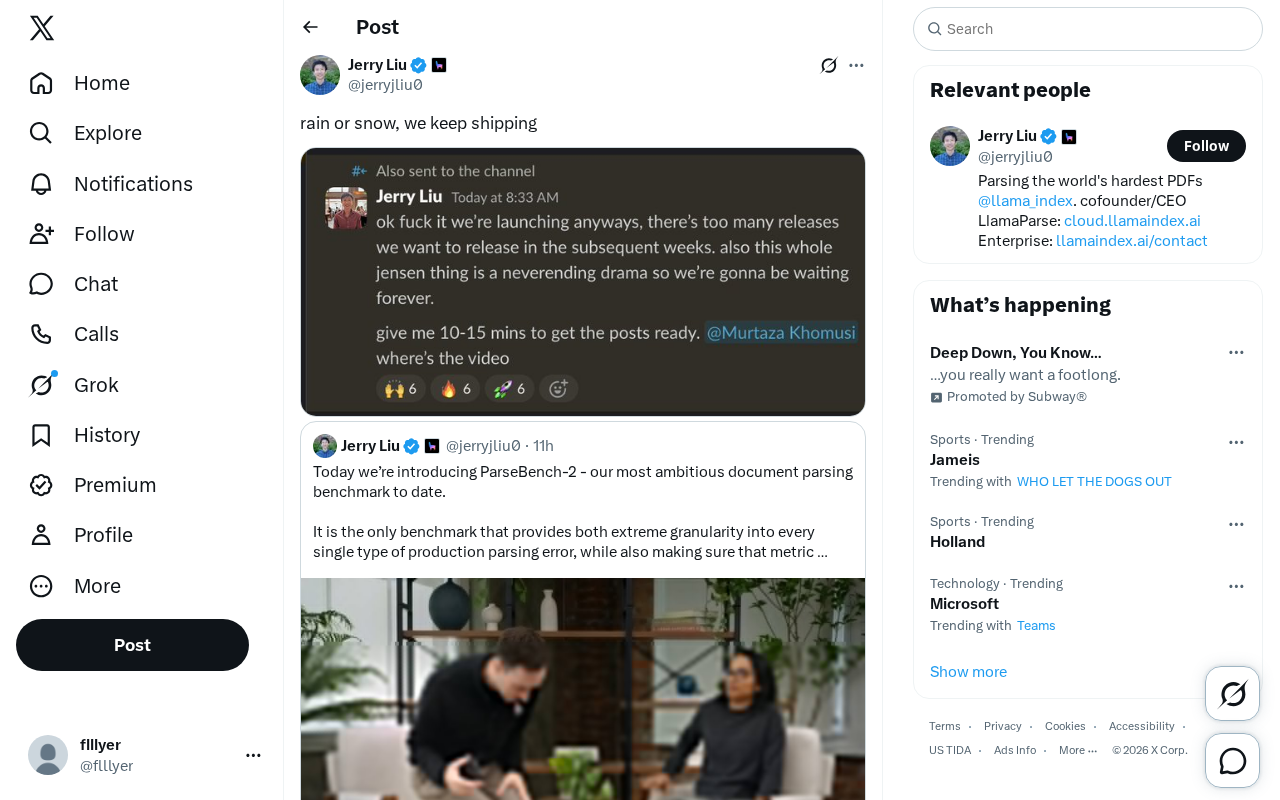
A short tweet from Twitter — "rain or snow, we keep shipping" — paired with a screenshot of a work scene, with no product specs and no funding news, nonetheless sparked considerable discussion in developer circles. The literal meaning is plain: whether it rains or snows, we keep shipping. But in today's AI engineering context, it touches on a question more fundamental than technology choices — how teams maintain delivery cadence amid uncertainty.
Why a single "keep shipping" resonates
Delivery culture has a long history in the software industry, but the AI era has added new footnotes. Model capabilities iterate quickly, data distributions drift, and online feedback lags — any one of these links can trap a team in a "let's tune it a bit more" loop. The tweet's author didn't elaborate on details, but used a weather metaphor to stake out a stance: external conditions are not a reason to pause.
This kind of expression works on social media because it speaks to two audiences at once. For the internal team, it's a rallying cry; for outside observers, it hints at a predictable product cadence. According to the original screenshot of the tweet, the content itself carried no technical explanation — its传播力 (reach) came almost entirely from the semantic tension of that one sentence.
What continuous delivery really means in AI products
What you ship isn't code — it's a feedback loop
In traditional SaaS, "shipping" usually means launching a feature; for AI products, it's closer to getting a feedback loop from data to model to user behavior running end to end. If a delivery only pushes a model into production without accompanying evaluation metrics and rollback mechanisms, that's more of an adventure than a delivery. The "keep" emphasized in the tweet is about continuity — keeping the loop turning, rather than chasing perfection in a single release.
Continuous Delivery is an umbrella term for a set of engineering practices: code changes go through automated builds and tests and are always kept in a state where they can be safely deployed to production at any time, with the deployment action itself triggered manually or automatically. It differs from Continuous Deployment — the latter means every change that passes tests goes live automatically, with no human sign-off. In AI products, this set of practices needs to be extended: traditional testing focuses on code correctness, while model launches also require offline evaluation sets, online A/B experiments, drift monitoring, and more — these constitute the evaluation side of the "feedback loop." Understanding this distinction helps clarify what the article means by "what you ship isn't code" — the CI/CD pipeline only covers the engineering side, and the observability of model performance is the additional cost source of AI delivery.
The engineering resilience behind the weather metaphor
"Rain or snow" can be understood as external disturbances: traffic spikes, dependency service failures, fluctuations in model performance. Engineering resilience isn't about promising zero incidents — it's about the team still maintaining release cadence when incidents happen. This aligns with the industry's discussion of continuous deployment, but the AI context adds another layer — release decisions need to be tied to model evaluation results, rather than simply checking whether the code passes tests.
Data Drift refers to the phenomenon where the statistical characteristics of input data in production environments deviate over time from the training data distribution. Common types include covariate shift (changes in input distribution), label shift (changes in the relationship between inputs and outputs), and concept drift. It is the core operational risk that distinguishes AI systems from traditional software: even if the code doesn't change, model performance can keep degrading. The industry typically addresses this by monitoring distribution metrics of input features (such as PSI, KL divergence), tracking the distribution of online prediction confidence, and periodically retraining with new data. This explains why the article emphasizes that "release decisions need to be tied to model evaluation results" — in the presence of drift, a release that passes unit tests is not the same as a safe release.
Rollback is more complex in AI scenarios than in traditional services. Code rollback only requires switching to the previous version's image, whereas model rollback also involves whether model weights, feature engineering pipelines, inference configurations, and dependent data snapshots are rolled back in sync — any inconsistency can lead to "rolled back but performance didn't recover." Common industry practices include: tagging each model release with a complete snapshot including data version and configuration, using shadow deployment or canary releases to validate on small traffic first, and decoupling model serving from feature storage so they can be rolled back independently. The article lists "whether the rollback path is short enough" as a self-check question precisely because rollback time directly determines whether a team dares to release frequently.
What a single tweet reveals about a team's external communication strategy
When executives and engineers at tech companies speak on social platforms, they often serve a "cultural signal" function. This tweet uses no marketing vocabulary and doesn't include detailed explanations of product links — it's typical low-information, high-attitude content. Its purpose isn't to persuade new users, but to reinforce existing audiences' impression of the team's execution capability.
This communication approach carries risk: if the subsequent delivery cadence can't keep up, the slogan quickly turns into irony. Therefore, teams that can sustain this kind of expression over the long term usually do have a stable release process internally as support. In other words, the tweet is a manifestation of the result, not the cause.
Takeaways for practitioners
For teams building AI products, this sentence is worth breaking down into three actionable questions: Is release frequency being slowed by evaluation costs? Is the rollback path short enough? And is the team mistaking "waiting for perfection" for rigor? The original tweet doesn't provide answers, but it offers a criterion — when external conditions worsen, is your delivery cadence still there?
It should be noted that this tweet carries limited information; the analysis in this article is based on its wording and publishing context, and does not involve inferences about any specific team's delivery data.
Related articles

US Classified National Security Communications Network Outage: A Security Warning for the AI Era
Reuters reports a highly classified US national security communications network outage, sparking Hacker News discussion. This article analyzes critical infrastructure resilience challenges and their implications for AI system security design and failure recovery.

SEC Investigates Nvidia: Behind the Jensen Huang Departure Controversy
The Wall Street Journal reports the SEC is investigating Nvidia following CEO Jensen Huang's departure and admitted affair with an alleged Chinese spy. This article maps the timeline, compliance risks, and potential impact on the AI chip industry, while noting the information awaits cross-verification.

MacBook Neo Sees Rare $50 Discount Ahead of Black Friday — A Good Time for Students to Buy
MacBook Neo gets a rare $50 discount ahead of Black Friday: 256GB at $649, 512GB at $749, all four colors available at Amazon, Best Buy, and Target—great for students.