Six AI Agent Frameworks Compared: Choosing Wrong Costs Weeks—How to Choose Right in One Minute

Six mainstream AI Agent frameworks compared—choose by metaphor fit, not by strength.
Based on a tech blogger's review, this article breaks down LangGraph, CrewAI, OpenAI Agents SDK, Claude Agent SDK, Google ADK, and Microsoft Agent Framework. All Agents share the same loop, and a framework's value lies in state tracking, multi-Agent division of labor, human approval, crash recovery, and observability. Selection should match your team's way of thinking.
Title
Six AI Agent Frameworks Compared: Choosing Wrong Costs Weeks—How to Choose Right in One Minute
Meta Description
A side-by-side comparison of LangGraph, CrewAI, OpenAI Agents SDK, Claude Agent SDK, Google ADK, and Microsoft Agent Framework—covering core concepts, strengths, weaknesses, and use cases—plus a one-minute decision guide for choosing what you need.
Article Content
Choosing an AI Agent framework is becoming the first pitfall for many developers. The same set of capabilities, implemented with the wrong framework, can mean weeks of rewriting. A tech YouTuber did a side-by-side breakdown of six mainstream frameworks—LangGraph, CrewAI, OpenAI Agents SDK, Claude Agent SDK, Google ADK, and Microsoft Agent Framework—and the core conclusion isn't "which is best" but "which one thinks most like you do."
What Does a Framework Actually Do for You?
Every Agent essentially runs the same loop: the model reads the situation, selects a tool, examines the result, and decides the next step. You can write that loop yourself in about 50 lines of code. According to the video, a framework's value lies in handling the "dirty work" outside the loop—state tracking, multi-Agent division of labor, pausing for human approval, crash recovery, and post-hoc observability.
So evaluating a framework only requires four questions: How does it organize work? Which languages does it support? Does it lock you into a single model vendor? What does it provide for production? These four questions form the comparison framework for this article.
MCP (Model Context Protocol) is an open protocol proposed by Anthropic at the end of 2024 to standardize how LLM applications connect to external tools and data sources. Think of it as "the USB-C port for AI applications": tool providers implement an MCP Server per the protocol, and any MCP-compatible client (Agent framework, IDE, desktop app) can call it plug-and-play without writing an adapter layer for each framework. The "deep support" for MCP in the Claude Agent SDK mentioned here means it can directly reuse existing MCP Servers in the ecosystem, and also means tools built with it are easier to migrate to other MCP-compatible hosts.
A2A (Agent-to-Agent) protocol is another standard led by Google, solving "how Agents discover and talk to each other" rather than "how an Agent calls a tool." It defines the Agent Card (capability description), task lifecycle, and message format, enabling Agents built by different teams—or even different frameworks—to collaborate across boundaries. Google ADK natively supports A2A, which is the technical basis of its interoperability claim; MCP governs vertical tool integration, A2A governs horizontal Agent interconnection—the two are often discussed together but have different responsibilities.
LangGraph: Draw Your Agent as a Graph
The core metaphor of LangGraph is a graph. Nodes are steps, edges are paths, and the entire state is saved after each step. This delivers three practical capabilities: a mid-run crash can recover from the last saved point; execution can pause for human approval; and you can roll back to earlier steps for debugging. It supports Python and TypeScript, and is compatible with most model vendors.
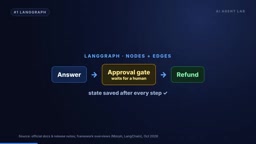
The cost is upfront design effort. Using it for a simple Agent is overkill—"like drawing an entire flowchart just to brew a cup of tea." It suits complex workflows with branching, retries, approval stages, and the need to run reliably in production.
Checkpoints and state persistence are the key mechanisms behind LangGraph's crash recovery and human-approval capabilities. During Agent execution, the full state after each step—message history, variables, pending nodes—is serialized and written to persistent storage: memory, SQLite, Postgres, or Redis. On recovery, the framework reconstructs the state from the latest checkpoint and continues, so a process restart, timeout, or interruption for human approval won't lose context. This also enables "time travel" debugging: you can return to any historical checkpoint to replay or fork execution. The trade-off is that state must be serializable, and the storage layer becomes part of the production deployment—under high concurrency, checkpoint write frequency and storage choice directly affect latency and cost, an infrastructure concern to plan for early when choosing a graph-style framework.
CrewAI: Give Your Agent a Team
The core metaphor of CrewAI is a team. You create Agents with roles, goals, and backstories—researcher, writer, editor—then assign tasks and let the whole crew collaborate. It supports Python only, is one of the fastest ways to get a multi-Agent system running, and ranks among the largest communities in multi-Agent frameworks, with examples easy to find.
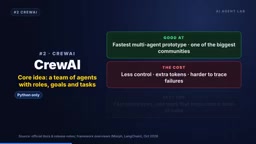
Control is its weak spot. You describe who does what, but you don't control how they communicate step by step; role-playing itself consumes extra tokens; and when things go wrong, it's harder to trace the cause. It suits rapid prototyping and workflows that naturally map to role division.
OpenAI Agents SDK: Handoffs at the Core
It replaces OpenAI's earlier experimental project Swarm. The core metaphor is handoffs: one Agent can hand the conversation to another that's better suited, like a customer service hotline where a triage agent picks up first and then transfers to billing or technical support. There are also guardrails that check inputs and outputs, plus built-in tracing. It supports Python and TypeScript, and is deliberately lightweight with few concepts.
The cost also comes from being lightweight: long flows requiring persistent state or complex branching need more infrastructure built yourself.
Handoff is semantically different from an ordinary "tool call." A tool call is an Agent invoking a function and getting a result back, while retaining control; a handoff transfers control of the entire conversation, context, and subsequent responsibility to another Agent, which then continues interacting with the user. In implementation, a handoff is usually modeled as a special tool, where the receiving Agent inherits the message history and can be configured to filter what's passed along. The advantage is clear routing logic, with each Agent focusing only on its domain; the limitation is that handoffs are one-way—if you need repeated back-and-forth among multiple specialists, you must rely on multiple handoffs or an outer orchestration layer to compensate, which is one reason lightweight frameworks need self-built infrastructure for long flows.
Claude Agent SDK: An Agent That Can Operate a Computer
Formerly called the Claude Code SDK, the name itself reveals its lineage—exposing the same mechanisms that drive the coding Agent. The core metaphor is an Agent that can work on a computer, with built-in tools for reading/writing files and executing commands, support for sub-Agents, hooks that can intervene at each stage, and deep support for MCP. It supports Python and TypeScript.
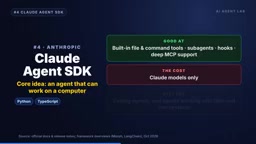
The limitation is clear: it only runs Claude models. If you need to switch model vendors, it's not suitable. Its target scenarios are coding Agents and Agents that need to operate files, terminals, and real systems.
Google ADK: Agent Trees and Cross-Framework Interoperability
The core metaphor of Google's Agent Development Kit is an Agent tree, where a parent Agent delegates to child Agents, which can have their own children. The real differentiator is coverage and interoperability: it has the broadest language support among the six—four SDKs in Python, TypeScript, Java, and Go; native support for the A2A (agent-to-agent) protocol, so your Agent can discover and converse with Agents built by other teams or even other frameworks; plus a command-line tool and a browser debugging interface.
The cost is a heavy dependence on Google Cloud for production, and a smaller community than LangGraph and CrewAI. It suits teams on Google Cloud and companies building with Java or Go.
Microsoft Agent Framework: The Merge of AutoGen and Semantic Kernel
If you've heard of AutoGen or Semantic Kernel, this framework merges and replaces both. Version 1.0 is generally available, and AutoGen itself is in maintenance mode, receiving only bug fixes and security patches. It inherits AutoGen's multi-Agent patterns (such as group chats where Agents debate each other), inherits Semantic Kernel's enterprise capabilities (state, middleware, telemetry), and adds graph workflows with checkpoints and human approval. It supports Python and .NET, and is compatible with multiple model vendors.
The cost is that group chat means many model calls and accumulating token costs; existing AutoGen projects need migration. It suits teams on Microsoft and Azure, and those still running AutoGen.
AutoGen is a multi-Agent conversation framework open-sourced by Microsoft Research in 2023, known for "conversable Agents + group chat orchestration," with a strong academic-experiment flavor; Semantic Kernel is an enterprise-oriented SDK emphasizing engineering capabilities like plugins, memory, middleware, and telemetry—more like an extension of traditional software engineering into AI. The two ran in parallel for a long time with overlapping positioning; merging them into the Microsoft Agent Framework aims to unify the API surface: retain AutoGen's multi-Agent collaboration patterns while using Semantic Kernel's enterprise infrastructure as the foundation, then layer on graph workflows with checkpoints and human approval. The practical impact on users is migration cost—AutoGen entering maintenance mode means new features only appear in the new framework, and existing projects need to assess the scope of rewriting, especially parts that deeply depend on the old GroupChat or custom Agent protocols.
The Same Task, Six Shapes
The video uses a support Agent that "answers customer questions and requires human approval for refunds" as a unified demo:
- In LangGraph, you draw it: an answer node, a refund node, and an approval gate in between that pauses for a human.
- In CrewAI, you hire for it: a support Agent plus a refund Agent, each with a role, advancing through a task list.
- In OpenAI Agents SDK, you route it: a front-desk Agent hands refund requests to a refund specialist, with guardrails checking outward-facing content.
- In Claude Agent SDK, you give a single Agent tools to look up orders and issue refunds, then use a hook to stop and ask before refunding.
- In Google ADK, you build a parent Agent with two child Agents, one handling Q&A and one handling refunds.
- In Microsoft Agent Framework, you build a workflow with a human-approval step and checkpoints, so stopping midway doesn't lose state.
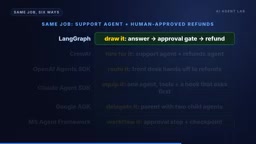
The same job, six shapes. The right one is the one that best matches your existing way of thinking.
Two More Options Worth Knowing
The video adds two more frameworks. Pydantic AI comes from the Pydantic team and focuses on type-safe Agents, returning clean, validated structured data; it isn't built for multi-Agent systems, but it's strong at data extraction and classification. The other targets TypeScript developers, bundling workflows, memory, and a local studio—a TypeScript-first design.
One-Minute Selection Guide
Answer in order: for complex workflows with branching, retries, human approval, and production reliability, choose LangGraph; to get a multi-Agent prototype running today, choose CrewAI; to build a focused assistant that routes among specialists, choose OpenAI Agents SDK; if the Agent must operate code, files, and terminals and you accept Claude, choose Claude Agent SDK; on Google Cloud or developing in Java/Go, choose Google ADK; on Microsoft/Azure or still using AutoGen, choose Microsoft Agent Framework; if you only need the model to emit clean structured data, choose Pydantic AI.
The video's closing judgment is worth remembering: frameworks iterate quickly—most of the frameworks in the video didn't exist two years ago—but the underlying concepts don't change: loops, tools, state, handoffs, human approval. Learn these once, and you can pick up any framework in a weekend. Start with the simplest framework that meets your needs, and add complexity only when necessary.
One-line Summary
A side-by-side comparison of six mainstream AI Agent frameworks: the core difference is how well their metaphors match your way of thinking, not which is stronger.
Paragraph Summary
Based on a tech blogger's side-by-side review, the article breaks down six mainstream Agent frameworks: LangGraph, CrewAI, OpenAI Agents SDK, Claude Agent SDK, Google ADK, and Microsoft Agent Framework. The author notes that all Agents share the same loop—read the situation, choose tools, examine results, decide the next step—and that a framework's real value lies in state tracking, multi-Agent division of labor, human approval, crash recovery, and observability. Evaluation should therefore focus on four questions: how it organizes work, which languages it supports, whether it locks you to a model vendor, and what it offers for production. The six frameworks use the metaphors of graph, team, handoff, operating a computer, Agent tree, and merged entity, respectively, and the same refund-approval task takes different shapes in each. The conclusion: choose based on your team's existing way of thinking—underlying concepts outlast frameworks.
Related articles
Gemini 4 Carbon Hands-On: The Strongest AI Model? Compared with Claude Opus 5.5
Google's Gemini 4 Carbon tops the Artificial Analysis leaderboard with 71% on CW Bench and leads Vending Bench. Hands-on comparison with Claude Opus 5.5: stunning front-end design but slightly behind in web development, with a clear price advantage.

Gemini 4 Carbon Tops Global Rankings as AI Productivity and Open-Source Ecosystems Surge
Google DeepMind's Gemini 4 Carbon tops global benchmarks, built for complex agents and system security. ByteDance launches Doubao Work integrated with Feishu, Anthropic's AI autonomously breaches 5 system-level attack chains, and ModelBest and Fudan open-source on-device multimodal and image generation models.

Overseas Creator Breaks Down N8n AI Agent Business Playbook: From Tooling to Monetization
An overseas creator breaks down the N8n AI agent business playbook: comparing Zapier, Make, and N8n, detailing four monetizable automation categories—lead capture, WhatsApp follow-up, booking, and content pipelines—plus agency pricing and a sales playbook.