SpaceX Hits $28B Annual Revenue, Emerging as a New Cloud Provider for AI Infrastructure
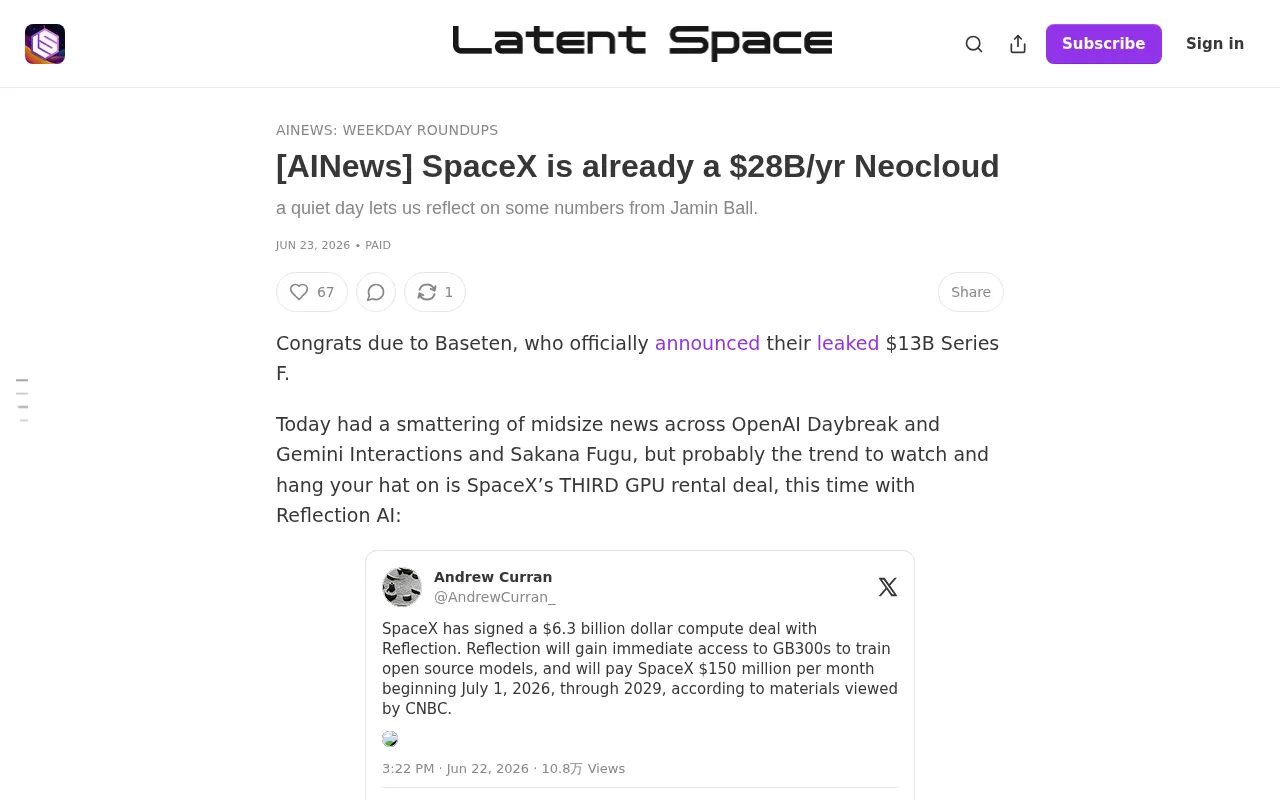
SpaceX's $28B revenue positions it as a major Neocloud player reshaping AI infrastructure.
SpaceX has emerged as a significant new cloud provider (Neocloud) with $28 billion in annual revenue driven by Starlink. Its vertical integration — from rocket launches to satellite operations — creates deep cost advantages over competitors. With low-latency LEO satellite networks ideal for edge AI, and strategic synergies with Musk's xAI, Tesla FSD, and Optimus, SpaceX is redefining AI infrastructure beyond traditional data centers.
Introduction: An Overlooked Cloud Computing Giant
The AI infrastructure landscape is undergoing a quiet revolution. While all eyes are fixed on the Big Three traditional cloud providers — AWS, Azure, and Google Cloud — SpaceX has quietly grown into a "Neocloud" with $28 billion in annual revenue. This figure comes from a recent analysis by well-known tech analyst Jamin Ball, prompting the AI industry to reassess the infrastructure landscape.

What Is a Neocloud?
"Neocloud" is a relatively new concept in the AI industry, referring to emerging infrastructure providers that differ from the traditional Big Three cloud vendors (AWS, Azure, GCP). These companies typically enter the market with distinct business models and technical approaches, offering compute, storage, and networking services for AI workloads.
The rise of Neoclouds is closely tied to the explosive demand for GPU compute power driven by AI training and inference. While traditional cloud providers also offer GPU instances, their multi-tenant architectures and general-purpose designs face efficiency bottlenecks when handling large-scale AI training tasks. Neocloud providers typically use bare metal deployment, allocating entire GPU clusters directly to a single customer. This eliminates virtualization overhead and enables deep optimization for high-speed interconnects like InfiniBand, achieving higher GPU utilization and lower communication latency in large model training scenarios.
Typical Neocloud players include GPU-focused companies like CoreWeave and Lambda Labs, but SpaceX's entry has fundamentally changed the scale perception of this space. Through its Starlink satellite internet business, SpaceX has built a global network infrastructure with annual revenue reaching $28 billion — a scale that surpasses many traditional cloud service providers.
What Does SpaceX's $28 Billion Revenue Mean?
Scale Comparison with AWS, Azure, and Other Traditional Cloud Providers
To understand the weight of this number, some horizontal comparisons are helpful. AWS has an annualized revenue of approximately $100 billion, Azure around $60 billion, and Google Cloud about $40 billion. While SpaceX's $28 billion hasn't yet reached Big Three levels, it already far exceeds the scale of most independent cloud service providers.
More critically, the growth rate matters. SpaceX's infrastructure business is in a phase of rapid expansion, with Starlink's user base continuing to climb and its AI compute investments accelerating. The massive GPU demand from Elon Musk's xAI further strengthens SpaceX's strategic position in the infrastructure space.
SpaceX's Unique Competitive Advantages
What makes SpaceX unique as a Neocloud is its vertical integration capability. It not only owns a satellite communications network but also controls rocket launch capabilities, meaning it can deploy and maintain global infrastructure at extremely low marginal costs.
This vertical integration model is revolutionary in the aerospace industry. Traditional satellite operators must pay exorbitant launch fees to third-party launch service providers, with costs of several thousand to tens of thousands of dollars per kilogram of payload to low Earth orbit. SpaceX, through its self-developed reusable Falcon 9 rocket, has reduced launch costs to approximately $2,700 per kilogram, and the Starship super heavy-lift rocket currently in development could push this figure down to just a few hundred dollars per kilogram. This means SpaceX's marginal cost for deploying each Starlink satellite is far lower than its competitors, creating a deep cost moat. This end-to-end control — from rocket manufacturing and launch services to satellite operations — is analogous to Apple's vertical integration strategy in consumer electronics and is extremely difficult for traditional cloud providers to replicate.
Furthermore, Starlink's low-orbit satellite network is naturally suited for edge computing scenarios, capable of providing low-latency AI inference services to remote areas and mobile environments. This opens up market opportunities that traditional data center models simply cannot reach. Starlink uses a Low Earth Orbit (LEO) satellite constellation architecture, with satellites operating at approximately 550 kilometers altitude — far lower than the 36,000 kilometers of traditional Geostationary Earth Orbit (GEO) satellites. This design reduces round-trip signal latency from over 600 milliseconds for GEO satellites to 20–40 milliseconds, approaching the latency levels of terrestrial fiber optic networks. As of late 2024, Starlink has deployed over 6,000 satellites covering more than 70 countries and regions, forming the largest satellite constellation in human history. The introduction of Inter-Satellite Laser Links technology enables data to be transmitted directly between satellites without ground station relays, further reducing global communication latency.
The AI Infrastructure Landscape Is Being Reshaped
From Centralized Data Centers to Distributed Architecture
SpaceX's rise reflects the broader trend of AI infrastructure evolving from centralized data centers to distributed architectures. As AI use cases extend from the cloud to the edge, the demand for global, low-latency infrastructure is growing rapidly. SpaceX's satellite network fills precisely this gap.
Edge Computing refers to executing computational tasks at network edge nodes close to data sources or end users, rather than in centralized data centers. In the AI domain, while model training still heavily relies on centralized GPU clusters, inference is rapidly migrating to the edge. Scenarios like autonomous driving, industrial quality inspection, and real-time translation are extremely latency-sensitive, typically requiring end-to-end response times within 10–50 milliseconds. Starlink's satellite network, combined with ground-based edge nodes, can deliver AI inference services in areas where traditional fiber optic networks cannot reach — oceans, deserts, polar regions — which holds significant value for vertical industries such as military, shipping, and energy exploration.
The Neocloud Space Continues to Heat Up
Beyond SpaceX, the entire Neocloud space is rapidly heating up. CoreWeave's valuation has surpassed $19 billion, and Lambda Labs has also secured substantial funding. These emerging players share a common trait: they focus on AI workload optimization and offer more cost-effective GPU compute than traditional cloud providers.
But SpaceX's entry elevates the competition to an entirely new dimension — it's not just competing at the compute layer, but redefining the physical boundaries of infrastructure itself.
Risks and Challenges: Can SpaceX Truly Disrupt Cloud Computing?
Simply classifying SpaceX as a "Neocloud" is not without controversy. Its revenue primarily comes from Starlink's consumer and enterprise internet services, which are fundamentally different from traditional cloud computing (IaaS/PaaS). Cloud computing is typically divided into three service model layers: Infrastructure as a Service (IaaS) provides foundational resources like virtual machines, storage, and networking; Platform as a Service (PaaS) adds development frameworks, databases, and other middleware on top; and Software as a Service (SaaS) delivers end-user applications directly. The core business of traditional cloud providers like AWS and Azure is concentrated in the IaaS and PaaS layers. SpaceX/Starlink currently primarily offers network connectivity services (Connectivity-as-a-Service), which is closer to a telecom operator's business model. The logic for classifying it as a Neocloud is that network connectivity is the foundational layer supporting cloud infrastructure, and SpaceX is extending into the compute layer through its synergy with xAI. In the future, it could evolve into a full-stack infrastructure provider encompassing connectivity + compute + storage.
Additionally, as a private company, SpaceX's financial data transparency is limited, and the composition of the $28 billion revenue figure requires further verification.
However, from a strategic perspective, SpaceX's penetration into AI infrastructure is almost inevitable. Musk's multi-front AI initiatives (xAI, Tesla FSD, Optimus) all require robust infrastructure support, and SpaceX is the most critical piece of this puzzle. Specifically, xAI is developing the Grok large language model, which requires massive GPU compute for training — its Memphis-based supercomputing cluster Colossus houses over 100,000 NVIDIA H100 GPUs, making it one of the world's largest AI training clusters. Tesla's Full Self-Driving (FSD) system and the Optimus humanoid robot project are core application scenarios for AI models, with driving data collected daily from millions of Tesla vehicles forming a unique data flywheel. SpaceX/Starlink provides global network infrastructure that could eventually handle critical functions like model distribution, edge inference, and data backhaul. This cross-company vertical integration gives Musk's AI ecosystem differentiated advantages across all three dimensions: data, compute, and applications.
Conclusion
As Jamin Ball's analysis reveals, the competitive landscape of AI infrastructure is being redefined. SpaceX's entry into the Neocloud space with $28 billion in annual revenue not only changes the market's perception of scale but also signals that AI infrastructure will expand from data centers into space and the global edge. For professionals following the AI industry, this is a structural shift that cannot be ignored.
Key Takeaways
Related articles
Codex Security: A Configuration Guide to Automatically Blocking Vulnerabilities at the PR Stage
OpenAI engineers demonstrate Codex Security PR Reviews: automatically scan for vulnerabilities at the GitHub PR stage, have AI generate fix commits and re-verify, with repository-level automatic review and alert threshold configuration.

Daybreak Blue Application and Enablement: Complete Process Guide
Based on the official demo video, this guide details the Daybreak Blue application and enablement process, covering enterprise verification, intended use statements, role permission configuration, user access verification, and API key creation to help cybersecurity teams quickly onboard frontier AI models.

United Airlines Bans AI Agents from Booking Flights, Escalating the Battle Between Airlines and Intelligent Agents
United Airlines bans AI agents from booking flights for travelers, sparking Hacker News debate. This analysis examines channel control, risk logic, the trust gap in the agent economy, and practical impacts on travel AI developers.