SpaceX Secures $40 Billion GPU Financing: The AI Compute Arms Race Escalates

SpaceX secures $40B in binding financing to buy AI chips and build its own compute.
SpaceX disclosed ~$40B in binding financing commitments specifically for AI chips and data center equipment, calling it the largest GPU financing in history. The article argues Starlink and Starship have continuous compute demand, but the $40B scale suggests SpaceX treats compute as a strategic asset, shifting from renting cloud to building infrastructure. The "equipment purchase" wording and Apollo's involvement signal compute hardware is now viewed as collateralizable. Deal terms are undisclosed, $40B is a commitment not a lump sum, and the "largest" label lacks third-party verification.
SpaceX disclosed in a regulatory filing submitted on Monday that it has secured approximately $40 billion in binding financing commitments to purchase AI chips and related data center equipment. The company calls it "the largest GPU financing in history."
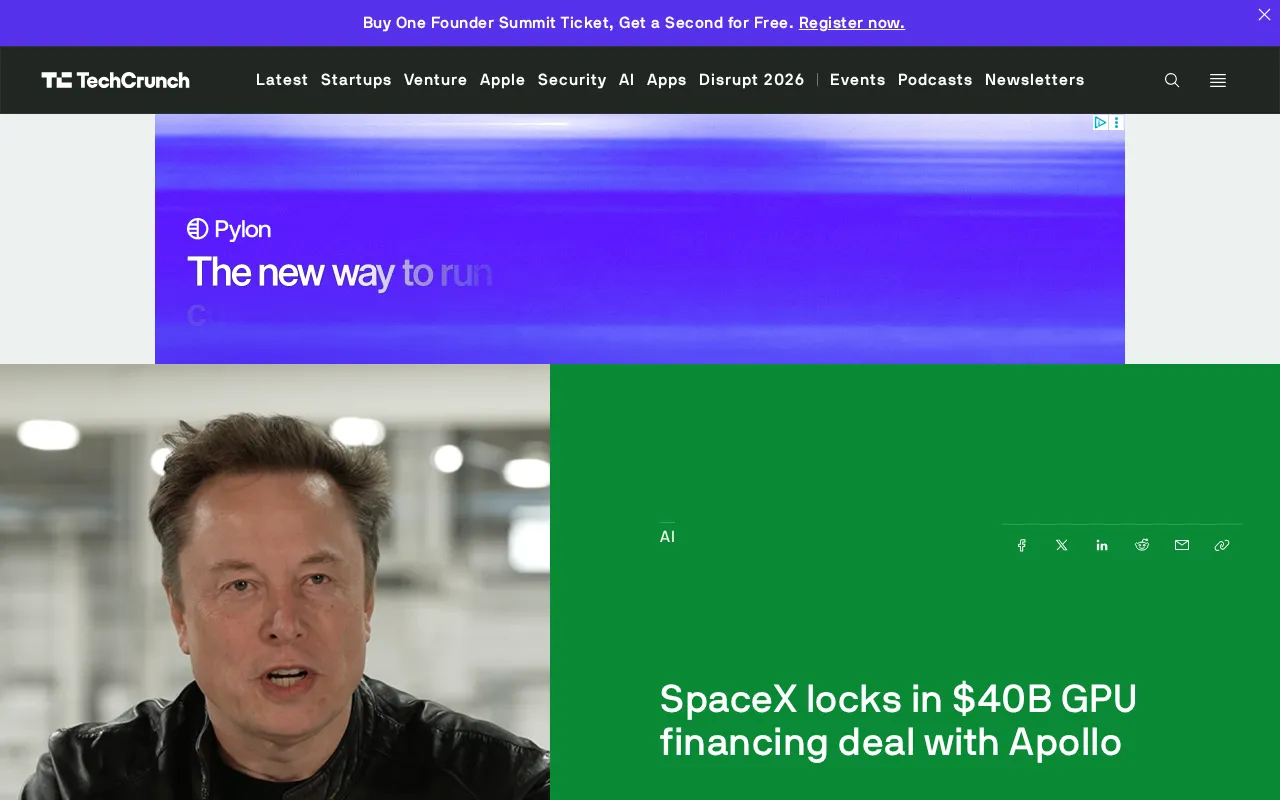
The core information about this deal comes from SpaceX's official regulatory disclosure, not market rumors. A $40 billion figure is a headline number in any industry, but for a space company, the signal significance far outweighs the financial significance.
Why Is SpaceX Buying GPUs?
Compute Demand from the Space Business Itself
SpaceX's day-to-day operations have long ceased to be as simple as "building rockets and launching satellites." The orbital scheduling of the Starlink constellation, signal interference avoidance, and ground station handovers all require real-time computing power. Starship's flight control, aerodynamic simulation, and launch window optimization likewise depend on large-scale parallel computing. The demand for GPUs in these scenarios is continuous and rigid.
However, internal space demand alone can hardly explain the $40 billion scale. A more reasonable interpretation is that SpaceX is treating compute as a strategic asset rather than a mere cost item.
The operation of the Starlink low-Earth-orbit constellation is not simply "satellites flying around the Earth." Thousands of satellites need to perform collision avoidance, frequency coordination, and ground station handovers in a dynamically changing orbital environment, and these decisions rely on real-time computation of orbital mechanics, signal propagation, and space weather. Starship's flight control involves supersonic aerodynamic simulation, engine thrust vector adjustment, and re-entry thermal protection modeling, with the computational load of a single mission reaching several times that of a traditional rocket. GPUs, with their parallel computing capabilities, are irreplaceable in such large-scale numerical simulation and real-time optimization tasks.
From "Using Compute" to "Building Compute"
According to the regulatory filing, the financing will be used for "AI chips and related data center equipment." The wording is noteworthy: not "purchasing services" but "purchasing equipment." This means SpaceX is building its own compute infrastructure rather than renting cloud services.
The logic of building compute in-house has special justification in the space sector. Launch missions have extremely high requirements for latency and reliability, and relying on third-party cloud services means handing critical paths to external suppliers. A self-built data center can be deeply coupled with mission control systems, obtaining exclusive compute guarantees during launch windows.
The Structure and Implications of the $40 Billion Financing
The Weight of a "Binding Commitment"
The regulatory filing uses the term "binding commitment." In a financing context, this carries far more weight than a "letter of intent" or "framework agreement," meaning the funders have completed internal approval and breach would entail legal consequences.
SpaceX characterizes the deal as "the largest committed GPU financing." This combination of qualifiers itself sends a signal: not the largest financing, but the largest GPU-specific financing. Singling out GPUs as the financing target shows that the use of funds is strictly limited to compute hardware.
In project finance and equipment finance, a binding commitment usually means the funder has completed credit committee approval and bears the contractual obligation to disburse under agreed conditions. Unlike a letter of intent (LOI) or term sheet, which lack legal enforceability, a binding commitment, once signed, makes the breaching party liable for damages. For a private company like SpaceX, such commitments are often accompanied by credit enhancement arrangements such as equipment collateral, priority claims, or rent securitization, and funders will set strict conditions on GPU models, deployment schedules, and residual value assessments.
Apollo's Role
The original headline mentioned Apollo's participation in the deal. Apollo, as a major asset management institution, means this financing has the characteristics of structured finance, possibly involving asset-backed, leasing, or receivables financing arrangements. For a private company, using the equipment itself as the financing anchor is a pragmatic choice.
Apollo Global Management is one of the world's largest alternative asset managers, with over $600 billion in assets under management, and specializes in structured credit, asset-backed financing, and leasing arrangements. In GPU financing, institutions like Apollo may hold GPU assets through special purpose vehicles (SPVs) and then provide funding to SpaceX via leases or transfers of revenue rights. The benefit of this structure for SpaceX is avoiding equity dilution, while for Apollo it provides collateralizable hardware assets and stable cash flow. In recent years, private credit institutions have been actively bringing data centers, fiber networks, and compute equipment into the category of financeable assets.
Threefold Impact on the Industry
Compute Competition Shifts from "Renting" to "Locking In"
Over the past two years, the mainstream approach for AI companies has been to rent compute from cloud providers. SpaceX's deal offers a new paradigm: directly locking in hardware financing and turning compute into an asset on the balance sheet. If more companies follow this model, competition in the GPU supply chain will shift from "who can get cloud quotas" to "who can lock in hardware capacity."
The Boundary Between Space and AI Blurs Further
SpaceX is simultaneously involved in launch services, satellite communications, and AI compute infrastructure, a business portfolio whose span is hard to classify under traditional industry categories. This financing shows that leading space companies are internalizing AI capabilities as a core competitiveness rather than treating them as externally procured tools.
Large Institutional Capital Enters the Compute Track
Apollo's participation shows that compute hardware is being viewed by institutional investors as a financeable, collateralizable asset class. This provides a financing path reference for other asset-heavy tech companies: use GPUs and data center equipment as financing targets instead of relying on equity financing or high-interest bonds.
Points to View Calmly
The information disclosed about this deal is currently limited. The regulatory filing does not specify the financing term, interest rate, composition of funders, or the schedule of disbursements in tranches. $40 billion is a committed amount, not a one-time arrival, and the actual execution progress depends on equipment delivery and deployment pace.
In addition, "largest GPU financing" is SpaceX's own characterization, currently without third-party data cross-verification. As an emerging category, GPU financing has no unified statistical standard, and the true value of this "largest" label will need more subsequent disclosures to test.
From a longer perspective, what is truly noteworthy about this deal is not the amount but the direction it reveals: compute is shifting from operating expenditure to capital expenditure, and from purchased services to self-built assets. SpaceX is simply the first company to run this math to the $40 billion scale.
One-line Summary
SpaceX secures $40 billion in binding financing to purchase AI chips and build its own compute.
Paragraph Summary
SpaceX disclosed in a regulatory filing approximately $40 billion in binding financing commitments, specifically for purchasing AI chips and data center equipment, calling it "the largest GPU financing in history." The article argues that while Starlink and Starship operations have continuous compute demand, the $40 billion scale is more reasonably interpreted as SpaceX treating compute as a strategic asset, shifting from renting cloud services to building infrastructure itself. The financing wording is "purchasing equipment" rather than "purchasing services," and Apollo's participation means compute hardware is being viewed by institutions as collateralizable assets. The specific term, interest rate, and disbursement schedule have not been disclosed; $40 billion is a committed amount rather than a one-time arrival, and the "largest" characterization lacks third-party verification.
Related articles

The Truth Behind Titanic's Sinking: Key Decisions and Communication Failures in the National Geographic Documentary
National Geographic's The Unsinkable Ship uses survivor testimony to reconstruct Titanic's fatal decisions—from the missing MSG telegram prefix and the broken boiler-room-to-bridge link to how 'unsinkable' thinking delayed damage control and evacuation.

74M-Parameter Open-Source Model Partially Outperforms Jev AI in Testing
Fastino AI's Glider 2.5 models, with just 74M–300M parameters, reportedly outperform Jev AI in some guardrail benchmarks per YouTube testing, run on consumer hardware, and even play Doom. We analyze small models' competitiveness and deployment value on specific tasks.

Gemini 4 Argon Hands-On: Aggressive Pricing, 3D Capabilities Need Coaching
Gemini 4 Argon hands-on: limited-time $2/$10 pricing, million-token output, strong 3D and reverse-engineering work, but weak front-end aesthetics and zero-shot ability need coaching.