Speculative Diffusion: A Dual-Trade-off Framework for Pareto-Optimal LLM Inference

The paper proposes a framework that jointly optimizes diffusion effort K and acceptance tolerance λ, significantly extending the speed-quality Pareto frontier of speculative decoding.
This paper combines diffusion language models with speculative decoding to propose a dual-trade-off optimization framework. It proves that linear acceptance is optimal under a total variation distance constraint, and that multi-step diffusion can directly use the final-step output probability as the proposal for rejection sampling. Experiments show the Pareto frontier is formed by multiple diffusion effort K values; tuning tolerance λ alone cannot obtain the complete frontier, while joint tuning significantly extends the speed-quality frontier, and the framework is general across acceptance strategies, block sizes, and draft models.
The field of LLM inference acceleration has seen a new breakthrough: a paper titled "Speculative Diffusion is a Tale of Two Trade-offs" combines diffusion language models with speculative decoding to propose a dual-trade-off optimization framework. The research not only provides theoretical proof but also experimentally verifies that jointly tuning parameters can significantly extend the speed-quality Pareto frontier. This article provides an in-depth breakdown of its core ideas and engineering implications.
The Autoregressive Bottleneck and the Limits of Speculative Decoding
Autoregressive models generate token by token, requiring each step to wait for the previous one to complete, and each step must read all parameters and the growing KV cache. GPU memory bandwidth improves slowly, leaving a large amount of compute idle. Speculative decoding reduces the number of calls by using a small model for drafting plus a large model for parallel verification, while remaining lossless. The acceptance rate is determined by the total variation distance between the draft and verifier distributions, with the ceiling limited by how well the two models match. Lossy methods such as the tolerance parameter or Cactus (which controls the KL divergence upper bound) can actively relax distribution consistency in exchange for speed, but adjusting them alone still struggles to break through the Pareto frontier.
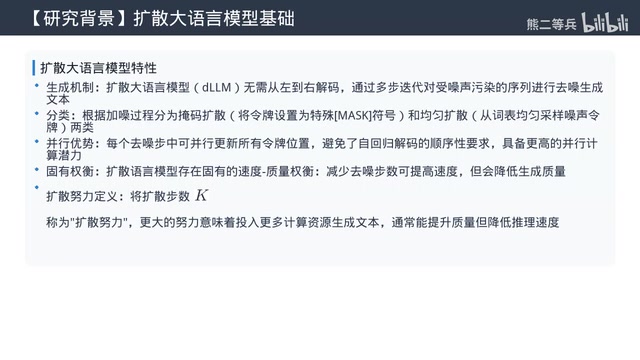
Total Variation Distance (TV) is a common metric for measuring the difference between two probability distributions, defined as half the sum of the absolute differences in probabilities across all events, ranging from 0 to 1. In speculative decoding, the TV distance between the draft model distribution Q and the verifier model distribution P directly determines the upper bound of the theoretical acceptance rate: the smaller the TV, the closer the two models are, and the higher the probability that the verifier accepts a draft token. Therefore, the ceiling of the acceptance rate can be approximated as 1 - TV(P, Q). This metric also provides a geometric interpretation for subsequently introducing the tolerance parameter ε—the allowed distribution shift is precisely constrained by the TV distance.
Diffusion Language Models: The Natural Advantage of Parallel Generation
Diffusion language models (DLLMs) update all positions in parallel through multi-step denoising, avoiding serial dependencies. They fall into two main categories: masked diffusion (replacing with [MASK] symbols) and uniform diffusion (randomly sampling tokens for replacement). The larger the number of denoising steps (diffusion effort K), the higher the draft quality but the longer the time. A diffusion model can generate an entire block of tokens in parallel in one step, making it naturally suited as a draft model for speculative decoding. Prior research was mostly limited to single-step diffusion, whereas this paper systematically explores the theoretical and optimization space of multi-step diffusion drafts.
The difference between masked diffusion and uniform diffusion: Masked diffusion replaces some tokens with a special [MASK] symbol at each step, then uses the model to predict the original tokens at the masked positions, similar to BERT's masked language modeling but with multi-step iterative denoising. Uniform diffusion does not mark positions specially; instead, it randomly samples a token at each step to replace the current position, gradually approaching the target distribution through multi-step iteration. Both support parallel updates of all positions, but masked diffusion updates more structurally at each step and is usually more denoising-efficient; uniform diffusion has cleaner theoretical analysis but may yield slightly lower actual generation quality. The multi-step diffusion drafts discussed in the paper are mainly based on the masked diffusion framework, as it is closer to practically usable diffusion language models.
Core Theory: Linear Acceptance Optimality and Multi-Step Diffusion Proposals
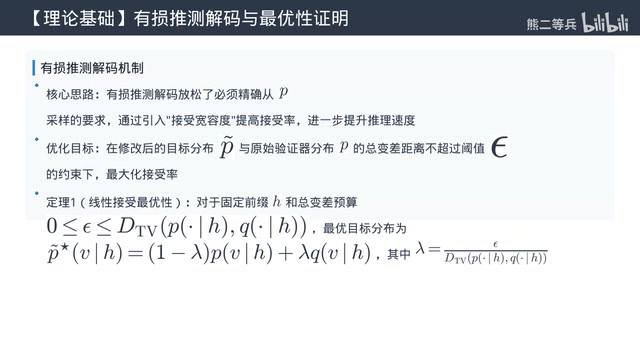
Theorem 1 (Linear Acceptance Optimality): When the modified verification distribution is allowed to have a total variation distance from the original distribution no greater than ε, the optimal modification that maximizes the acceptance rate is linear interpolation: P' = (1-λ)P + λQ, where λ = ε / TV(P,Q). This strategy determines the distribution before sampling, unlike Cactus's post-sampling modification. Total variation distance is a distance in a metric space, and linear interpolation is the shortest path between two distributions, so the conclusion holds strictly.
Proposition 2 (Multi-Step Diffusion Proposal): The multi-step diffusion generation process is stochastic, and directly computing the edit probability requires summing over all denoising trajectories, which is infeasible. Proposition 2 proves that directly using the probability output by the final diffusion step as the proposal probability for rejection sampling still guarantees that the sampling results follow the verifier distribution. This lays the theoretical foundation for multi-step diffusion drafts.
Joint Optimization Space and Throughput Model
Diffusion effort K controls draft speed and quality, while acceptance tolerance λ controls the speed and quality loss in the verification stage. Together they determine overall performance, and only joint tuning can approach the Pareto frontier. The paper's motivating example shows that tuning the tolerance of an autoregressive draft alone yields a speed ceiling far below that of reducing K in a diffusion model; using a diffusion model with a large K alone leaves the quality ceiling limited by the verifier. Diffusion raises the speed ceiling, and speculative decoding raises the quality ceiling—the two are complementary.
The theoretical throughput model expresses the average acceptance rate as 1-(1-λ)·D(K), where D(K) is the average total variation distance between the draft and verifier models under K-step diffusion; the quality proxy is 1-λ-K; the draft time is approximately a+bK (nearly linear in K), and the verification time is fixed. The model's predictions match measured trends; although it assumes the same acceptance rate across positions, it already captures the core effects.
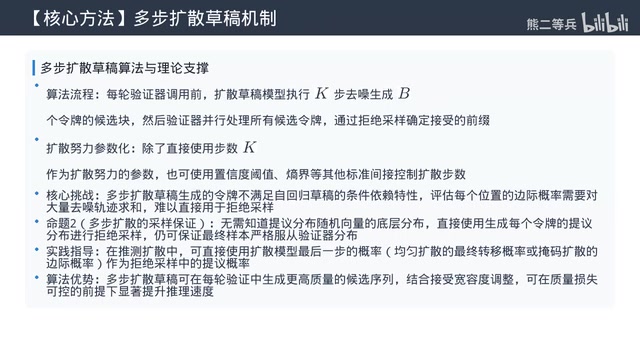
Rejection Sampling is a key mechanism for guaranteeing losslessness in speculative decoding. Specifically, for each token generated by the draft model, the verifier accepts it with probability min(1, P(x)/Q(x)), otherwise resamples from the normalized corrected distribution max(0, P(x)-Q(x)). This process ensures the final output strictly follows the verifier distribution P. When tolerance λ is introduced, the corrected distribution becomes P' = (1-λ)P + λQ, and the acceptance probability is adjusted accordingly, thereby increasing the acceptance rate under an allowed distribution deviation. The paper's linear acceptance optimality theorem provides the analytical solution for the optimal λ precisely for this corrected form.
Experimental Design and Key Findings
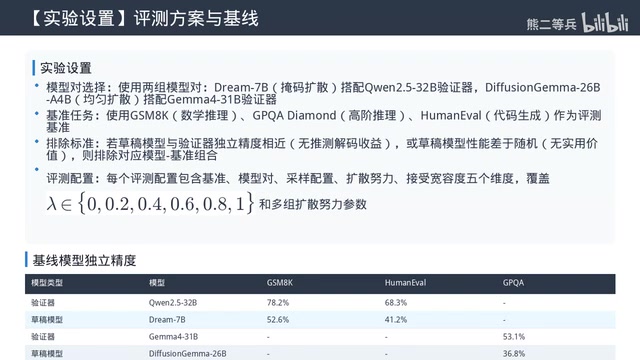
The experiments use two model teams: Dream 7B (draft) + Qwen 2.5-32B (verifier), and Diffusion Gemma 26B (draft) + Gemma 4-31B (verifier), with Qwen 3-8B as a unified verifier for comparison against dedicated diffusion draft models such as Uno, D-Flash, and D-Spark. The datasets cover GSM8K (math), GPQA Diamond (reasoning), and HumanEval (code). Exclusion criteria: if the standalone accuracy of the draft and verifier is similar, or the draft is worse than random, no testing is performed.
Key conclusion: The Pareto frontier is jointly formed by multiple different K values; fixing a single K value and tuning only the tolerance cannot obtain the complete frontier. Low K with a strict acceptance strategy corresponds to the high-accuracy region, while high K with high tolerance corresponds to the high-speed region. This trend holds under both linear acceptance and Cactus acceptance, and is consistent across different block sizes. For draft models that support multi-step diffusion, joint tuning significantly extends the Pareto frontier; even the untrained SDR model achieves competitive results through joint tuning, demonstrating the framework's generality.
Pareto Frontier refers to a set of non-dominated solutions in multi-objective optimization: no objective can be further improved without sacrificing another. In inference acceleration scenarios, the two objectives are usually generation speed (throughput) and output quality (accuracy). When diffusion effort K is fixed, adjusting only the tolerance λ moves along a single curve and cannot cover the entire frontier; jointly adjusting K and λ generates multiple curves whose upper envelope forms a more complete Pareto frontier. By plotting speed-quality curves for different K values, the paper's experiments intuitively demonstrate how joint tuning extends the frontier outward, providing richer configuration choices for engineering deployment.
Engineering Implications and Future Directions
In practical deployment, if a diffusion model is used as a speculative decoding draft, one should not fix single-step diffusion or tune only the tolerance; instead, K and λ should be searched jointly, and a configuration on the Pareto frontier should be selected according to business latency and quality requirements. For example, real-time chat can choose high K and high λ, while high-quality code generation can choose low K and low λ. Future research directions include dynamically adjusting K and λ (adapting to the difficulty of the generated content) and training draft models specifically tailored to speculative diffusion to improve distribution alignment.
The paper unifies two independent optimization dimensions into one framework, providing both theoretical support and experimental validation, and offering a clear new direction for inference acceleration.
One-line Summary
The paper proposes a framework for jointly optimizing diffusion effort K and acceptance tolerance λ, significantly extending the speed-quality Pareto frontier of speculative decoding.
Paragraph Summary
This paper combines diffusion language models with speculative decoding and proposes a dual-trade-off optimization framework. It theoretically proves that linear acceptance is optimal under a total variation distance constraint, and that multi-step diffusion can directly use the final-step output probability as the proposal for rejection sampling. Experiments show that the Pareto frontier is jointly formed by multiple diffusion effort K values and that tuning tolerance λ alone cannot obtain the complete frontier; joint tuning significantly extends the speed-quality frontier, and the framework is general across different acceptance strategies, block sizes, and draft models. For engineering, it recommends jointly searching K and λ and selecting configurations according to business needs.
Related articles

AI Writes Your Code—Do You Still Need to Learn Git? Five Reasons
AI coding agents handle Git operations automatically—is it still necessary to learn Git? Five reasons: team communication, reviewing agent PRs, monitoring code changes, fallback when AI goes down, and the joy of learning—plus how the focus of learning Git is shifting in the agent era.

Anthropic Reportedly Prices IPO at $83 Per Share, Valuing Company at $1.5 Trillion
Anthropic reportedly prices IPO at $83 per share, above the expected range, with a fully diluted valuation of $1.5 trillion. This article analyzes the signal significance of the pricing and its impact on the AI industry's financing environment.

Open-Source Code Hosting Platform Codeberg Suffers Outage, Sparking Debate in Developer Community
Open-source code hosting platform Codeberg.org suffered an outage, sparking Hacker News debate over nonprofit platform stability and open-source infrastructure dependency risks.