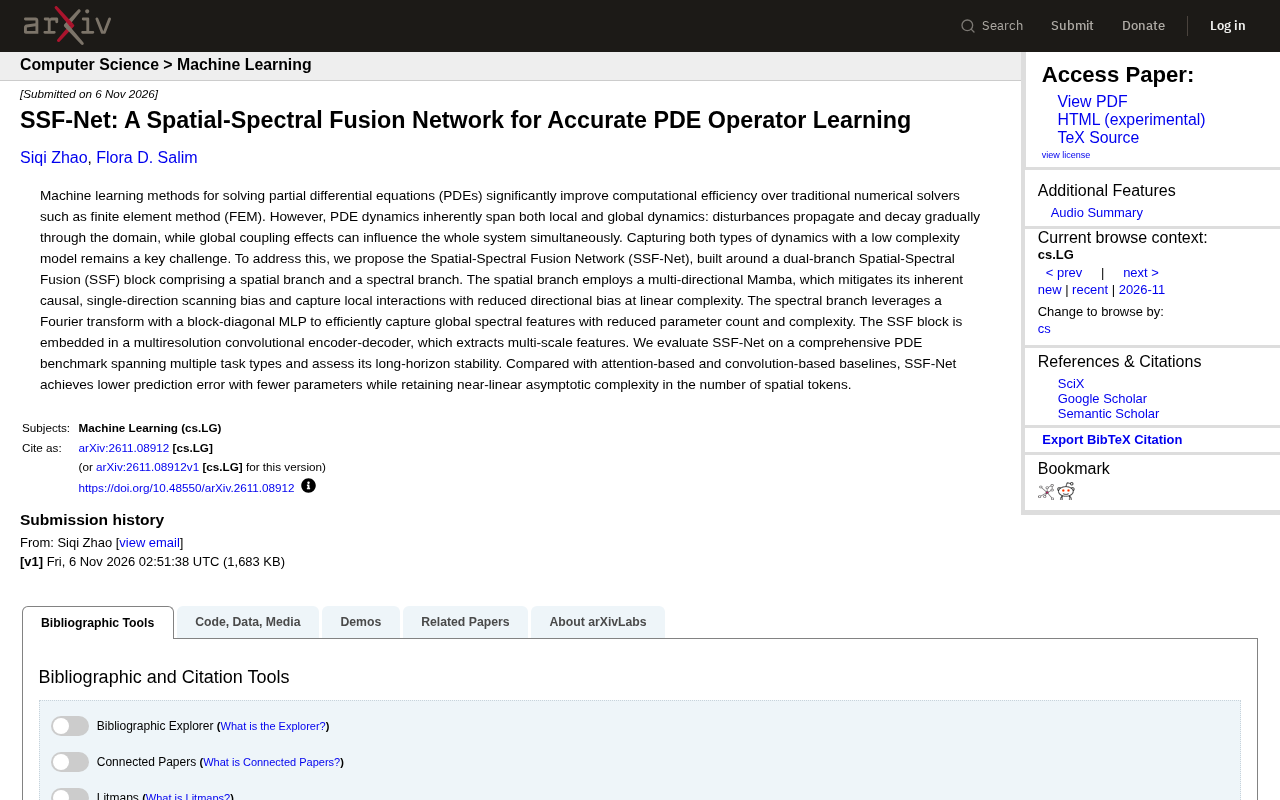
SSF-Net: A Spatial-Spectral Fusion Network for Accurate PDE Operator Learning

SSF-Net uses spatial-spectral dual-branch fusion to simultaneously model local propagation and global coupling in PDEs.
SSF-Net tackles the difficulty of balancing local propagation and global coupling in machine learning PDE solvers with a dual-branch spatial-spectral fusion block. The spatial branch uses multi-directional Mamba to mitigate the directional bias of unidirectional scanning while keeping linear complexity; the spectral branch applies the Fourier transform and a block-diagonal MLP to extract global features with far fewer parameters. The branches are fused within the block and embedded in a multi-resolution convolutional encoder-decoder. On multiple PDE benchmarks, SSF-Net achieves lower prediction error with fewer parameters and near-linear complexity in spatial tokens. Its differentiation is the block-diagonal MLP replacing conventional fully connected spectral processing, though long-horizon stability and multi-physics generalization still await independent validation.
Machine learning solvers for partial differential equations (PDEs) far outperform traditional numerical methods such as finite elements in computational efficiency, but PDE dynamics naturally contain two modes: local propagation and global coupling. Perturbations diffuse and decay gradually within the domain, while global effects can influence the entire system simultaneously. How to capture both types of dynamics with a low-complexity model has long been a core challenge in this field. The recently proposed Spatial-Spectral Fusion Network (SSF-Net) attempts to provide an answer.
Dual-Branch Fusion: The Design Logic of the SSF Block
The core of SSF-Net is a dual-branch spatial-spectral fusion block (SSF block), composed of a spatial branch and a spectral branch in parallel. The spatial branch is responsible for capturing local interactions, while the spectral branch extracts global features; the two are fused within the block, thereby accommodating both the local and global dynamics of PDEs. This design directly addresses the dual requirement in PDE solving: "local propagation needs fine-grained modeling, and global coupling needs efficient expression."
According to the paper, the SSF block is embedded in a multi-resolution convolutional encoder-decoder to extract multi-scale features. The overall architecture attempts to cover the information hierarchy from fine-grained local to coarse-grained global while maintaining a relatively low parameter count.
Spatial Branch: Multi-Directional Mamba Suppresses Scanning Bias
The spatial branch adopts a multi-directional Mamba structure. Mamba itself is a sequence modeling method with linear complexity, but standard Mamba suffers from an inherent bias toward causality and unidirectional scanning—that is, information propagates in only one direction, which does not fully match the physical property of PDEs that perturbations can diffuse in any direction.
SSF-Net alleviates this issue through multi-directional scanning, capturing local interactions with smaller directional bias while maintaining linear complexity. The paper emphasizes that this design makes the spatial branch more efficient than attention mechanisms while avoiding the physical distortion caused by unidirectional scanning.
Mamba is a sequence modeling architecture based on the Selective State Space Model. Its core idea is to let the state transition matrix adjust dynamically with the data through input-dependent parameters, thereby achieving long-range modeling capability similar to attention while maintaining linear time complexity. Unlike the quadratic complexity of Transformers, Mamba's recursive scanning makes its computation grow linearly with sequence length when processing long sequences. However, standard Mamba performs a unidirectional causal scan along the sequence direction, meaning each position can only aggregate information from preceding positions—an inductive bias originating from autoregressive tasks such as language modeling. When transferred to spatial field modeling tasks such as PDE solving, this unidirectionality introduces direction-dependent bias: propagation along the scan direction and against it is handled asymmetrically, conflicting with the physically isotropic diffusion process. Multi-directional scanning (e.g., forward, backward, and multi-axis crossing) mitigates this bias by executing multiple scan directions in parallel and then fusing the results, at the cost of a constant-factor increase in computation while the asymptotic complexity remains linear.
Spectral Branch: Fourier Transform Plus Block-Diagonal MLP
The spectral branch uses the Fourier transform to map features into the frequency domain, then processes global spectral features through a block-diagonal MLP (multi-layer perceptron). Compared with standard MLPs or attention mechanisms, the block-diagonal structure significantly reduces the parameter count and computational complexity while preserving the global receptive field.
The paper points out that this branch can efficiently capture global spectral features with fewer parameters and lower complexity. This complements the local modeling of the spatial branch: the spatial branch handles short-range propagation, and the spectral branch handles long-range coupling; after fusion within the SSF block, the two output a unified representation.
The Fourier transform holds a special place in PDE solving: it diagonalizes differential operators, turning convolution or differentiation into pointwise multiplication in the frequency domain, so frequency-domain representations are naturally suited to characterizing global coupling and long-range interactions. Spectral methods exploit exactly this property, using a few low-frequency modes to efficiently approximate smooth solutions. A block-diagonal MLP refers to a fully connected layer whose weight matrix has a block-diagonal structure—that is, the parameter matrix is nonzero only within several disjoint diagonal blocks and zero elsewhere. This structure is equivalent to partitioning the input features into several subgroups, applying linear transformations to each group independently, and then concatenating the results, thereby reducing the parameter count from O(n²) to O(n²/b) (where b is the number of blocks), with a corresponding reduction in computation. Compared with a fully connected MLP, the block-diagonal structure sacrifices some cross-group mixing capability but retains sufficient expressiveness within each group; compared with attention mechanisms, it has no quadratic overhead in sequence length. Applying a block-diagonal MLP to features in the frequency domain amounts to performing global linear modulation separately on different frequency bands or channel subsets, maintaining the global receptive field while compressing model capacity.
Experimental Evaluation: Lower Error, Fewer Parameters
The paper evaluates SSF-Net on PDE benchmarks covering multiple task types and examines its long-horizon stability. Compared with attention-based and convolution-based baseline models, SSF-Net achieves lower prediction error with fewer parameters while maintaining near-linear asymptotic complexity in the number of spatial tokens.
The significance of this result is that it shows the dual-branch fusion strategy can improve accuracy without sacrificing efficiency. For scientific computing scenarios that require repeatedly solving PDEs, a model with fewer parameters and near-linear complexity means a lower deployment barrier and better scalability.
Asymptotic complexity describes the rate at which computation grows with input size, not absolute runtime. The phrase "near-linear in the number of spatial tokens" mentioned in the paper means that when the spatial domain is discretized into more grid points or tokens, the model's forward computation grows roughly linearly with the number of tokens, whereas standard attention mechanisms grow quadratically. This property is particularly critical for high-resolution PDE solving: mesh refinement is a standard means of improving numerical accuracy, and if model complexity grows with the square of resolution, high-resolution scenarios quickly become unaffordable. Near-linear complexity means the model can scale relatively smoothly to finer meshes without having to increase compute quadratically. It should be noted that the complexity analysis here concerns the spatial token dimension and does not yet cover the O(n log n) overhead of the Fourier transform in the frequency-domain branch or the constant factor of multi-directional scanning; actual end-to-end runtime is also affected by implementation optimization, batch size, and hardware.
Multi-Source Perspectives and Limitations
Currently, public information about SSF-Net comes mainly from the paper itself; independent third-party reproductions or comparative analyses have not yet appeared. Judging from the paper's own account, its advantages are concentrated in prediction error and parameter efficiency, but the specific performance of long-horizon stability and generalization capability on multi-physics coupling problems still require more experimental validation.
It is worth noting that the combination of Mamba-like structures with Fourier methods is not new; SSF-Net's differentiation lies in replacing the common fully connected spectral processing with a block-diagonal MLP, thereby compressing the parameter count. Whether this design choice holds across all PDE types remains to be tested by future research. For developers interested in AI for Science, SSF-Net offers a lightweight approach that balances local and global modeling; if its code is open-sourced, it would be worth running a benchmark test on one's own PDE datasets.
One-line Summary
SSF-Net uses spatial-spectral dual-branch fusion to simultaneously model the local propagation and global coupling of PDEs.
Paragraph Summary
SSF-Net addresses the difficulty of simultaneously accommodating local propagation and global coupling in machine learning solvers for partial differential equations by proposing a dual-branch spatial-spectral fusion block. The spatial branch adopts multi-directional Mamba, maintaining linear complexity while alleviating the directional bias caused by standard Mamba's unidirectional scanning; the spectral branch uses the Fourier transform to map features into the frequency domain and then processes global spectral features with a block-diagonal MLP, significantly compressing the parameter count while preserving the global receptive field. The two branches are fused within the block and embedded in a multi-resolution convolutional encoder-decoder to extract multi-scale features. On various PDE benchmarks, SSF-Net achieves lower prediction error with fewer parameters and maintains near-linear complexity in the spatial token dimension. Its differentiation lies in replacing the common fully connected spectral processing with a block-diagonal MLP, but long-horizon stability and multi-physics generalization capability still await independent validation.
Related articles
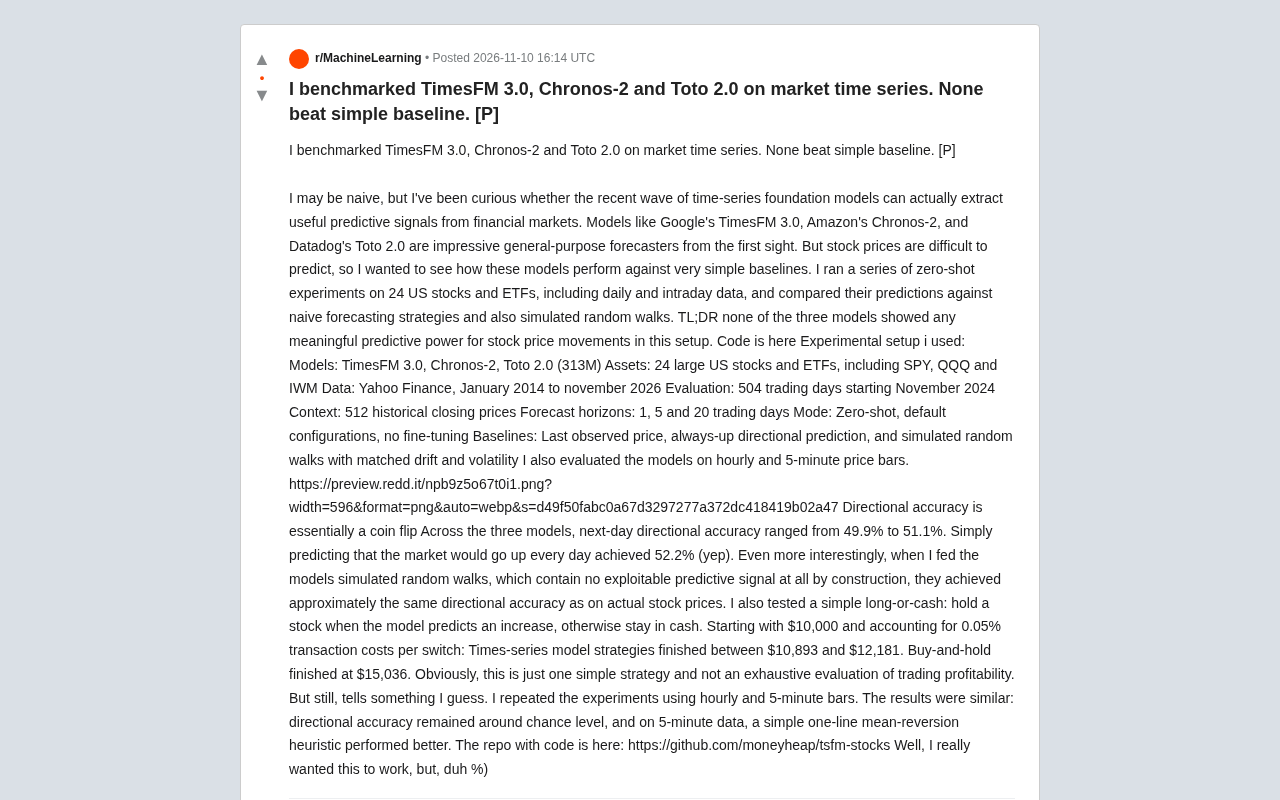
Putting TimesFM 3.0, Chronos-2, and Toto 2.0 to the Test: Time-Series LLMs Can't Beat Simple Baselines
A developer's zero-shot benchmark of TimesFM 3.0, Chronos-2 and Toto 2.0 on 24 U.S. stocks and ETFs: directional accuracy of just 49.9%-51.1%, and simulated trading underperformed buy-and-hold. Time-series foundation models show no edge over simple baselines on financial data.

LangChain Agents No Longer Hold Stripe Keys: Refunds Require Slack Approval
A developer shares a credential management approach for LangChain agents: agents don't hold Stripe keys, and sensitive operations like refunds are forwarded through a local proxy and only executed after human approval in Slack, with code examples and engineering details.

Does LangChain Really Make Agent Development Easier? A Developer Reflects on the Cost of Abstraction
A Reddit developer reflects on the abstraction cost of LangChain and LangGraph in multi-agent workflows: easy to start, but StateGraph, state management, debugging, and cost control add new complexity. The discussion covers debugging methods, whether to mix native Python + model SDKs, and production trade-offs.