Stack Overflow Falls from Grace: AI Disruption and the Privatization Predicament
Stack Overflow's new question volume has plunged 99.5%, with AI and private equity acquisition shrinking the community ecosystem.
Stack Overflow's new question volume has fallen from a peak of 207,000 per month to fewer than 1,000—a 99.5% decline—turning the former developer "second brain" into a "ghost town." After AI coding assistants became widespread, developers increasingly prefer asking AI directly; the platform once banned ChatGPT content, triggering moderator strikes, and in 2024 Google and OpenAI successively signed API agreements, with users banned for deleting answers in protest. After a private equity firm acquired it for $1.8 billion in 2021, its valuation shrank about 87% to $230 million; the company now earns about $129 million annually from enterprise private Q&A and AI licensing and has achieved its first profit, but community vitality has severely declined.
Stack Overflow was once the "second brain" of countless developers—when faced with an obscure error or bizarre compiler behavior, the first instinct was to Google it and click into that familiar orange page. But according to a discussion on the YouTube channel TheStandup, the site's new question volume has plummeted from a peak of 207,000 per month to fewer than 1,000—a decline of 99.5%. This is not an ordinary traffic dip, but a sharp contraction of an entire developer community ecosystem.
From Golden Age to "Ghost Town"
TheStandup's host reminisced about using Stack Overflow around 2009: setting up servers with XAMPP late at night, writing PHP in NetBeans, and turning to Stack Overflow for answers when problems arose. In that era, it was almost the most reliable help channel for web development newcomers. The show noted that the Stack Overflow network now covers 183 sites with a cumulative 24.2 million questions, spanning everything from React to mathematics and even trivia discussions about The Lord of the Rings.
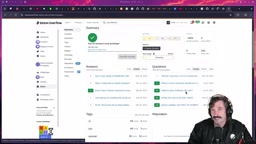
But scale does not equal vitality. The host browsed the latest question list live and found that many questions had negative scores—one was downvoted for having an "unfriendly tone." This subtle shift in atmosphere is precisely a footnote to the community's decline.
AI Coding Assistants: The Last Straw
What truly put Stack Overflow on the back foot was the rise of AI coding tools. The show explicitly pointed out that after ChatGPT began to achieve mass adoption in 2023, "why bother asking on Stack Overflow when you can just let AI give you the answer" became a common mindset among developers.
Stack Overflow's reaction was also quite dramatic: it once tried to ban ChatGPT-generated content, triggering moderator discontent and even strikes, followed by reports of layoffs. These moves show the platform was aware that content quality and traffic were being eroded, but its countermeasures failed to reverse the decline.
According to the show, in February 2024 Google signed an API agreement with Stack Overflow, and OpenAI subsequently reached a partnership as well. Some users protested by deleting their answers, only to be banned by the platform. Under the CC BY-SA license, user-contributed content is available for platform use, so this protest was destined to be ineffective.
Stack Overflow's content is licensed under the CC BY-SA license (Creative Commons Attribution-ShareAlike). This license allows the platform to freely use, modify, and even commercially develop user-contributed content, provided the original author is credited and the content is shared under the same license. This means that once users publish an answer, they effectively grant the platform a permanent, irrevocable right to use it. When Google and OpenAI pay to access Stack Overflow data for model training or real-time answers, the platform does not need to share revenue with users. Therefore, users protesting the API partnership by deleting answers not only fails to stop data licensing, but may also result in bans for violating platform rules—the symbolic value of the protest far outweighs its practical effect.
After Privatization: Data Became the Only Asset
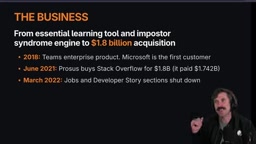
Stack Overflow's fateful turn happened earlier. The show laid out a key timeline: Microsoft had intended to acquire it in 2018, but ultimately in 2021 a private equity firm completed the acquisition for $1.8 billion. The host bluntly remarked that the typical playbook after private equity takes over is to "squeeze out the value and walk away."
Facts bear this out. The show mentioned that Stack Overflow's valuation has shrunk by about 87% from $1.8 billion to approximately $230 million. Yet it is not entirely without revenue—its enterprise private Q&A product still contributes revenue, with about $129 million in fiscal year 2026 and its first operating profit of roughly $1 million. In other words, the company is still alive, but it has become something else: making money from AI licensing and enterprise services rather than from an active developer community.
Private equity (PE) acquisitions follow a different logic from tech company acquisitions. PE typically obtains control through leveraged buyouts, with part of the funding coming from borrowing, so after taking over it often prioritizes cost-cutting, layoffs, divesting non-core assets, and finding quick monetization channels. After Stack Overflow was acquired by PE for $1.8 billion, its valuation shrank significantly while it pivoted to enterprise private Q&A and AI data licensing—consistent with the typical PE strategy of turning mature platforms into "cash flow machines": no longer investing in community growth, but relying on existing assets to generate stable revenue. This also explains why declining community activity and the company's first operating profit can occur simultaneously.
Moments Worth Remembering
The show included an interesting nostalgic segment. The host shared a classic answer about Vim: don't memorize thousands of shortcuts, but understand the underlying composable "building blocks"—that is the right way to learn programming. Another participant recalled spending every day on Stack Overflow answering obscure questions and networking to build reputation, ultimately accumulating only about 800 points, while a companion's account exceeded 4,700 points and earned multiple gold badges.
These stories highlight Stack Overflow's true value: it was not just a Q&A repository, but a public space where developers built professional identities and mutually validated knowledge. When question volume collapses, what is damaged is not only site traffic but also this mechanism of collective knowledge accumulation.
Stack Overflow's reputation and badge system is the core mechanism of its community governance. Users accumulate reputation points by asking questions, answering, having answers accepted, and receiving votes, with different score thresholds unlocking different privileges (such as commenting, voting, editing, and reviewing). Badges reward specific behaviors—for example, "gold badges" usually represent long-term high-quality contributions. This system draws on gamification design to encourage continuous contribution and self-governance within the community. But when question volume plummets, new users decline, reputation accumulation slows, and badges and rankings gradually lose their motivational power—the community's knowledge accumulation cycle breaks down as well.
Conclusion: Death or Transformation?
Stack Overflow is clearly not "dead"—it still has revenue, enterprise customers, and massive historical data. But as a community built on developers voluntarily contributing content, its golden age is over. AI has made getting answers too easy, and private equity has made the platform care more about monetization than community health. Together, these forces have pushed what was once an internet landmark into "ghost town" status.
For developers, this may be a reminder: the knowledge infrastructure you rely on can be rewritten at any time by business logic and new technology.
One-line Summary
Stack Overflow's new question volume has plunged 99.5%, with AI and private equity acquisition shrinking the community ecosystem.
Paragraph Summary
Stack Overflow's new question volume has fallen from a peak of 207,000 per month to fewer than 1,000—a 99.5% decline—turning the former developer "second brain" into a "ghost town." After AI coding assistants became widespread, developers increasingly prefer asking AI directly; the platform once banned ChatGPT content, triggering moderator strikes, and in 2024 Google and OpenAI successively signed API agreements, with users banned for deleting answers in protest. After a private equity firm acquired it for $1.8 billion in 2021, its valuation shrank about 87% to $230 million; the company now earns about $129 million annually from enterprise private Q&A and AI licensing and has achieved its first profit, but community vitality has severely declined.
Related articles
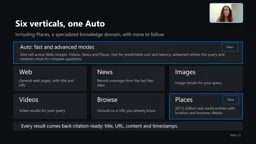
Microsoft WebIQ: Verifiable Real-Time Web Grounding for AI Agents
Microsoft WebIQ gives AI Agents real-time, citable web grounding across web, news, images, videos, and Places—164ms P95 latency, 50% fewer tokens, Scopes source control, and MCP integration.
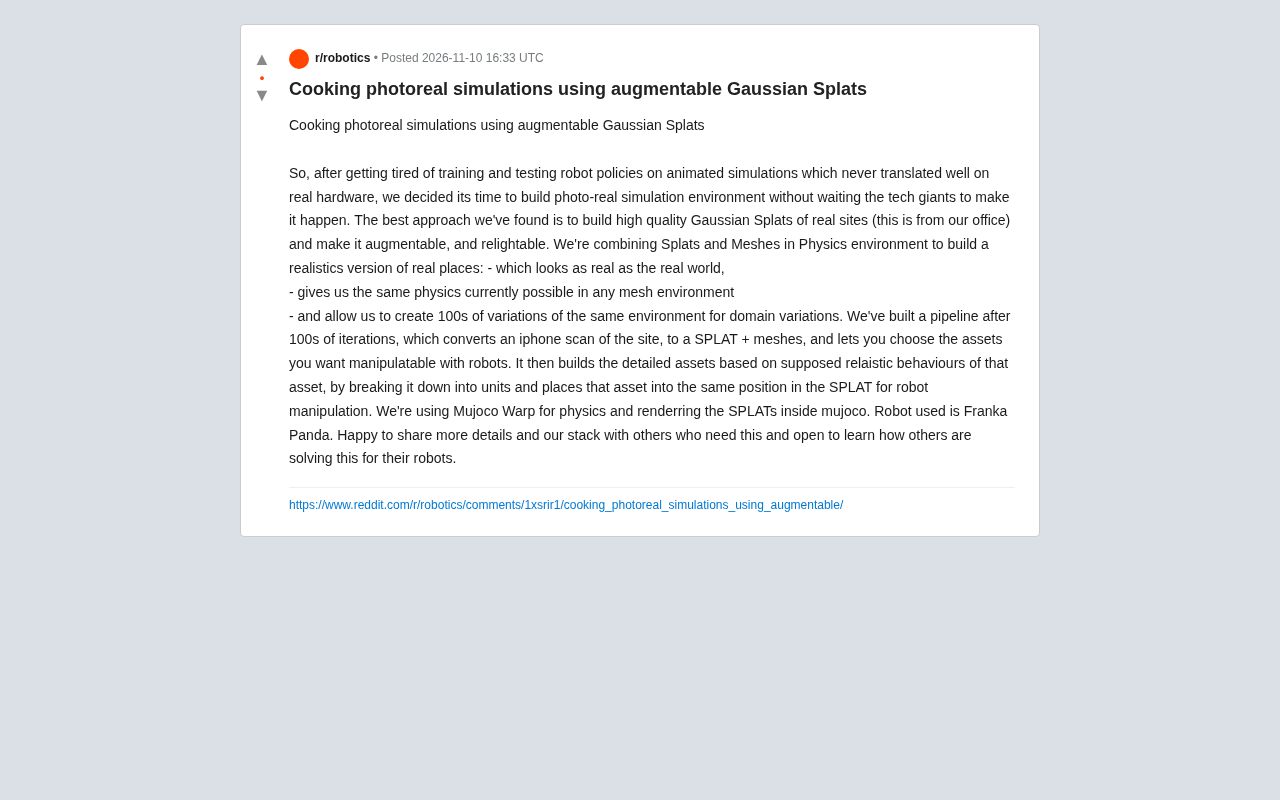
Augmentable Gaussian Splatting: Building Photorealistic Simulation Environments for Robot Training
Team combines Gaussian Splatting with meshes to build photorealistic robot simulation environments, integrating MuJoCo Warp physics and Franka Panda for augmentable, relightable real-site simulation.

Gemini 4 Carbon Released: The Leap from Gemini 3 to Gemini 4 in Under a Year
Google releases Gemini 4 Carbon, less than a year after Gemini 3. In the official demo, Carbon reverse-engineered the Theme Park binary, added a new DeepMind-themed ride, and ported it to the web in one shot.