Starlink Mobile: SpaceX's Carrier Ambitions and the 5G Deployment Challenge
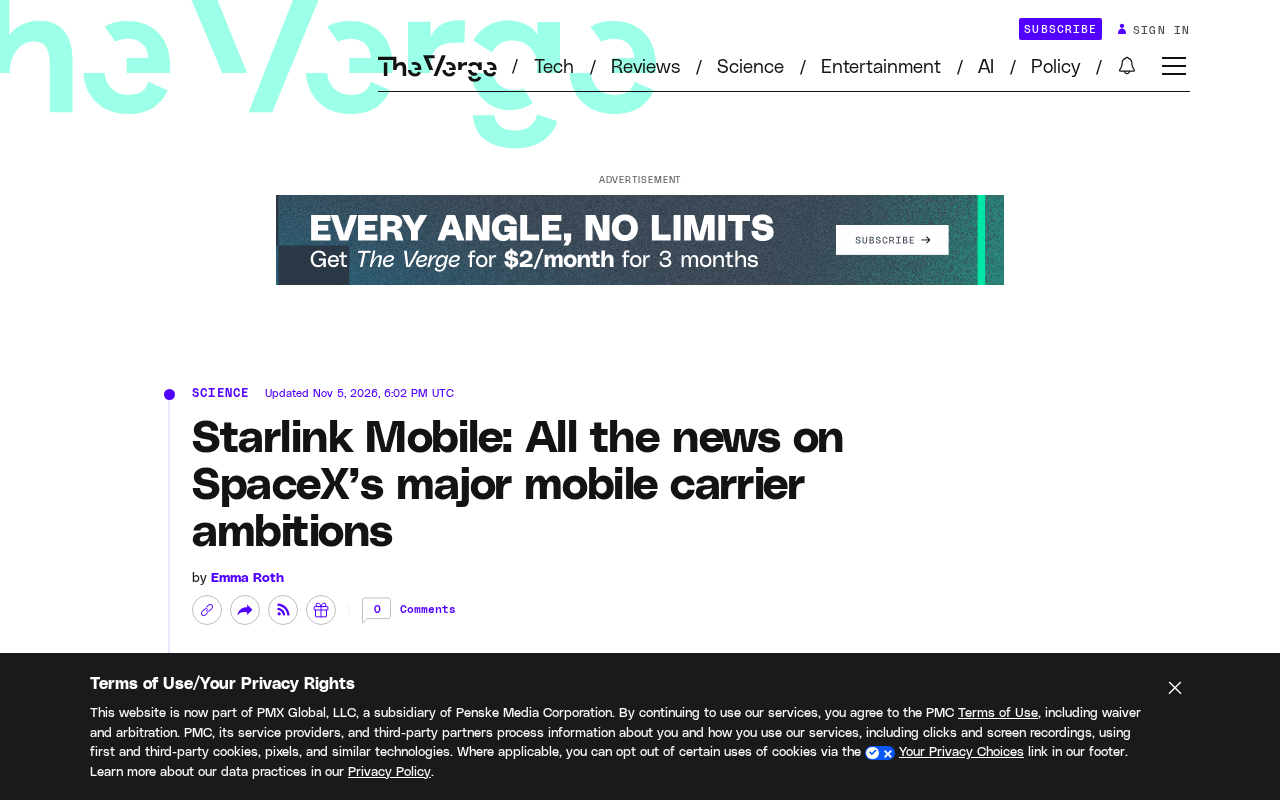
SpaceX announces plans to make Starlink Mobile a mainstream carrier, challenging the Big Three with a dual satellite and terrestrial 5G strategy.
SpaceX has publicly announced its intention to turn Starlink Mobile into a mainstream mobile carrier, directly challenging AT&T, Verizon, and T-Mobile. Its strategy is dual-track: deploying thousands of direct-to-cell satellites to fill coverage gaps, and building a terrestrial 5G network for high-density urban traffic. SpaceX has signed an agreement with undisclosed terms to advance its carrier plans. However, terrestrial 5G involves spectrum acquisition, base station construction, and regulatory approvals, with construction cycles that cannot be compressed, and it must compete head-on with the Big Three that have decades of accumulation. In the short term, Starlink Mobile is more likely to enter with supplementary services; in the long term, it needs to shore up shortcomings in network quality, customer service, and device ecosystem.
SpaceX is no longer content to be merely a "supplement" to satellite internet. The company has publicly announced its intention to turn Starlink Mobile into a "mainstream" mobile carrier, directly challenging AT&T, Verizon, and T-Mobile. Behind this declaration are thousands of direct-to-cell satellites already in orbit and a 5G network being rolled out on the ground.
From Satellite to Ground: Starlink Mobile's Dual-Track Strategy
Starlink's direct-to-cell service has moved past the technical validation stage. SpaceX has placed a large number of phone-compatible satellites into orbit, allowing ordinary smartphones to connect to the network in areas without terrestrial signal. This is Starlink Mobile's first card that distinguishes it from traditional carriers—coverage that does not depend on base station density.
But satellites can only solve the "signal or no signal" problem; they cannot alone handle city-level high-density traffic. SpaceX's next step is to build a 5G network on the ground. This means it must enter a capital-intensive, regulatory-complex, and fiercely competitive field, going head-to-head with the three dominant U.S. carriers.
Direct-to-Cell technology refers to allowing ordinary smartphones to connect directly to a mobile network via satellite without dedicated terminals. The technical challenge lies in the fact that satellites are hundreds to thousands of kilometers above the ground, causing severe signal attenuation, while phones have limited transmit power and low antenna gain. Implementing this service requires satellites equipped with large phased-array antennas and the use of specific spectrum (such as the PCS band) coordinated with terrestrial networks to avoid interference. SpaceX's approach relies on a low-Earth-orbit satellite constellation, ensuring continuity by having multiple satellites cover the same area. Unlike traditional satellite phones, direct-to-cell service does not require an external antenna or dedicated device; the goal is to let existing phones automatically switch to the satellite network when there is no terrestrial signal. However, bandwidth and capacity are far lower than terrestrial 5G, making it more suitable for SMS, voice, and low-speed data.
5G Terrestrial Network: The Real Hard Battle
The narrative of direct-to-cell satellites can easily obscure one fact: the core business of a mobile carrier still takes place on the ground. To become a "mainstream" carrier, SpaceX must build its own 5G infrastructure or obtain access through partnerships.
According to the original report, SpaceX has signed an agreement to advance its carrier plans (specific terms were not disclosed in the source material). The exact content of this deal remains unclear, but what is certain is that terrestrial 5G coverage, spectrum resources, and network operations are areas SpaceX has not previously engaged in on a large scale. Experience in satellite manufacturing and orbital operations cannot be directly transferred to the deployment of terrestrial cellular networks.
A comparison worth noting: AT&T, Verizon, and T-Mobile each possess decades of spectrum accumulation and tens of thousands of base stations. Even with funding and engineering capability, SpaceX cannot compress the construction cycle and regulatory approval process of a terrestrial network to the same pace as satellite launches.
Spectrum resources are the core asset of a mobile carrier. In the United States, terrestrial cellular spectrum is primarily allocated by the Federal Communications Commission (FCC) through auctions, and the three major carriers hold substantial low-band (wide coverage), mid-band (balanced capacity and coverage), and millimeter-wave (high-capacity short-range) spectrum. Low-band spectrum is particularly precious because it can significantly reduce the number of base stations. If SpaceX builds terrestrial 5G, it will need to obtain spectrum usage rights, possibly through auctions, secondary market transactions, or partnerships with existing holders. In addition, satellite spectrum is managed by the International Telecommunication Union (ITU) and the FCC's satellite division, under different rules from terrestrial spectrum, so SpaceX must navigate two regulatory systems simultaneously. The scarcity and high cost of spectrum are the primary barriers to terrestrial network construction.
Competitive Landscape: Where SpaceX Differentiates
Starlink Mobile's potential advantage lies in coverage continuity. Traditional carriers have obvious signal blind spots in remote areas, at sea, and in the air, and direct-to-cell satellites can fill these gaps. For users who frequently need communication outdoors, at sea, or in emergency scenarios, this coverage capability has practical value.
But from a business model perspective, SpaceX faces a market with existing competition. User growth space in the U.S. mobile communications market is limited, and the three major carriers have already established stable contract systems and pricing structures. If Starlink Mobile wants to attract mainstream users, it needs to offer differentiated solutions in pricing, roaming, and device compatibility—not just "can connect to satellites."
Another variable is regulation. The ownership and usage rules of satellite spectrum and terrestrial 5G spectrum are managed by different agencies, and SpaceX needs to deal with both regulatory frameworks simultaneously. The original material did not disclose the specific partners or regulatory progress of the agreement; this information remains to be observed.
Mobile Virtual Network Operator (MVNO) is an operating model that does not require building its own radio access network: an MVNO buys voice, data, and roaming services wholesale from a traditional carrier with a physical network and retails them to users under its own brand. The agreement SpaceX signed likely involves an MVNO or similar cooperative arrangement, enabling it to provide terrestrial coverage before its own 5G network is completed. The MVNO model has low entry barriers and fast coverage, but profit margins are constrained by wholesale costs, and it is difficult to exercise deep control over network quality. For SpaceX, which aims to become a "mainstream" carrier, MVNO can serve as a transitional strategy, but in the long term it still needs to build its own network or engage in deep partnerships to gain differentiated capabilities.
What It Means for the Industry
If SpaceX's carrier ambitions gradually materialize, it will drive "satellite + terrestrial" converged networks to become a standard industry configuration. Traditional carriers are already partnering with satellite companies to extend coverage, while SpaceX has chosen to become a carrier itself, effectively putting the competitive relationship on the table.
In the short term, Starlink Mobile is more likely to enter the market with a "supplementary" service, serving scenarios where traditional network coverage is insufficient. But SpaceX's publicly stated goal is to be a "mainstream" carrier, meaning that in the long run it needs to shore up shortcomings in network quality, customer service, and device ecosystem. Satellite count advantages cannot replace the capacity and stability of terrestrial networks.
The key to this competition is not how many satellites SpaceX can launch, but whether it can replicate its execution efficiency in the satellite domain in the engineering and commercial operations of terrestrial 5G.
One-line Summary
SpaceX announces plans to make Starlink Mobile a mainstream carrier, challenging the Big Three with a dual satellite and terrestrial 5G strategy.
Paragraph Summary
SpaceX has publicly announced its intention to turn Starlink Mobile into a mainstream mobile carrier, directly challenging AT&T, Verizon, and T-Mobile. Its strategy is dual-track: on one hand, deploying thousands of direct-to-cell satellites to let ordinary phones connect in areas without terrestrial signal, filling gaps left by traditional carriers; on the other hand, building a terrestrial 5G network to handle high-density urban traffic. SpaceX has signed an agreement with undisclosed terms to advance its carrier plans. However, terrestrial 5G involves spectrum acquisition, base station construction, and regulatory approvals, with construction cycles that cannot be compressed, and it must compete head-on with the Big Three that have decades of accumulation. In the short term, Starlink Mobile is more likely to enter with supplementary services; in the long term, it needs to shore up shortcomings in network quality, customer service, and device ecosystem.
Related articles
 Tech Frontiers
Coldframe: A Honeypot Disguised as a Supermarket Freezer Controller
Coldframe is a honeypot disguised as Danfoss AK-SM 800A and Dixell XWEB freezer controllers, built as a single Python file that detects CVE-2025-41450 attempts and is identified as real devices on Shodan.
 Tech Frontiers
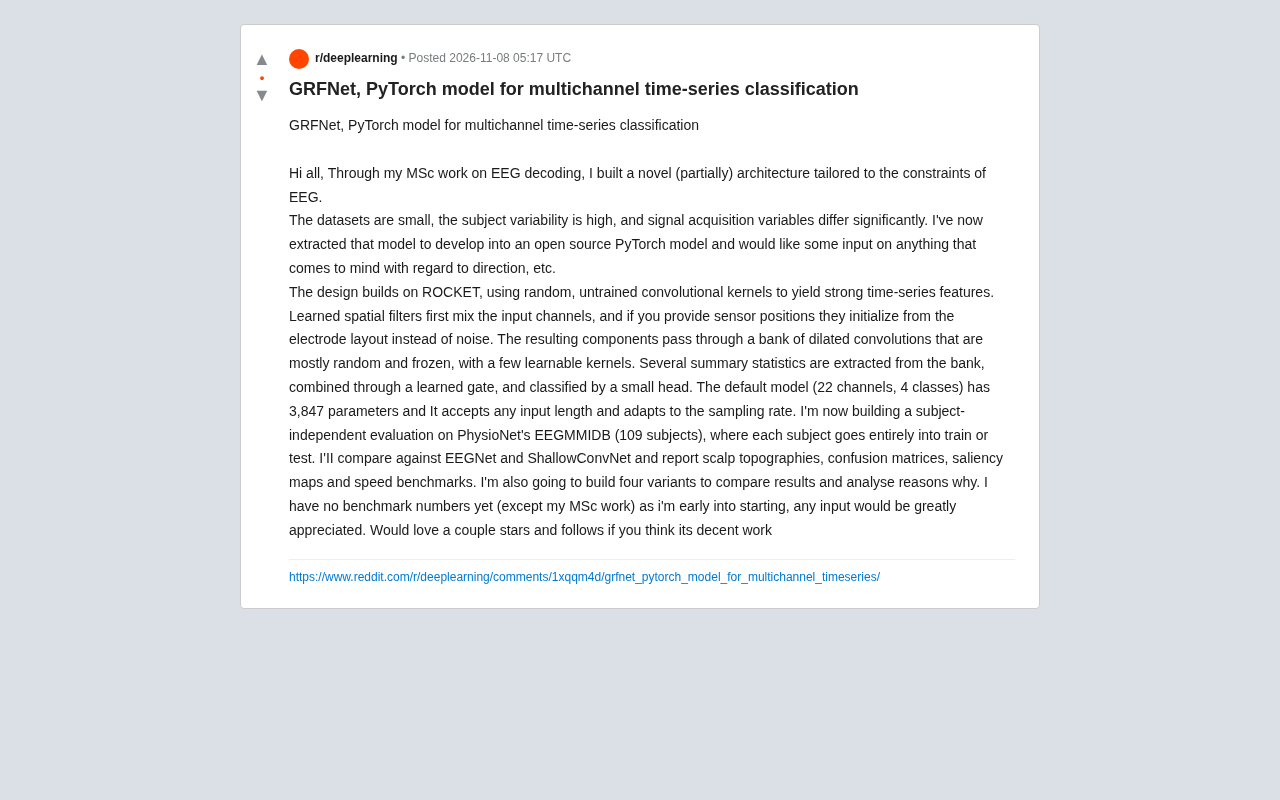
GRFNet: A Lightweight PyTorch Model Designed for Multichannel Time-Series Classification
GRFNet is a lightweight PyTorch model for multichannel time-series classification, originating from EEG decoding research. With only 3,847 parameters, it is based on the ROCKET architecture, combining random convolution kernels with learnable spatial filters, supports arbitrary input lengths, and will soon be evaluated on the PhysioNet dataset.
 Tech Frontiers
CUDA-Accelerated Rocket League Simulator: A Player-Made Hardcore Experiment
A Reddit post shows a "100% Accurate" Rocket League simulator accelerated with CUDA. We analyze its technical context, CUDA's value in game physics simulation, and the significance and limitations of such community projects.